
Everest Base Camp Trek vs Annapurna Base Camp Trek.
Nepal is home to some of the world’s most spectacular Himalayan trekking routes, but two adventures consistently stand out: the Everest Base Camp Trek and the Annapurna Base Camp Trek. Both offer extraordinary mountain scenery, traditional villages, fascinating cultures, comfortable teahouse accommodation, and an unforgettable experience in the Himalayas.
The Everest Base Camp Trek takes you deep into the legendary Khumbu region, home of Mount Everest. It combines high-altitude trekking with Sherpa culture, Buddhist monasteries, dramatic glaciers, suspension bridges, and some of the most recognizable mountain scenery on Earth. The Best Trek Adventure itinerary is designed as a 15-day journey and includes acclimatization days in Namche Bazaar and Dingboche before reaching Everest Base Camp and Kala Patthar.
The Annapurna Base Camp Trek, meanwhile, offers a shorter 12-day Himalayan adventure. The route travels through lush forests, terraced landscapes, traditional mountain villages, and the spectacular Annapurna Sanctuary before reaching Annapurna Base Camp at 4,130 meters. It also includes Machhapuchhre Base Camp and the natural hot springs at Jhinu Danda.
Everest Base Camp Trek vs Annapurna Base Camp Trek: Which One to Choose?

So, which trek should you choose?
The answer depends on what you want from your Nepal adventure. If standing beneath Mount Everest and experiencing the legendary Khumbu landscape is your lifelong dream, the Everest Base Camp Trek is the obvious choice. If you prefer a shorter itinerary with incredible mountain scenery, rich biodiversity, traditional villages, forests, and a lower maximum altitude, Annapurna Base Camp may be the better option.
This detailed comparison will help you understand the major differences between the two treks and decide which Himalayan journey is right for you.
Everest Base Camp Trek vs Annapurna Base Camp Trek at a Glance
Before comparing each part of the journey in detail, here is a quick overview.
Feature Everest Base Camp Trek vs Annapurna Base Camp Trek
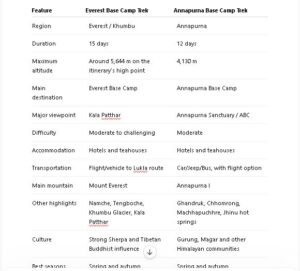
The Best Trek Adventure Everest package is a 15-day Kathmandu-to-Kathmandu itinerary with hotel and teahouse accommodation, meals, trekking, sightseeing, and acclimatization built into the route. The Annapurna package is a 12-day Kathmandu-to-Kathmandu itinerary with a maximum altitude of 4,130 meters and transportation by car, jeep or bus, with flight upgrades available on some sections.
1. Everest Base Camp Trek: What Makes It Special?
The Everest Base Camp Trek is one of Nepal’s most iconic trekking adventures. The appeal is obvious: you are walking into the Everest region toward the world’s highest mountain.
But Everest Base Camp is about much more than seeing Mount Everest. The journey introduces you to the unique Sherpa culture of the Khumbu. Along the trail, you encounter mountain villages, Buddhist monasteries, prayer wheels, prayer flags, mani walls, suspension bridges and dramatic Himalayan valleys.
The Best Trek Adventure 15-day itinerary begins with arrival in Kathmandu and sightseeing before heading toward Lukla. From Lukla, trekkers walk through Phakding and Namche Bazaar, spend an acclimatization day in Namche, continue toward Debuche and Dingboche, and take another acclimatization day before ascending toward Lobuche and Gorak Shep.
The major trekking objective arrives with the journey from Lobuche to Everest Base Camp, followed by a stay at Gorak Shep. The following morning is dedicated to Kala Patthar, one of the famous viewpoints for Himalayan panoramas, before descending toward Pheriche and eventually returning to Lukla.
The itinerary therefore combines adventure, altitude acclimatization, cultural exploration and spectacular scenery into one extended Himalayan experience.
For many travelers, the emotional highlight is simply reaching the Everest Base Camp area and looking across the Khumbu landscape knowing that Mount Everest is above the surrounding peaks.
2. Annapurna Base Camp Trek: What Makes It Special?
The Annapurna Base Camp Trek offers a completely different type of Himalayan experience.
Instead of following the high, dry landscapes of the Everest region for many days, the Annapurna route takes trekkers through an impressive variety of environments.
The Best Trek Adventure 12-day itinerary travels from Kathmandu to Pokhara before beginning the trek toward Ghandruk. From Ghandruk, the trail continues through Chhomrong and Sinuwa before climbing toward Deurali, Machhapuchhre Base Camp and finally Annapurna Base Camp at 4,130 meters.
One of the route’s biggest attractions is its changing landscape.
You can walk through green forests, bamboo groves and rhododendron-covered hills before gradually entering a more alpine environment. Terraced fields, waterfalls, suspension bridges and traditional villages create a constantly changing backdrop.
The final approach to Annapurna Base Camp is particularly impressive. Trekkers enter the Annapurna Sanctuary, where enormous Himalayan peaks surround the valley.
The route also offers a special cultural experience. Villages such as Ghandruk and Chhomrong provide opportunities to experience local Himalayan communities and traditional teahouse hospitality.
And there is another feature that makes the Annapurna itinerary especially attractive: Jhinu Danda’s natural hot springs. After several days of trekking, relaxing in natural hot springs can be a memorable way to finish the mountain journey.
3. Which Trek Is More Difficult?
This is one of the most important questions when choosing between Everest Base Camp and Annapurna Base Camp.
Everest Base Camp Trek
- The Everest Base Camp Trek is generally more demanding because of its significantly higher altitude.
- The route reaches the Everest Base Camp area and continues to Kala Patthar, with the itinerary’s listed maximum altitude around 5,644 meters. The high elevation means that altitude acclimatization becomes a major part of the trek.
- The Best Trek Adventure itinerary includes dedicated acclimatization days in Namche Bazaar and Dingboche, helping trekkers adjust before continuing toward the higher sections of the route.
- Daily trekking can also be physically demanding, especially as the air becomes thinner.
Annapurna Base Camp Trek
- Annapurna Base Camp reaches 4,130 meters, considerably lower than the highest elevations encountered on the Everest itinerary.
- Best Trek Adventure categorizes the ABC trek as moderate. However, moderate does not mean easy. The route includes steep stone steps, frequent ascents and descents, long walking days and changing weather conditions. The company’s itinerary notes trekking days of approximately 4–7 hours on several sections.
Winner for easier trekking: Annapurna Base Camp
- If altitude is your primary concern, Annapurna Base Camp is generally the more accessible choice.
- However, every trekker should take altitude seriously. Fitness does not completely eliminate the risk of altitude sickness.
4. Which Trek Has the Better Mountain Views?
This is difficult to answer because both treks offer exceptional scenery—but the scenery is different.
Everest Base Camp
Everest is the obvious attraction.
The route provides views of some of the world’s most famous peaks, including:
- Mount Everest
- Lhotse
- Nuptse
- Ama Dablam
- Thamserku
- Cho Oyu
- Khumbu Glacier
The landscape becomes increasingly dramatic as you move toward Lobuche, Gorak Shep and Everest Base Camp. Kala Patthar is another major attraction because it provides a spectacular Himalayan panorama.
If your dream is to see Mount Everest in person, Everest Base Camp has the advantage.
Annapurna Base Camp
Annapurna Base Camp offers a different visual experience.
The final sanctuary is surrounded by impressive peaks, including:
- Annapurna I
- Annapurna South
- Hiunchuli
- Machhapuchhre, also called Fishtail
- Singu Chuli
- Tharpu Chuli
The Annapurna route also offers more variation in landscape at lower elevations, from forests and farmland to alpine terrain.
Winner for iconic Everest scenery: Everest Base Camp
Winner for landscape variety: Annapurna Base Camp
5. Which Trek Has Better Culture and Villages?
Both routes provide meaningful cultural experiences, but their cultural character is different.
Everest Region
The Everest Base Camp route is strongly associated with the Sherpa people and Tibetan Buddhist traditions.
Namche Bazaar is one of the most important settlements along the route. Monasteries, prayer flags, mani walls and Buddhist symbols are common throughout the region.
Tengboche Monastery is another major cultural highlight.
Walking through the Khumbu therefore gives you an opportunity to experience the relationship between Himalayan communities, Buddhism and mountain life.
Annapurna Region
Annapurna provides a broader mixture of Himalayan cultures.
The route passes through villages associated with communities including Gurung and Magar populations. Ghandruk, in particular, is a well-known village where trekkers can experience traditional architecture and local culture.
The combination of village life, forests, mountain scenery and teahouse hospitality makes the Annapurna experience culturally rewarding.
Winner: Tie
Choose Everest for a stronger Sherpa and Buddhist Himalayan experience.
Choose Annapurna for a varied cultural journey through traditional mountain villages.
6. Which Trek Is Shorter?
There is a clear difference.
The Best Trek Adventure Everest Base Camp itinerary takes 15 days, including arrival and departure, Kathmandu sightseeing, acclimatization and the trekking route.
The Annapurna Base Camp package takes 12 days.
This three-day difference can be significant for international travelers with limited vacation time.
Choose Annapurna Base Camp if:
- You have around two weeks available.
- You want a shorter Himalayan adventure.
- You prefer spending fewer days at high altitude.
- You want to combine trekking with time in Pokhara.
Choose Everest Base Camp if:
- You have more time available.
- Everest is a major bucket-list goal.
- You want a longer Himalayan experience.
- You want dedicated acclimatization days.
Winner for shorter holidays: Annapurna Base Camp
7. Transportation: Everest vs Annapurna
Transportation is another major difference.
For the Everest Base Camp Trek
The classic route begins with travel toward Lukla, followed by trekking through the Khumbu region. The Best Trek Adventure itinerary allows Kathmandu/Ramechhap-to-Lukla flight arrangements depending on operational conditions and season.
The journey to and from Lukla adds an exciting aviation element to the Everest adventure.
For Annapurna Base Camp, the journey is more road-accessible.
The Best Trek Adventure itinerary travels from Kathmandu to Pokhara by road or optional flight. From Pokhara, transportation continues toward the trekking starting area around Birethanti. After completing the trek, trekkers travel back toward Pokhara before returning to Kathmandu.
Winner for accessibility: Annapurna Base Camp
Winner for adventure: Everest Base Camp
8. Accommodation on Both Treks
Neither trek requires luxury accommodation in the mountains.
Both are classic teahouse trekking experiences.
The Everest package includes hotel accommodation in Kathmandu and teahouse accommodation during the trekking portion.
The Annapurna package similarly combines hotels in Kathmandu and Pokhara with teahouses or local guesthouses along the trekking route.
Teahouses generally provide a simple room, bed and basic facilities. Dining areas become important social spaces where trekkers eat, rest and exchange stories.
Food generally includes traditional Nepali meals such as dal bhat, along with noodles, soups, rice dishes, pasta and other common trekking meals.
The higher you go, the more basic facilities may become.
Trekkers should therefore approach both routes as mountain adventures rather than hotel holidays.
9. Everest Base Camp vs Annapurna Base Camp for Beginners
Beginners often ask whether they can complete either trek without previous high-altitude trekking experience.
The answer is: yes, with appropriate preparation—but preparation matters.
Annapurna Base Camp may be the more comfortable introduction because of its lower maximum altitude and shorter itinerary.
However, it still includes long trekking days, steep stairs and significant elevation gain.
Everest Base Camp requires more attention to acclimatization because of the much higher altitude.
A first-time trekker can complete Everest Base Camp, but should take the itinerary seriously, maintain a slow pace and follow the guide’s recommendations.
Best for first-time Himalayan trekkers: Annapurna Base Camp.
Best for ambitious first-time trekkers: Everest Base Camp
10. Best Time to Trek
Both Everest Base Camp and Annapurna Base Camp are best suited to the major trekking seasons.
Spring: March to May
Spring brings relatively stable conditions and excellent mountain visibility.
The Annapurna region is particularly attractive in spring because rhododendron forests can add spectacular color to the landscape.
Autumn: September to November
Autumn is another excellent trekking season.
The monsoon has generally cleared the atmosphere, creating excellent mountain visibility. Temperatures are also suitable for trekking.
Best Trek Adventure identifies spring and autumn as the best seasons for both its Everest and Annapurna trekking packages. The Annapurna page specifically lists March–May and September–November as its preferred periods.
Best season: Tie
If you want the safest general recommendation, choose spring or autumn.
11. Everest Base Camp vs Annapurna Base Camp: Cost
Trekking costs depend on several factors, including:
- Number of trekking days
- Transportation
- Accommodation
- Guide and porter services
- Permits
- Meals
- Domestic flights
- Group size
- Travel season
- Personal spending
The Annapurna Base Camp package currently displayed by Best Trek Adventure has group-dependent pricing, with the listed per-person price decreasing for larger groups. The page displays prices beginning at US$699 for larger groups, while smaller groups have higher per-person rates.
Everest Base Camp generally involves additional logistical costs because of the longer itinerary, higher-altitude logistics and Lukla transportation.
Therefore, if budget is a major consideration, Annapurna Base Camp may offer a more economical option, particularly when combined with road transportation.
However, travelers should compare the complete inclusions rather than simply comparing advertised starting prices.
12. Which Trek Has Better Photography Opportunities?
Both routes are excellent for photography.
Everest Base Camp Photography
Everest is ideal if your photography goal is dramatic high-altitude Himalayan scenery.
Excellent subjects include:
- Mount Everest
- Ama Dablam
- Khumbu Glacier
- Tengboche Monastery
- Namche Bazaar
- Prayer flags
- Mountain bridges
- Sherpa villages
- Kala Patthar sunrise
Annapurna Base Camp Photography
Annapurna offers greater environmental variety.
You can photograph:
- Terraced fields
- Rhododendron forests
- Waterfalls
- Suspension bridges
- Traditional villages
- Ghandruk
- Machhapuchhre
- Annapurna South
- Annapurna Sanctuary
- Jhinu hot springs
Winner for variety: Annapurna Base Camp
Winner for iconic mountain images: Everest Base Camp
13. Which Trek Is More Scenic Overall?
This comes down to personal preference.
- Everest is more dramatic and high-altitude focused.
Annapurna is more diverse.
- On Everest, the scenery gradually transitions from green lower valleys to rugged alpine terrain and glaciers.
On Annapurna, the trail can change dramatically within a relatively short period—from subtropical vegetation and terraced farmland to rhododendron forests and high alpine landscapes.
- If you want the classic “Himalayan giant peaks” experience, Everest may be more impressive.
If you want forests + villages + waterfalls + mountains + sanctuary, Annapurna may provide greater variety.
14. Everest Base Camp vs Annapurna Base Camp for Families
For families, the answer depends heavily on age, fitness and previous trekking experience.
Annapurna Base Camp can be attractive because it is shorter and reaches a lower maximum altitude.
However, parents should not assume that a shorter trek is automatically easy. Stone steps and daily walking can still be demanding.
Everest Base Camp requires greater consideration of altitude and acclimatization.
For families traveling with children, elderly trekkers or members who are inexperienced with altitude, professional guidance and an appropriate customized itinerary are especially important.
Family-friendly choice: Annapurna Base Camp
15. Everest Base Camp vs Annapurna Base Camp for Adventure Seekers
If you define adventure as high altitude, dramatic landscapes and reaching a destination associated with the world’s highest mountain, Everest wins.
If you define adventure as varied terrain, forests, rivers, mountain villages, suspension bridges and a spectacular sanctuary, Annapurna is an excellent choice.
Neither trek is a technical mountaineering expedition.
You do not need climbing skills to reach either base camp on the standard trekking routes.
What you do need is stamina, preparation, appropriate equipment and the ability to walk for several hours a day.
16. Pros and Cons of Everest Base Camp Trek
Pros
- Experience the legendary Everest region.
- Reach Everest Base Camp.
- Also we have 12 days itinerary.
- See Mount Everest and other giant peaks.
- Visit Namche Bazaar.
- Experience Sherpa culture.
- Visit Tengboche Monastery.
- Enjoy spectacular views from Kala Patthar.
- Dedicated acclimatization days are included.
- Excellent teahouse trekking experience.
Cons
- Higher altitude.
- Longer itinerary.
- More physically demanding.
- Weather can affect flights to/from Lukla.
- Accommodation becomes increasingly basic at higher elevations.
- Greater attention to altitude acclimatization is required.
17. Pros and Cons of Annapurna Base Camp Trek
Pros
- Shorter 12-day itinerary.
- Also we have 7-day itinerary.
- Lower maximum altitude of 4,130 meters.
- Beautiful mountain views.
- Diverse landscapes.
- Traditional villages.
- Rhododendron and bamboo forests.
- Machhapuchhre Base Camp.
- Annapurna Sanctuary.
- Natural hot springs at Jhinu Danda.
- Road access makes logistics relatively straightforward.
Cons
- Steep stone staircases.
- Several long walking days.
- No dedicated acclimatization day in the standard itinerary.
- Weather can change quickly in the mountains.
- Higher sections have basic facilities.
- Lower altitude does not eliminate altitude-sickness risk.
The Best Trek Adventure itinerary specifically describes ABC as a moderate trek while noting long walking days, steep terrain and altitude considerations.
18. Which Trek Should You Choose?
Here is the simplest way to decide.
Choose Everest Base Camp Trek if:
-
Mount Everest is your dream.
Choose Everest if reaching the world’s highest mountain is one of your major travel goals. It is the better option if you want a longer, higher-altitude journey with strong Sherpa culture and famous Himalayan landmarks.
Choose Annapurna Base Camp Trek if:
-
You want a shorter and more varied Himalayan adventure.
Annapurna is ideal if you have less time, prefer a lower maximum altitude, enjoy forests and traditional villages, and want to experience the spectacular Annapurna Sanctuary.
19. Everest Base Camp or Annapurna Base Camp: Final Verdict
There is no universal winner.
The two treks provide different experiences.
Everest Base Camp Trek is the better choice for:
- Everest lovers
- High-altitude adventure seekers
- Trekkers who want a bucket-list Himalayan experience
- Travelers interested in Sherpa culture
- People who want to experience the Khumbu region
- Those willing to spend more time trekking
Annapurna Base Camp Trek is the better choice for:
- Travelers with limited time
- First-time Himalayan trekkers
- People looking for a lower maximum altitude
- Nature lovers
- Photographers who want diverse scenery
- Travelers who enjoy traditional villages and forests
- Trekkers who want to combine mountains with Pokhara
Ultimately, your decision should be based on what you want to remember most when you return home.
If your dream is to say, “I trekked to Everest Base Camp,” choose Everest.
If your dream is to walk through beautiful Himalayan forests, villages and dramatic mountain scenery before entering a spectacular natural amphitheater, choose Annapurna Base Camp.
Either way, Nepal will give you an unforgettable Himalayan experience.
Frequently Asked Questions
Is Everest Base Camp harder than Annapurna Base Camp?
Generally, yes. The Everest Base Camp route reaches substantially higher elevations and requires more attention to acclimatization. The Annapurna Base Camp route reaches 4,130 meters and is categorized as moderate by Best Trek Adventure.
Which trek is shorter, Everest Base Camp or Annapurna Base Camp?
The Best Trek Adventure Everest itinerary is 15 days, while its Annapurna Base Camp itinerary is 12 days.
Which trek is better for beginners?
Annapurna Base Camp is generally the more approachable option because it reaches a lower altitude and has a shorter itinerary. However, beginners still need adequate fitness and preparation.
Which trek has better mountain views?
Both are spectacular. Everest offers iconic views of Mount Everest, Ama Dablam, Lhotse and Nuptse, while Annapurna offers dramatic views of Annapurna I, Annapurna South, Hiunchuli and Machhapuchhre.
Can I do either trek without previous trekking experience?
Yes. Previous high-altitude trekking experience is not mandatory, but good physical preparation is important. A professional guide can make the journey safer and more manageable.
What is the best month for Everest Base Camp Trek?
Spring and autumn are generally the preferred trekking seasons. March to May and September to November provide favorable conditions for trekking.
What is the best month for Annapurna Base Camp Trek?
March, April, May, September, October and November are generally the preferred months. Best Trek Adventure specifically identifies spring and autumn as the best seasons for ABC.
Is Annapurna Base Camp safe?
Annapurna Base Camp is a well-established trekking route, but mountain trekking always involves risks related to weather, terrain and altitude. Proper preparation, responsible pacing and professional guidance are recommended.
Do I need a guide for Everest Base Camp?
Trekking requirements and regulations can change, so travelers should confirm the current rules before departure. Regardless of regulations, a professional guide can provide valuable assistance with navigation, accommodation, altitude management and emergencies.
Do both treks have teahouses?
Yes. Both itineraries use teahouse accommodation during the trekking sections, with hotels before and/or after the mountain trek.
Prepare for Your Himalayan Adventure
Whichever trek you choose, preparation is one of the keys to a successful journey.
Start training several weeks before your departure. Walking, hiking, stair climbing and cardiovascular exercise can help build the endurance needed for multiple hours of trekking.
Your packing list should include:
- Comfortable trekking boots
- Warm layers
- Waterproof jacket
- Trekking trousers
- Thermal base layers
- Warm sleeping bag
- Gloves and hat
- Sunglasses
- Sunscreen
- Water bottle
- Headlamp
- Personal medication
- Basic first-aid supplies
- Trekking poles
- Backpack
- Power bank
- Personal toiletries
For Everest Base Camp, pay particular attention to cold-weather equipment and altitude preparation.
For Annapurna Base Camp, comfortable footwear and good preparation for long stair sections are particularly useful.
Most importantly, do not rush.
The Himalayas reward patience.
Book Your Everest or Annapurna Trek with Best Trek Adventure
Choosing between Everest Base Camp and Annapurna Base Camp is difficult because both offer unforgettable experiences.
Everest gives you the legendary Khumbu landscape, Sherpa culture, high-altitude adventure and the opportunity to stand at the base of the world’s highest mountain.
Annapurna offers a shorter but incredibly diverse Himalayan journey through forests, villages, rivers, mountain landscapes and the magnificent Annapurna Sanctuary.
If you are still unsure which trek suits you, the experienced team at Best Trek Adventure can help you select an itinerary according to your available time, fitness level, budget and travel preferences.
Explore the detailed trekking itineraries before making your decision:
Everest Base Camp Trek – 15 Days
Annapurna Base Camp Trek – 12 Days
Whether you choose Everest or Annapurna, your Himalayan journey begins with the first step.
Choose your trail. Prepare well. And get ready for the adventure of a lifetime in Nepal.
Everest Base Camp Trek vs Annapurna Base Camp Trek
Everest Base Camp Trek 15 Days
Annapurna Base Camp Trek 12 Days
Annapurna Circuit Trek
Everest View Trek
Annapurna Base Camp with Poon Hill Trek
For quick response Contact us WhatsApp us: +9779705048567


