Annapurna Base Camp Trek – 12 Days
A complot cost and itinerary for Annapurna Base Camp Trek – 12 Days

Trip Duration
12 Days

Country
Nepal

Region
Annapurna

Activities
Trekking / Hiking

Grade
Moderate

Max Altitude
4,130 m

Best Season
Autumn (Sep-Nov) & Spring (Mar-May)

Accomodation
Tea house and Hotels

Meals
Breakfast, Lunch, Dinner

Start-End Point
Kathmandu / Kathmandu

Group Size
1-99

Transportation
Car / Jeep / Bus
Annapurna Base Camp Trek – 12 Days Overview
The Ultimate Guide to the Annapurna Base Camp Trek
The Annapurna Base Camp Trek (ABC) is one of the most celebrated mountain journeys not just in Nepal, but across the entire globe. Every year, thousands of adventure seekers set out into the heart of the Himalayas to embark on this iconic, bucket-list expedition.
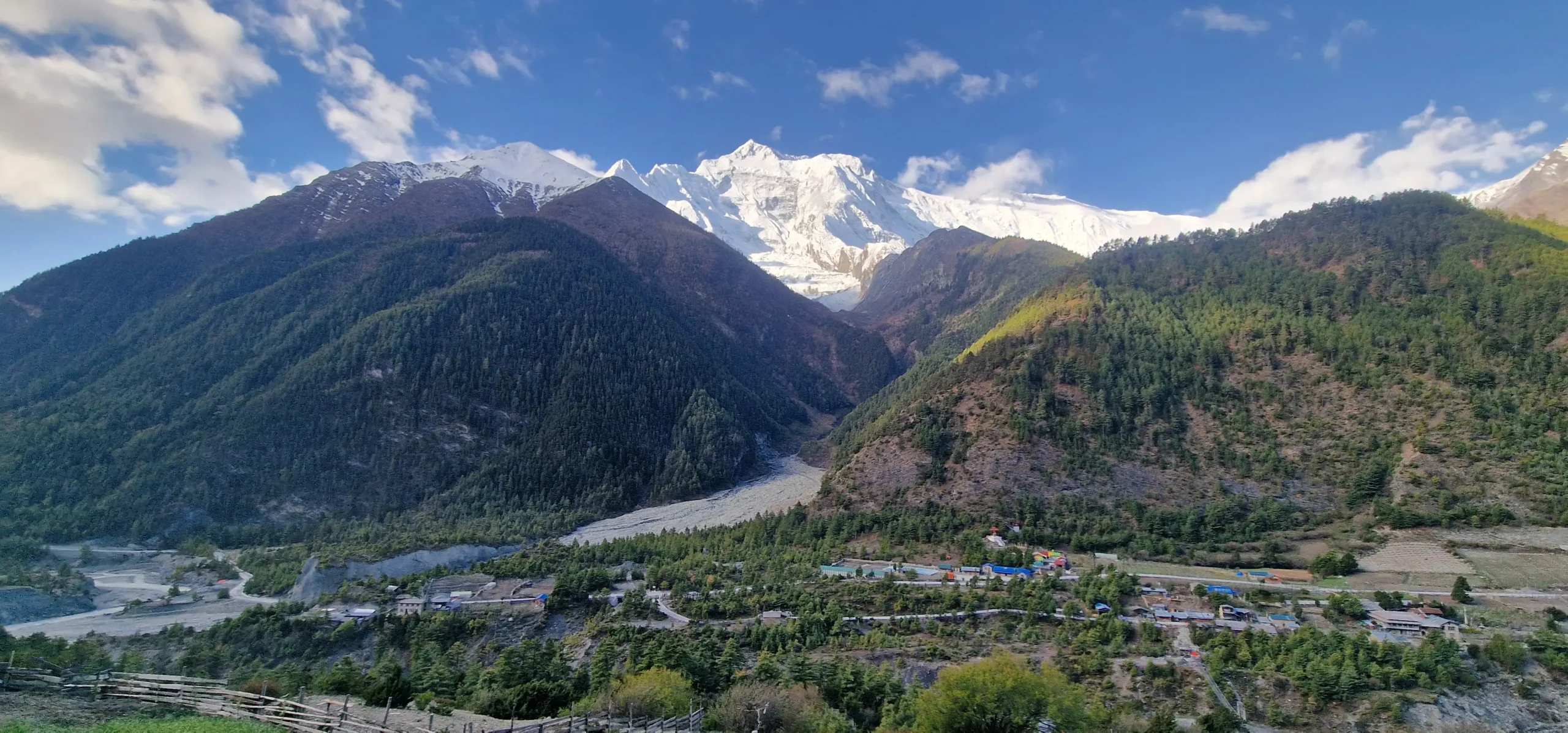
Taking you deep into the Annapurna Conservation Area, the trail winds along the roaring Modi Khola river through an ever-changing landscape. As you gain altitude, you will transition from subtropical bamboo groves and vibrant rhododendron forests to terraced rice fields and alpine glacial moraines. What makes this trek truly extraordinary is its unique “two-in-one” feature—allowing you to conquer both Machhapuchhre Base Camp (3,700 m) and Annapurna Base Camp (4,130 m) in a single journey.
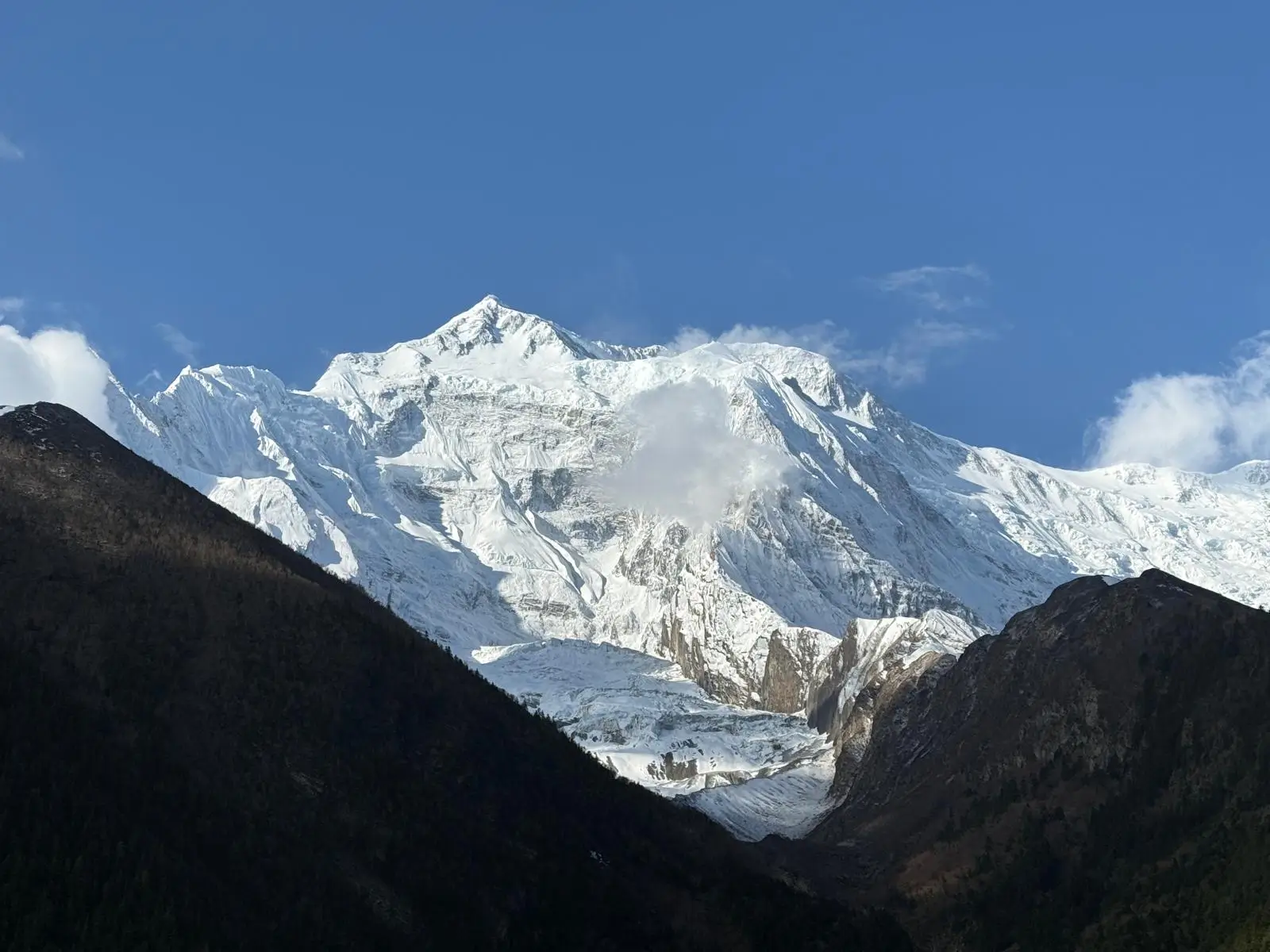
Reaching the sanctuary at 4,130 meters rewards you with a breathtaking, 360-degree panorama of high-altitude giants. You will stand face-to-face with Mt. Annapurna I (8,091 m)—the 10th highest peak on Earth—alongside its magnificent neighbors: Annapurna South (7,219 m), Hiunchuli (6,441 m), and the sacred, needle-like peak of Machhapuchhre (6,993 m).
Beyond the towering Himalayan peaks, the culture along the trail is equally captivating. You will pass through iconic mountain villages like Ghorepani, Tadapani, and Chhomrong, home to the Gurung, Magar, Thakali, and Loba communities. Their warm hospitality, rich traditions, and authentic teahouse culture provide a comforting retreat at the end of each day’s walk.
Whether you are soaking in the natural hot springs at Jhinu Danda, enjoying spring blossoms across the hillsides, or watching the sunrise illuminate the snow-capped summits, the Annapurna Base Camp Trek delivers an unforgettable blend of natural beauty, rich culture, and mountain adventure that never disappoints.
Where is the Annapurna Mountain Range Located?
The Annapurna Massif is located in north-central Nepal within the Gandaki Province, approximately 160 km (100 miles) west of Kathmandu. The range sits directly north of Pokhara, Nepal’s second-largest city and the primary gateway for all Annapurna expeditions.
Geographically, the Annapurna region is bounded by two distinct natural landmarks: the Kali Gandaki Gorge (one of the deepest river gorges on Earth) to the west, and the Marshyangdi River valley to the north and east. The range encompasses over thirty individual mountain peaks, with Annapurna I reaching a summit elevation of 8,091 meters (26,545 feet), making it the 10th highest peak in the world.
What is the Annapurna Conservation Area (ACA)?
Established in 1986 and formally gazetted in 1992, the Annapurna Conservation Area (ACA) is the largest protected region in Nepal, spanning an impressive 7,629 square kilometers (2,946 sq miles) across five districts (Kaski, Myagdi, Lamjung, Manang, and Mustang). Managed by the National Trust for Nature Conservation (NTNC), ACA is a pioneer in sustainable community-managed tourism.
Key Facts About the Annapurna Conservation Area:
-
Extreme Altitude Elevation Range: The conservation area spans a vertical rise exceeding 7,000 meters—stretching from subtropical lowlands at 790 meters up to the snow-capped summit of Annapurna I at 8,091 meters.
-
Rich Biodiversity: ACA protects over 1,226 species of flowering plants (including the world’s largest natural rhododendron forests in Ghorepani), 105 species of mammals (such as rare snow leopards and red pandas), and over 520 species of birds.
-
Cultural Diversity: Home to more than 100,000 permanent residents, the region is a tapestry of various ethnic groups—primarily the Gurung and Magar communities in the south, and the Thakali, Manange, and Loba communities in the trans-Himalayan north.
-
Protected Status & Permits: Unlike standard national parks, local communities live within the boundaries and hold rights over natural resources. All trekkers entering the region are required to hold an ACAP Entry Permit.
Annapurna Base Camp Trek Highlights
- Exploring the old architecture and historical places in Kathmandu.
- Pass through dense forests filled with seasonal flowers and plants in the Annapurna Region.
- Get the chance to learn about the traditions, culture, and history of the villages while passing through.
- Take a relaxing bath in the natural hot springs at Jhinu.
- Crossing through various suspension bridges over Modi.
- Get to see the 10th highest mountain in the world Mt Annapurna and other peaks like Machapuchhre, Hiunchuli, Annapurna South, and Annapurna I.
Outline Itinerary
-
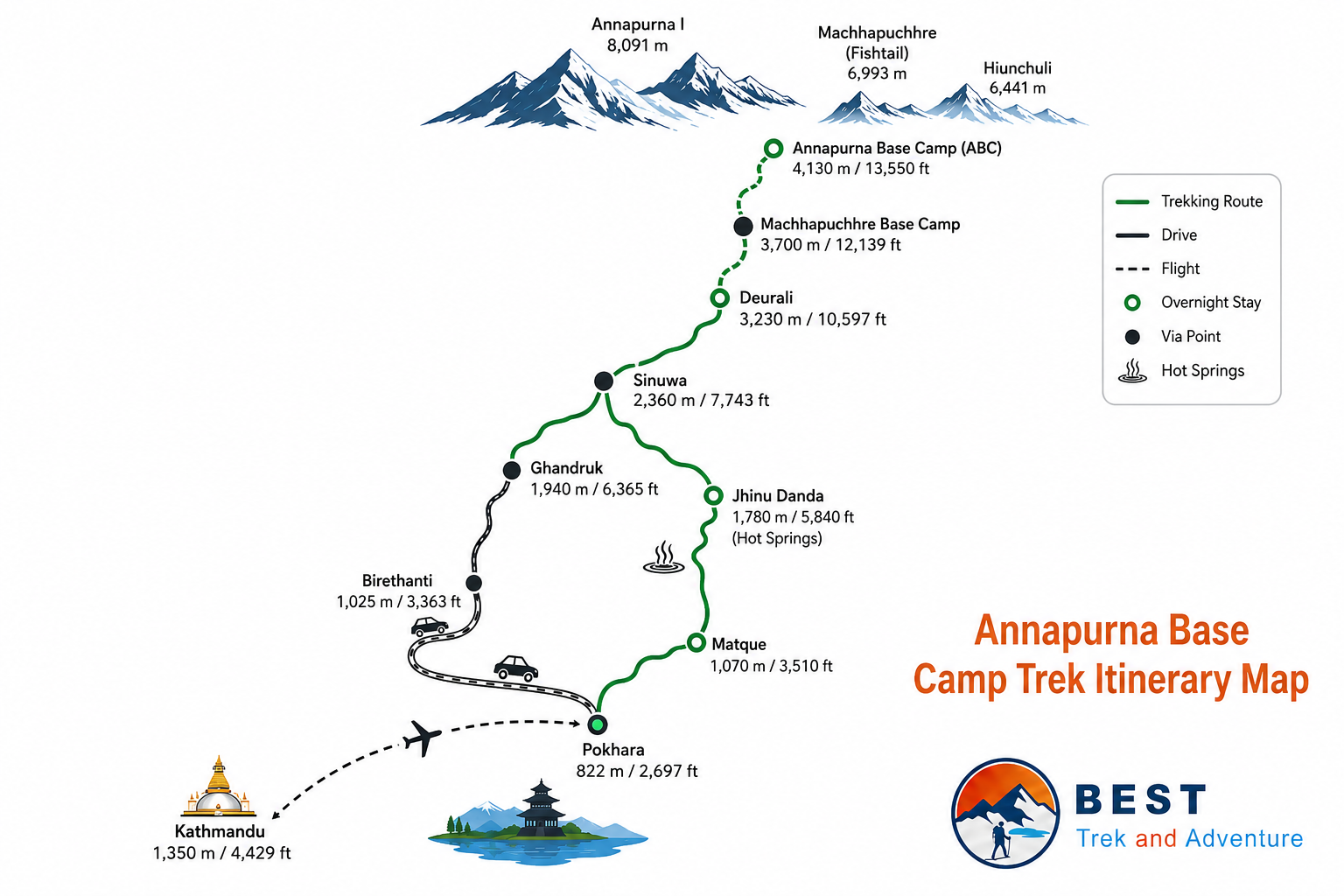
Day 01: Arrive in Kathmandu and transfer to hotel — 1,350 m / 4,429 ft
-
Day 02: Kathmandu Sightseeing Tour & Trek Preparation — 1,350 m / 4,429 ft
-
Day 03: Drive / Fly to Pokhara — 822 m / 2,697 ft
-
Day 04: Drive to Birethanti (1,025 m / 3,363 ft) & Trek to Ghandruk — 1,940 m / 6,365 ft
-
Day 05: Trek from Ghandruk to Sinuwa — 2,360 m / 7,743 ft
-
Day 06: Trek from Sinuwa to Deurali — 3,230 m / 10,597 ft
-
Day 07: Trek from Deurali to Annapurna Base Camp (ABC) — 4,130 m / 13,550 ft (via Machhapuchhre Base Camp at 3,700 m / 12,139 ft)
-
Day 08: Trek from Annapurna Base Camp down to Sinuwa — 2,360 m / 7,743 ft
-
Day 09: Trek from Sinuwa to Jhinu Danda (Natural Hot Springs) — 1,780 m / 5,840 ft
-
Day 10: Trek from Jhinu Danda to Matque (1,070 m / 3,510 ft) & Drive to Pokhara — 822 m / 2,697 ft
-
Day 11: Drive / Fly from Pokhara back to Kathmandu — 1,350 m / 4,429 ft
-
Day 12: Final Departure from Kathmandu — 1,350 m / 4,429 ft
Annapurna Base Camp Trek Detailed Itinerary
Expand AllUpon your arrival at Tribhuvan International Airport (TIA), a representative from our team will warmly greet you at the terminal and escort you to your hotel via private transfer. After checking in, you are free to unwind, relax, and freshen up from your journey. Later in the day, you will attend a pre-trek briefing with your guide to review the route, perform an equipment check, and ensure you are fully prepared for the Annapurna Base Camp adventure ahead.
Max Altitude:
1,350 m / 4,429 ft
Duration:
30 Minutes
Accommodation:
3 Star Category Hotel
Meals:
-
On your second day, embark on a guided sightseeing tour of the vibrant Kathmandu Valley, home to a rich concentration of ancient culture, history, and art. You will explore several iconic UNESCO World Heritage Sites, including the sacred Hindu temple complex of Pashupatinath, the towering Buddhist stupas of Boudhanath and Swayambhunath (the Monkey Temple), and the intricate medieval architecture of Patan Durbar Square. After a full day of cultural discovery, return to your hotel for an early rest.
Max Altitude:
1,350 m / 4,429 ft
Duration:
5-6 Hours
Accommodation:
3 Star Category Hotel
Meals:
Breakfast.
After breakfast, depart Kathmandu for a scenic 6-to-7-hour drive (approx. 210 km) to Pokhara, the gateway to the Annapurna region. The journey winds through lush hills, terraced farmlands, traditional rural villages, and along the flowing waters of the Trishuli and Marsyangdi rivers. Upon arriving in Pokhara, check in to your hotel and enjoy a relaxed afternoon exploring the lively Lakeside area, taking a serene boat ride on Phewa Lake, or soaking in the vibrant local evening atmosphere.
Flight Upgrade Option: Direct 30-minute flights between Kathmandu and Pokhara are available upon request for an additional fee.
Max Altitude:
822 m / 2,697 ft
Duration:
6-7 hrs of Drive
Accommodation:
3 Star Category Hotel
Meals:
Breakfast. lunch , dinner
After breakfast in Pokhara, embark on a scenic drive passing through Nayapul toward Birethanti. The road winds along the Modi Khola and Bhurungdi Khola rivers, offering picturesque views of terraced farmlands, cascading waterfalls, and rural mountain settlements. Upon reaching Birethanti, lace up your boots to begin your hike to Ghandruk. The 3-to-4-hour trail ascends through lush forests and stone-paved steps until you reach the beautiful village of Ghandruk—one of the largest Gurung settlements in the region. Spend the afternoon exploring the traditional stone houses, visiting the local Gurung cultural museum, and enjoying up-close views of Annapurna South, Hiunchuli, and Fishtail (Machhapuchhre).
Trek Distance:
8.5 km / 5.3 mi
Max Altitude:
1,940 m / 6,365 ft
Duration:
5 Hours
Accommodation:
Tea House / Local Guest House
Meals:
Breakfast, Lunch, Dinner
Begin your morning with sunrise views over the Himalayas before leaving Ghandruk. The trail descends through forests to cross the Kimron Khola via a suspension bridge before climbing back up toward Chhomrong, a bustling village built into the hillside with breathtaking vistas of Annapurna South and Machhapuchhre (Fishtail). After a brief rest or lunch in Chhomrong, descend the famous stone staircase into the Chhomrong Khola valley, then cross the river and make a final steady ascent to the peaceful village of Sinuwa for your overnight stay.
Trek Distance:
12 km / 7.5 mi
Max Altitude:
2,360 m / 7,743 ft
Duration:
4-6 Hours
Accommodation:
Tea House or Local Guest House
Meals:
Breakfast, Lunch, Dinner
Enjoy an early breakfast at Sinuwa before setting out through dense, serene forests filled with bamboo, oaks, and colorful rhododendrons. The trail takes you through Bamboo and Khuldigar village, winding past cascading waterfalls and lush mountain greenery that energizes the senses. Continuing along the Modi Khola valley, the trail gradually climbs past Dovan and Himalaya (2,920 m / 9,580 ft) through a dramatic, rocky gorge. A final steady ascent brings you to the alpine settlement of Deurali for your overnight rest.
Trek Distance:
11 km / 6.8 mi
Max Altitude:
3,230 m / 10,597 ft
Duration:
5-7 Hours
Accommodation:
Tea House or Local Guest House
Meals:
Breakfast, Lunch, Dinner
Today marks the most exciting highlight of the trek as you journey from Deurali to Annapurna Base Camp (ABC), experiencing two historic base camps in a single day. The trail gradually ascends out of the valley gorge toward Machhapuchhre Base Camp (MBC), where the iconic, sacred peak of Fishtail comes dramatically into view. After a short rest at MBC, continue your climb into the high-altitude Annapurna Sanctuary. As you approach 4,130 m, the trail becomes steeper and the air thinner, requiring a steady pace. Upon reaching Annapurna Base Camp, you will be rewarded with a breathtaking 360-degree amphitheater of snow-capped peaks, including Annapurna I, Annapurna South, Hiunchuli, and Fishtail.
Trek Distance:
8 km / 5 mi
Max Altitude:
4,130 m / 13,550 ft
Duration:
6-7 Hours
Accommodation:
Tea House or Local Guest House
Meals:
Breakfast, Lunch, Dinner
Wake early to absorb a memorable sunrise over the Annapurna massifs before beginning your descent from the sanctuary. The trail retraces its route downhill along the Modi Khola, taking you past Machhapuchhre Base Camp, Deurali, and Himalaya into dense forests of bamboo and oak. Passing through Bamboo—a picturesque settlement cradled inside the bamboo forest—the path winds across suspension bridges and past mountain waterfalls. Enjoy continuous views of Annapurna South, Hiunchuli, Machhapuchhre, Singu Chuli, and Tharpu Chuli as you return to the warmer air and peaceful atmosphere of Sinuwa for your overnight stay.
Trek Distance:
14 km / 8.7 mi
Max Altitude:
2,360 m / 7,743 ft)
Duration:
5-6 Hours
Accommodation:
Tea House or Local Guest House
Meals:
Breakfast, Lunch, Dinner
After a well-deserved rest in Sinuwa, continue your journey downhill toward Jhinu Danda. The trail retraces its steps back across the Chhomrong Khola before climbing up to Chhomrong village. From there, descend a steep stone path through lush bamboo, oak, and rhododendron forests until you arrive at Jhinu Danda. In the afternoon, take a 15-to-20-minute walk down to the riverbanks of the Modi Khola to relax in the natural, mineral-rich hot springs—a perfect way to soothe tired muscles after days of high-altitude trekking. Return to your teahouse for an evening of warm hospitality and authentic local cuisine.
Trek Distance:
8.5 km / 5.3 mi
Max Altitude:
1,780 m / 5,840 ft)
Duration:
4-6 Hours
Accommodation:
Tea House or Local Guest House
Meals:
Breakfast, Lunch, Dinner
After a relaxing stay at Jhinu Danda, set out on the final leg of your hike toward Matque (Matkyu). The peaceful trail winds through lush green forests, terraced farmlands, and traditional local villages, offering a humbling glimpse into the resilient lifestyle of the Himalayan communities. Along the way, enjoy beautiful backdrop views of Annapurna South, Hiunchuli, and Machhapuchhre (Fishtail) peaks. Crossing high suspension bridges over the flowing Modi Khola, you soon reach Matque, where your foot-trek officially comes to an end. After a brief rest, board a local vehicle or private jeep for the scenic 2.5-to-3-hour drive back to Pokhara. In the evening, unwind with a stroll around the Lakeside market, enjoy an optional boat ride on Phewa Lake, and immerse yourself once more in Pokhara’s vibrant nightlife.
Trek Distance:
4 km / 2.5 mi
Max Altitude:
822 m / 2,697 ft)
Duration:
4-6 Hours
Accommodation:
3 Star Category Hotel
Meals:
Breakfast and Lunch
After breakfast in Pokhara, depart for your journey back to Kathmandu. You can choose to take a scenic 6-to-7-hour drive along the Prithvi Highway, enjoying final views of winding river valleys, terraced hills, and rural settlements, or take an optional 30-minute domestic flight for an extra fee. Upon arrival in Kathmandu, check into your hotel and enjoy the rest of the afternoon at your leisure for last-minute souvenir shopping in Thamel. In the evening, gather for a special farewell dinner at a traditional Nepali restaurant featuring a live cultural dance performance to celebrate your successful trek.
Max Altitude:
1400m1,350 m / 4,429 ft
Duration:
5-7 Hours / 30 Minutes by Flight.
Accommodation:
3 Star Category Hotel
Meals:
Breakfast
On your final day in Nepal, enjoy a leisure breakfast at your hotel before checking out. A company representative will meet you at the lobby and escort you to Tribhuvan International Airport via private transfer in time for your flight home. Before saying goodbye, our team will bid you farewell in traditional Nepalese fashion, offering a flower garland and a ceremonial Khada (silk scarf) as a token of respect, goodwill, and safe wishes. Board your flight with wonderful memories of your Annapurna Base Camp adventure, until we welcome you back to Nepal again.
Max Altitude:
1,350 m / 4,429 ft
Duration:
30 Minutes
Accommodation:
-
Meals:
Breakfast
Annapurna Base Camp Trek – 12 Days Includes/Exclude
- Airport pickup by private vehicle from International/ domestic flight.
- All the transportation as per the itinerary.
- Hotel accommodation in Kathmandu days with a B/B basis.
- Tea house accommodation during the trek.
- Three times meal during the trek days.
- Hot soup in high places- last 2 evening.
- A professional guide for trek and tour.
- An assistant guide for more than 10 persons travellers.
- Porter service (2 trekkers: 1 porter).
- Insurance for guides and porters.
- Food and accommodation for guides and porters.
- All necessary documents (Permits and TIMS).
- All government and local taxes.
- Necessary medical kit for staff.
- Trekking map as itinerary.
- T-shirt from the company.
- Farewell dinner in Kathmandu.
- Trip completion certificate.
- Airport drop to private vehicle from an International flight.
- Visa for Nepal.
- International and domestic flight to and from Kathmandu.
- Lunch and dinner in Kathmandu and Pokhara Days.
- Entry fee in monuments areas in Kathmandu.
- Travel and rescue insurance of clients.
- Personal expenses: Hot shower, battery charge during the trek, bar bills, laundry service, and mineral water.
- Extra night accommodation exception of the itinerary.
- Tips for your guide and porters.
Annapurna Base Camp Trek route map
Annapurna Base Camp Trek – 12 Days Altitude Chart
Annapurna Base Camp Trek – 12 Days Gallery/Video
Best Time for the Annapurna Base Camp Trek
The most suitable seasons for the Annapurna Base Camp (ABC) trek are Spring and Autumn. During these peak periods, the weather and temperatures are stable, offering optimal trekking conditions and significantly lessening the overall difficulty of the journey.
-
Spring (March to May): Spring offers warm weather, clear skies, and minimal rainfall. Trail conditions are excellent, with a very low risk of natural hazards like landslides or heavy snowstorms. The blooming rhododendron forests add vibrant color to the trail, while clear mountain views remain consistently visible.
-
Autumn (September to November): Autumn follows the monsoon season, which clears the air and leaves crystal-clear mountain vistas. Walking trails dry out after the heavy rains, making them safe and comfortable. Days are pleasant and warm while nights are crisp and cool. Additionally, trekking in autumn gives you the unique opportunity to experience major Nepali cultural festivals like Dashain and Tihar.
Annapurna Base Camp Trek Difficulty
The ABC trek is categorized as moderately difficult. Reaching an elevation of 4,130 meters (13,550 feet) requires a reasonable level of physical fitness and stamina.
Key considerations regarding difficulty include:
-
No Built-In Acclimatization Days: The standard itinerary ascends steadily without dedicated rest days, making proper pacing essential.
-
Daily Trekking Hours: Expect to walk 6 to 7 hours per day over varied terrain, including steep stone staircases, forest trails, and rocky glacial paths.
-
Basic High-Altitude Healthcare: Medical facilities above Chhomrong are extremely basic, meaning trekkers with pre-existing health conditions must prepare thoroughly and trek responsibly.
Permits Required for the ABC Trek
To trek in the Annapurna region, every hiker must acquire two mandatory permits, which are verified at various trailside checkpoints.
-
Trekking Information Management System (TIMS) Permit:
-
Administered jointly by the Nepal Tourism Board (NTB) and the Trekking Agencies Association of Nepal (TAAN) to register trekker details for safety and search-and-rescue purposes.
-
Can be obtained at the TAAN office or NTB service centers in Kathmandu or Pokhara.
-
Cost:
-
Group Trekkers (via Agency): NPR 1,000 per person
-
Individual/Solo Trekkers: NPR 2,000 per person
-
-
-
Annapurna Conservation Area Permit (ACAP):
-
Required for entering any part of the protected conservation zone, regardless of the duration of your stay. Valid for a single entry per person.
-
Cost Breakdown:
-
Locals: NPR 100
-
Foreign Nationals (SAARC countries): NPR 1,000 (~$10 USD)
-
Foreign Nationals (Non-SAARC): NPR 3,000 (~$25 USD)
-
-
Food & Meals on the Trail
Teahouses along the ABC route offer a diverse menu blending authentic local dishes with popular international meals. During peak seasons, lodges stock up thoroughly, offering a wide array of choices.
Popular meal choices include:
-
Dal Bhat Tarkari: The traditional Nepalese staple consisting of steamed rice (bhat), lentil soup (dal), and seasoned vegetable curry (tarkari). It is nutritious, filling, and comes with free refills.
-
Momos: Steamed or fried dumplings filled with vegetables or meat, served alongside a spicy tomato chutney—a favorite snack across Nepal.
-
Tibetan Bread: A dense, pan-fried flatbread that is popular for breakfast, providing high-energy fuel for early morning starts.
-
Yak Steak: A lean, protein-rich dish served grilled or stir-fried with rice or vegetables at select teahouses.
-
Vegetable Curry: A flavorful blend of seasonal fresh vegetables simmered in aromatic spices, perfect for warm, light dinners.
Accommodation Along the Route
Accommodation along the trail primarily consists of local teahouses and mountain lodges.
-
Teahouse Standards: Rooms are generally basic with twin beds, comfortable mattresses, and shared bathroom facilities. Upgraded rooms with attached private bathrooms are only available at lower elevations (e.g., Ghandruk, Jhinu Danda, Chhomrong).
-
Peak Season Bookings: Because rooms are limited at higher stops like Deurali, MBC, and ABC, pre-booking through a guide or agency during peak months (March–May and September–November) is highly recommended.
-
Heating & Hot Water: Hot bucket showers or solar showers are available for a small additional fee at most stops. During cold evenings, communal dining halls are heated with central wood or yak-dung stoves.
Accommodation in Kathmandu & Pokhara
Before and after the trek, major cities like Kathmandu and Pokhara offer a wide range of accommodation—from budget hostels in tourist hubs like Thamel (Kathmandu) and Lakeside (Pokhara) to luxury 5-star hotels.
Wi-Fi Access & Connectivity
Wi-Fi is available in most teahouses up to Chhomrong for a nominal fee or free of charge, though speeds gradually drop as you ascend.
-
Lower Altitudes: Villages like Ghandruk and Chhomrong generally offer relatively stable connections.
-
High Altitudes: Beyond Bamboo towards Machhapuchhre Base Camp (MBC) and Annapurna Base Camp (ABC), Wi-Fi becomes spotty, slow, or unavailable due to harsh weather and frequent power outages.
-
Mobile Data: Purchasing a local SIM card (Ncell or Nepal Telecom) in Kathmandu or Pokhara with a pre-paid data package provides a convenient alternative, though cellular signals disappear above Chhomrong.
Altitude Sickness (Acute Mountain Sickness – AMS)
Because Annapurna Base Camp stands at 4,130 meters (13,545 feet), Acute Mountain Sickness (AMS) is a real consideration for all trekkers regardless of age or fitness level.
-
Common Symptoms: Headaches, dizziness, loss of appetite, fatigue, nausea, and shortness of breath.
-
Key Preventive Measures:
-
Pacing & Gradual Ascent: Walk slowly and avoid overexertion.
-
Hydration: Drink at least 3 to 4 liters of clean water daily.
-
Dietary Care: Consume hot soups (such as traditional garlic soup) and avoid alcohol or smoking at high altitudes.
-
Medication & Monitoring: Carry Diamox (acetazolamide) after consulting a doctor, and regularly monitor blood oxygen levels using a portable pulse oximeter.
-
Drinking Water Management
Proper hydration is critical for preventing altitude sickness and maintaining stamina.
-
Purchasing Bottled Water: Commercial bottled water is available at teahouses along the trail for roughly $1 to $2 USD per bottle, though prices rise with elevation. Trekkers are encouraged to minimize single-use plastics.
-
Boiled & Purified Water: You can purchase safe, boiled drinking water at teahouses or refill reusable water bottles from local taps using water-purification tablets, UV purifiers, or squeeze filters.
Communication & Emergency Contacts
-
Mobile Coverage: Ncell and Nepal Telecom (NTC) networks work well in lower regions but lose coverage in high-altitude gorges past Chhomrong.
-
Emergency Contacts: Satellite phones and landline services are available in most villages for emergency communication. Guides and trekking crews frequently utilize walkie-talkies for localized trail updates.
Travel Insurance
Comprehensive travel insurance is mandatory for trekking in Nepal. Ensure your policy specifically covers:
-
High-Altitude Trekking: Coverage up to 5,000 meters.
-
Emergency Helicopter Evacuation: Crucial for medical emergencies or severe AMS.
-
Trip Cancellation & Medical Expenses: Covers non-refundable travel expenses, hospital charges, and unexpected delays.
Tipping Guidelines
Tipping is a customary way to express gratitude for your crew’s hard work. Tipping is typically presented as a group pool at the end of the trek.
Standard Tipping Ranges:
-
Main Guide: $15 – $20 USD per day (from the group)
-
Assistant Guide: $10 – $15 USD per day
-
Porters: $8 – $10 USD per day per porter
Currency Exchange & Cash Requirements
The official currency of Nepal is the Nepalese Rupee (NPR / रु).
-
No Trail ATMs: There are no ATMs along the Annapurna Base Camp Trek route. You must withdraw sufficient cash in Kathmandu or Pokhara prior to starting your trek.
-
Daily Expense Cash: Carry enough NPR cash in smaller denominations (NPR 100, 500, and 1000 notes) to cover personal expenses like hot showers, Wi-Fi, snacks, charging electronics, and tipping.
Cost & Date
Trip duration: 12 Days
| Departure | Return | Price | Departure status |
|---|
Annapurna Base Camp Trek – 12 Days FAQS
Expand AllYou will be staying at hotels in cities and developed areas and during the trekking days, tea houses are available for the overnight stay.
Food is well prepared and hygienic where you will be tasting the authentic Nepali Cuisine (Dal bhat and Tarkari) and also (Dhindo other optional traditional food of Nepal).
Basic facilities provided by accommodations are hot water for baths, proper hygienic toilets, warm and cozy rooms and beds, and many other things.
From Kathmandu to Pokhara you can either book a flight or take the direct vehicle. It takes around 25 min to reach Pokhara by flight and 6-7 hrs by bus. Flight costs are higher than vehicle costs but you can save time to explore Pokhara city by flight.
Permits needed for Annapurna Base Camp Trek are as follows:
- TIMS (Trekkers Information Management System Card)
- ACAP (Annapurna Conservation Area Project) Entry Permit
You can obtain both of this permits form Nepali Tourism Board Office in Pokhara or Kathmandu.
Annapurna Base Camp trek is a moderate type of trekking route where the trekking trails are full of ups and downs and constant changes in weather with high levels of altitude. So, there are some requirements for this trek to complete it with prior experience or you could have the good physique to trek 6-7 hrs per day, and thus adapt to the increasing altitude.
Yes, you can purchase the trekking equipment from affiliated stores which are related to trekking. There are some markets that sell good quality equipment at a reasonable price. Some of the famous places are Thamel, New Road, and Durbarmarg and you can also contact our company for further details.
The ABC trek is rated relatively difficult. Though it does not entail any actual mountaineering, the program entails long daily treks, hundreds of stairs, and high altitudes that can be rather strenuous.
The trek is normally a 7-12 day event due to the length of the trail the pace at which people walk and if one has to acclimatize to the high-altitude terrain. The short one will however take 7 days to complete while those with sidetrips or extra days for camping will take up to 12 days.
The best seasons are Spring (March, April and May) and Autumn (September, October and November). These are good trekking seasons since we have relatively stable weather, clear skies, and favorable temperatures.
Though the trails are well marked, making it possible to do the trek on your own, getting a guide is likely to give a better experience and safety. A porter is also useful if you want to travel with a lot of equipment because a porter can also help you transport heavy equipment thus making the trekking experience more enjoyable.
Trekkers need two permits: There are three kinds of permits; the Annapurna Conservation Area Permit (ACAP) and the Trekkers’ Information Management System (TIMS) card. Both are required and can be accredited in Kathmandu or even in Pokhara.
Tea houses or lodges are powering the major accommodation in the course of ABC trekking. These are simple, but clean, providing their clients with uncomplicated accommodations with beds, blankets, and shared baths. The facilities are generally not very advanced when compared to the low-altitude lodging facilities.
The climb to Annapurna Base Camp is often regarded as a safe trip, but it is critical to be prepared and take the necessary precautions to ensure a safe and enjoyable experience.
Some teahouses and resorts have basic first-aid services. However, you should have your travel insurance that covers medical emergencies and helicopter evacuations in the event of serious illness or accident.
Yes, altitude sickness is very possible depending on the altitude we are expecting to travel, above 2,500 meters is normal to experience altitude sickness. The chance of developing any of the symptoms should be reduced by going slowly, keeping hydrated, and taking acclimatization days if required.
These items include; warm clothes, quality boots for trekking, warm sleeping bags, waterproof cloths, and toiletry items among others. They should carry a first aid kit, sunscreen, and trekking poles. It is necessary to travel light but to bring only what is necessary.
There is however network coverage for mobile networks at some of the lower elevations but as the altitude increases the coverage is either weak or there is none at all. Internet access is nearly universal in tea houses but it is often slow and sometimes it costs extra.
Traveler Reviews
Explore authentic feedback from our past adventurers with Best Treks and Adventure, sourced from TripAdvisor, Google, Facebook, and Trustpilot.

Emma Johansson (USA)
I cannot speak highly enough about Best Treks and Adventure and the Annapurna Base Camp trek they organized for me and my friends. From the initial planning to the final farewell, everything was seamless. Our guide, Bishnu, was fantastic—his expertise and sense of humor made the trek so much more enjoyable. The trail itself was stunning, with diverse landscapes and amazing mountain views. The team ensured we were well-fed, safe, and motivated throughout the journey. This was hands down one of the best adventures of my life. I’ll definitely be trekking with them again!
Liam Carter
Australia
I had an unforgettable experience trekking to Annapurna Base Camp with Best Treks and Adventure. The team was professional, friendly, and made us feel at ease the entire time. Our guide, Dinesh, was outstanding—he shared fascinating stories about the local culture and ensured we were acclimatized and comfortable every step of the way. The views along the trail were spectacular, and the sense of accomplishment upon reaching Base Camp was overwhelming. This trek wouldn’t have been the same without such an incredible team. Thank you for the memories of a lifetime!
Olivia Martinez (UK)
Trekking to Annapurna Base Camp with Best Treks and Adventure was one of the most magical experiences of my life. The scenery along the way was breathtaking, from lush green forests to towering snow-capped peaks. The team was incredibly organized, ensuring everything went smoothly. Our guide, Rajendra, was amazing—always cheerful, knowledgeable, and attentive to everyone’s needs. The tea houses were cozy, and the meals were hearty, which kept us energized throughout the trek. Reaching ABC felt like a dream come true. I highly recommend Best Treks and Adventure to anyone planning this trek!
Add a Review
Why choose Us
- An Excellent reviews and High Star Rating.
- Organized and Customizable Itinerary.
- Affordable Price.
- Focus for Eco-Friendly Tourism
- Well-Qualified Guides and Workers.