Nar Phu Valley with Annapurna Circuit Trek
The Ultimate Guide For Nar Phu Valley with Annapurna Circuit Trek

Trip Duration
20 Days

Country
Nepal

Region
Manaslu

Activities
Hiking

Grade
Challenging

Max Altitude
5,416m

Best Season
Spring and Autumn

Accomodation
Hotel/Lodge/ Tea House

Meals
Breakfast, Lunch and Dinner

Start-End Point
Kathmandu- Kathmandu

Group Size
2-29

Transportation
Private Vehicle and Public Vehicle
Nar Phu Valley with Annapurna Circuit Trek Overview
Nar Phu Valley with Annapurna Circuit
The Nar Phu Valley Trek is one of the rare and rewarding adventures in Nepal’s restricted trekking regions. Situated on the northern, rain-shadow side of Manang, this hidden sanctuary requires a Restricted Area Permit (RAP) to enter, keeping its trails pristine, uncrowded, and peaceful. Unlike standard trekking routes, this journey offers raw Himalayan wilderness and an intimate window into “Little Tibet.” Here, ancient Buddhist customs thrive in stone-built fortress villages like Nar ( 4,110 m) and Phu Gaon ( 4,080 m), where flat-roofed houses, fluttering prayer flags, centuries-old gompas, and traditional wool-spinning define daily life.
Beyond its rich cultural heritage, this trek delivers high-altitude thrills by connecting the remote valley directly back to the classic Annapurna Circuit. Over the course of the expedition, you will test your endurance across two spectacular mountain passes—the secluded Kang La Pass ( 5,320 m) and the world-famous Thorong La Pass ( 5,416 m)—offering breathtaking panoramas of Annapurna II, Tilicho Peak, and Dhaulagiri.
The adventure wraps up with a descent into the sacred pilgrimage site of Muktinath ( 3,800 m), a scenic mountain flight to Pokhara, and well-earned relaxation by Phewa Lake. It is the ultimate itinerary for trekker seekers wanting both off-the-beaten-path cultural immersion and double high-pass achievement.
What Makes This Trek Unique Compared to Others in Nepal
The primary factor that sets the Nar Phu Valley Trek apart from popular routes like Everest Base Camp or the classic Annapurna Circuit is its rare combination of restricted isolation and double high-pass achievement. Because Nar Phu was strictly off-limits to foreign visitors until 2002 and remains a protected restricted area requiring a specialized group permit and an official guide, it receives only a fraction of the foot traffic seen elsewhere. Trekkers experience raw, uncrowded trails, quiet teahouses, and a genuine sense of wilderness exploration that has largely vanished from Nepal’s more commercialized routes.
Culturally, the valley offers an unvarnished encounter with authentic Tibetan heritage, earning its reputation as “Little Tibet.” Unlike regions where modern tourism has altered local lifestyles, the remote stone villages of Nar and Phu maintain ancient, unchanged traditions.
Settlements feature flat-roofed stone fortresses, century-old monastic sanctuaries like Tashi Lhakhang, and active cultural practices such as traditional carpet weaving, wool-spinning, and yak herding. The local Gurung, Ghale, and Lama residents live in harmony with the harsh high-altitude terrain, providing a rare cultural immersion that feels like stepping back in time. Geographically, this itinerary is remarkably diverse because it crosses two major high-altitude passes above 5,000 meters—the secluded Kang La Pass ( 5,320 m) and the world-famous Thorong La Pass ( 5,416 m).
The trail transitions dynamically from dense sub-tropical forests into wild, narrow granite canyons, high alpine yak pastures, wind-carved desert landscapes in Lower Mustang, and finally the subtropical lakeshores of Pokhara. Combining a hidden, off-the-beaten-path valley with the dramatic highlights of the broader Annapurna region creates a comprehensive Himalayan expedition that very few single trekking routes in Nepal can match.
Trek Highlights
- Phu Gaon Fortress Village ( 4,080 m): Explore a stone-and-mud high-altitude village that feels completely untouched by modern times.
- Tashi Lhakhang Monastery: Visit a 600-year-old sanctuary in Phu, recognized as one of the 108 great Buddhist monasteries of the Himalayas.
- Himalayan Blue Sheep Sightings: Spot rare blue sheep (bharal) navigating the steep cliffs along the narrow Phu Khola canyon.
- Cultural Immersion in Nar Village ( 4,110 m): Experience authentic Tibetan culture, four ancient gompas, and traditional wool-spinning in Nar.
- Kang La Pass Crossing ( 5,320 m): Climb over a high pass that offers an unhindered 360 panorama of Annapurna II, Gangapurna, and Tilicho Peak.
- 900-Year-Old Bhraka Monastery: Discover ancient Tibetan artifacts, statues, and murals inside a historic cliffside monastery near Manang.
- Gangapurna Lake & Glacier Viewpoint: Hike up to the Chongkor Viewpoint ( 3,800 m) for close-up views of turquoise glacial waters and the Gangapurna Glacier.
- High-Altitude Pastures of Yak Kharka ( 4,020 m): Trek through open alpine meadows where herds of yaks and horses graze beneath snow-capped peaks.
- Thorong La Pass Milestone ( 5,416 m): Conquer one of the highest navigable trekking passes in the world, marked by thousands of fluttering prayer flags.
- Sacred Muktinath Temple ( 3,800 m): Visit a holy pilgrimage site for Hindus and Buddhists featuring 108 sacred stone water spouts.
- Thrilling Jomsom to Pokhara Flight: Fly directly through the Kali Gandaki gorge between the towering Dhaulagiri and Annapurna massifs.
- Lakeside Relaxation in Pokhara ( 822 m): Unwind by Phewa Lake, watch the sunrise over the mountains from Sarangkot, or enjoy local adventure sports.
Brief Itinerary
Day 1: Arrival in Kathmandu (1,400 m / 4,593 ft)
Day 2: Kathmandu City Tour and Trek Preparation (1,400 m / 4,593 ft)
Day 3: Drive from Kathmandu to Jagat (1,300 m / 4,265 ft)
Day 4: Trek from Jagat to Dharapani (1,960 m / 6,430 ft)
Day 5: Trek from Dharapani to Koto (2,610 m / 8,563 ft)
Day 6: Trek from Koto to Meta (3,560 m / 11,680 ft)
Day 7: Trek from Meta to Phu Gaon (4,080 m / 13,386 ft)
Day 8: Acclimatization Day in Phu Gaon (4,080 m / 13,386 ft)
Day 9: Trek from Phu Gaon to Nar Village (4,110 m / 13,484 ft)
Day 10: Acclimatization and Exploration Day in Nar Village (4,110 m / 13,484 ft)
Day 11: Trek from Nar to Ngawal (3,660 m / 12,008 ft) via Kang La Pass (5,320 m / 17,454 ft)
Day 12: Trek from Ngawal to Manang (3,540 m / 11,614 ft)
Day 13: Acclimatization and Exploration in Manang (3,540 m / 11,614 ft)
Day 14: Trek from Manang to Yak Kharka (4,020 m / 13,189 ft)
Day 15: Trek from Yak Kharka to Thorong Phedi (4,450 m / 14,600 ft)
Day 16: Cross Thorong La Pass (5,416 m / 17,769 ft) and Trek to Muktinath (3,800 m / 12,467 ft)
Day 17: Drive from Muktinath to Jomsom (2,700 m / 8,858 ft) and Fly to Pokhara (820 m / 2,690 ft)
Day 18: Pokhara City Tour (820 m / 2,690 ft)
Day 19: Drive from Pokhara to Kathmandu (1,400 m / 4,593 ft)
Day 20: Departure from Kathmandu (1,400 m / 4,593 ft)
Detailed Itinerary
Expand AllAfter receiving your Visa on Arrival at Tribhuvan International Airport immigration, our representative will greet you and escort you to your hotel. Once checked in, take some time to unwind and enjoy a warm, authentic Nepalese meal.
In the late afternoon or evening, take a gentle stroll through the vibrant streets of Thamel. You can exchange your foreign currency for Nepalese Rupees at a nearby exchange center, sample local coffee, or pick up any last-minute trekking essentials. As night falls, feel free to experience Thamel’s lively nightlife, famous for its live music pubs, cozy acoustic bars, and colorful markets.
Max Altitude:
1,400 m / 4,593 ft
Duration:
30–45 minutes drive
Accommodation:
3 star hotel
Start your day with a warm, comforting breakfast paired with a fresh cup of traditional Nepali spiced tea. Afterward, you can easily book a taxi or motor ride using local ride-sharing apps like Pathao or InDrive to explore the rich architecture, art, and vibrant culture of Kathmandu Valley.
Kathmandu Valley is home to seven UNESCO World Heritage Sites, historically serving as a major crossroads for ancient Asian civilizations. Today, the valley features an incredible array of sacred Hindu temples, Buddhist stupas, and ancient royal squares.
The afternoon is also an ideal time to complete your trek preparation. You can pick up any remaining clothing or gear at local shops in Thamel and socialize with your fellow trekking team while soaking in the energy of the city.
Max Altitude:
1,400 m / 4,593
Duration:
5–6 hours
Accommodation:
3 star hotel
Meals:
Breakfast
Depart early in the morning from Kathmandu, enjoying a scenic drive along the winding Prithvi Highway. The route passes through lush green hills, terraced farms, and vibrant river valleys, offering stunning distant views of the Ganesh Himal and Manaslu mountain ranges.
Instead of continuing toward Pokhara, you will branch off north at Dumre toward Besisahar, the traditional gateway to the Annapurna region. From Besisahar, the road transitions into a off-road track that weaves alongside the Marshyangdi River through emerald rice fields and small settlements until you reach Jagat—a charming village characterized by traditional stone architecture influenced by Tibetan heritage.
Max Altitude:
1,400 m / 4,593 ft
Duration:
7-8 hours drive
Accommodation:
local hotel / tea house
Meals:
Breakfast , lunch dinner
After an early breakfast, begin your first full day of foot trekking along a winding trail that gradually ascends through the valley. The route leads up toward Chamje before descending along a steep, rocky path to cross a suspension bridge over the roaring Marshyangdi River.
Continuing past dramatic cliff faces and cascading waterfalls, the trail reaches the beautiful horseshoe-shaped village of Tal, marking your entry into the Manang District. From Tal, navigate a windy, rocky path through small settlements and river beds to reach Dharapani, where you will check in to a traditional teahouse lodge for the night.
Trek Distance:
15 km / 9.3 miles
Max Altitude:
1,960 m / 6,430 ft (
Duration:
6-7 hours
Accommodation:
Local hotel
Meals:
Breakfast , lunch , dinner
Following a warm, hearty breakfast in Dharapani, begin your trek toward the ancient Buddhist village of Bagarchhap. Here, you will be rewarded with your first striking views of Annapurna II (7,937 m) and the towering peak of Mt. Manaslu (8,163 m).
Continue ascending through fragrant pine and fir forests alongside the Marshyangdi River. After a few hours of steady trekking, you will arrive at Koto, the official gateway to the restricted Nar Phu Valley. Check in to your teahouse for the night and rest up for the wilderness trail ahead.
Trek Distance:
14 km / 8.6 miles
Max Altitude:
2,610 m / 8,563 ft
Duration:
5-6 hours
Accommodation:
local hotel
Meals:
Breakfast , lunch , dinner
Since today involves a long and strenuous journey into the restricted region, you will set off early in the morning. After presenting your permits at the Koto checkpoint, leave the main Annapurna Circuit to follow the trail along the Soti Khola (Seti Khola). The path winds through dense pine forests, passing ancient cave shelters used by pilgrims, cascading waterfalls, and steep, dramatic ascents through deep river gorges.
As you climb higher out of the treeline and onto the open Tibetan Plateau after 7–8 hours of trekking, you will be rewarded with sweeping panoramic views of Annapurna II and Mt. Manaslu before arriving at Meta Village.
Trek Distance:
14.5 km / 9 miles
Max Altitude:
3,560 m / 11,680 ft
Duration:
7-8 hours
Accommodation:
Local hotel
Meals:
Breakfast , lunch , dinner
Magnificent monasteries and vibrant chortens draped in waving prayer flags welcome you as you continue deep into the rain-shadow valley. The trail descends past the abandoned settlements of Junam and Chyakhu before crossing a suspension bridge toward Kyang—a former Khampa settlement offering breathtaking views of Pisang Peak and Annapurna II.
Following the course of the Phu Khola through narrow canyon walls, keep a lookout for native blue sheep grazing on the steep cliffs. Finally, pass through the ancient wooden Phu entrance gate to reveal the stone-built, fortress-like village of Phu Gaon. Check into your teahouse and rest after a long day of high-altitude trekking.
Trek Distance:
15.5 km / 9.6 miles
Max Altitude:
4,080 m / 13,386 ft
Duration:
7-8 hours
Accommodation:
local hotel
Meals:
breakfast , lunch , dinner
Today is set aside for crucial high-altitude acclimatization, allowing your body to adapt to the lower oxygen levels, crisp climate, and rugged environment. Spend the day immersing yourself in the rich spiritual traditions, ancient architecture, and untouched cultural surroundings of the Phu Valley.
As you wander through the stone-paved alleys, you will encounter local villagers—predominantly of Gurung, Ghale, and Lama ethnicities—and learn about their unique high-mountain way of life. A highlight of the day is a short side hike up to the 600-year-old Tashi Lhakhang Monastery (4,150 m / 13,616 ft), recognized as one of the 108 great Buddhist monasteries of the Himalayas. For those looking for an extra challenge, an optional day hike toward Himlung Base Camp (4,850 m / 15,912 ft) offers sweeping panoramas of snow-capped peaks.
Trek Distance:
4–8 km / 2.5–5 miles
Max Altitude:
4,150 m / 13,616 ft
Duration:
3–5 hours
Accommodation:
local hotel
Meals:
breakfast , lunch , dinner
After enjoying breakfast, pass back through the ancient wooden Phu gate and begin your descent along the Phu Khola. The trail leads through dramatic gorges, crossing numerous mountain streams via suspension bridges as you retrace your steps toward Mahendra Pul.
At Mahendra Pul, cross the high suspension bridge suspended 80 meters over the Lapche River gorge to reach Nar Phedi, home to the historic Nar Phedi Monastery (Satte Gompa). From the monastery junction, the trail parts ways with the return route to Koto and begins a steady, winding ascent. Passing colorful Buddhist stupas and ancient chortens along the way, you will arrive at the secluded, high-altitude settlement of Nar Village.
Trek Distance:
16 km / 9.9 miles
Max Altitude:
4,110 m / 13,484 ft
Duration:
6-7 hours
Accommodation:
local hotel
Meals:
breakfast , lunch , dinner
Today is your second dedicated acclimatization day, strategically placed before your high-pass crossing tomorrow. To help your body adjust to the high altitude while keeping active, spend the day exploring the traditional mountain culture and peaceful surroundings of Nar Village.
Nar is renowned for its rich Buddhist heritage, boasting four main monasteries (gompas) and numerous ancient stone chortens. Take a leisurely walk through the village to observe locals carrying out daily life—spinning raw sheep wool, hand-printing prayer flags, and reciting mantras. You can also visit local gompas to watch monks spin bronze prayer wheels and take in sweeping views of the majestic Pisang Peak dominating the horizon.
Trek Distance:
3–5 km / 1.8–3.1 miles
Max Altitude:
4,110 m / 13,484 ft
Duration:
3–4 hours
Accommodation:
local hotel
Meals:
breakfast , lunch , dinner
As today’s leg is one of the longest and most challenging of the trek, set off before dawn into the crisp mountain air. The trail ascends steadily along the lateral moraine of the Temdenzon Khola, winding past high alpine yak pastures with striking close-up views of the western ridge of Pisang Peak.
The final steep push brings you to the summit of the Kang La Pass (5,320 m / 17,454 ft). Standing at the pass, you will be rewarded with a breathtaking 360-degree panorama of Annapurna II, Gangapurna, Tilicho Peak, and the surrounding massifs. After taking in the views, begin a long, steep descent into the Manang Valley, ultimately arriving at the scenic, stone-paved village of Ngawal for the night.
Trek Distance:
18 km / 11 miles
Max Altitude:
5,320 m / 17,454 ft
Duration:
7-8 hours
Accommodation:
local hotel
Meals:
breakfast , lunch , dinner
After fueling up with a warm breakfast, begin a gentle descent back into the main Marshyangdi River valley. The route takes you through pine forests and past traditional settlements, including Paugh and the ancient cultural hub of Bhraka (Braga).
Along the way, you can stop to admire historic chortens, visit a local monastery school, and explore the iconic 900-year-old Bhraka Monastery perched on a rocky cliff. Continuing along the trail with constant, impressive views of the Annapurna Massif, Gangapurna, and Tilicho Peak, a final short stretch brings you to Manang—the largest and liveliest hub on the Annapurna Circuit.
Trek Distance:
9.1 km / 5.7 miles
Max Altitude:
3,660 m / 12,008 ft
Duration:
3–4 hours
Accommodation:
local hotel
Meals:
breakfast, lunch , dinner
After 12 days of continuous mountain trekking, today serves as a crucial third acclimatization day to prepare your body for the higher elevations ahead. Spending an active rest day in Manang allows your respiratory system to adapt while keeping your muscles loose.
Begin with a scenic walk down to the turquoise, glacier-fed Gangapurna Lake situated just below the village. From the lake, follow a winding trail up the ridge to the Chongkor Viewpoint (~3,800 m / 12,467 ft). Reaching the top rewards you with magnificent, up-close panoramas of the Gangapurna Glacier, Annapurna III, Tilicho Peak, and the vast Marshyangdi River Valley.
Trek Distance:
5–6 km / 3.1–3.7 miles
Max Altitude:
3,800 m / 12,467 ft
Duration:
3–4 hours
Accommodation:
local hotel
Meals:
breakfast, lunch, dinner
After recharging your body with an active rest day, leave Manang and head northwest toward the Jar Sang Khola Valley. Cross a small stream to climb up to Tenki Village before continuing a gradual ascent through high alpine landscape. Along the way, pass through Gunsan (Ghunsang), where you will often spot yaks and horses grazing across the open pastures against dramatic mountain backdrops.
Crossing a wooden bridge over the headwaters of the river, the trail gently climbs into Yak Kharka—meaning “Yak Pasture”. Here, enjoy the high-altitude atmosphere and sweeping views across the expansive valley.
Trek Distance:
9.5 km / 5.9 miles
Max Altitude:
4,020 m / 13,189 ft (
Duration:
3-4 hours
Accommodation:
local hotel
Meals:
breakfast, lunch, dinner
Begin the steady ascent toward the base of the mighty Thorong La Pass. After leaving Yak Kharka, cross the headwaters of the Marshyangdi River via a suspension bridge and pass through Ledar.
The trail then traverses a high mountain path along steep cliffs and scree slopes prone to rockfall, so careful footwork is essential. Following a short final descent, arrive at Thorong Phedi (“Foot of the Pass”), a small outpost nestled beneath towering cliffs. Spend the afternoon resting, hydrating, and preparing your gear for tomorrow’s crucial early morning pass crossing.
Trek Distance:
6.5 km / 4 miles
Max Altitude:
4,525 m / 14,846 ft
Duration:
3-4 hours
Accommodation:
local hotel
Meals:
breakfast , lunch , dinner
Widely considered the most challenging and rewarding day of the entire trek, setting off before dawn (around 3:30–4:00 AM) helps avoid the strong afternoon winds at high altitude. The trail climbs steeply over high alpine terrain toward the summit of the iconic Thorong La Pass (5,416 m / 17,769 ft). Adorned with fluttering Buddhist prayer flags and stone chortens, reaching the pass after about 4 hours of relentless uphill hiking rewards you with sweeping, panoramic views across the Annapurna and Dhaulagiri mountain ranges.
From the pass, begin a long, steep descent of nearly 1,600 meters into the Mustang region. By late afternoon, arrive at the ancient holy town of Muktinath. A sacred site venerated by both Hindus and Buddhists, Muktinath attracts thousands of pilgrims each year who come to offer prayers at its central temple. Within the temple complex, you can see the famous 108 stone water spouts—believed by devotees to cleanse the soul and forgive past sins—before settling into your lodge for a well-earned rest.
Trek Distance:
16.5 km / 10.2 miles
Max Altitude:
5,416 m / 17,769 ft
Duration:
7-8 hours
Accommodation:
local hotel
Meals:
breakfast , lunch , dinner
Enjoy an early morning scenic jeep ride starting on smooth, paved roads before transitioning onto off-road tracks. The drive offers sweeping views of the arid, wind-carved Mustang landscape, passing through the ancient cliffside settlement of Kagbeni along the banks of the Kali Gandaki River. Along the way, you may spot herds of sheep and yaks grazing across the barren terrain.
Upon arriving in Jomsom, transfer to the airport for a spectacular 20-minute morning flight to Pokhara. This thrilling aerial journey glides directly between the Annapurna and Dhaulagiri mountain ranges, providing close-up panoramas of snow-capped peaks. After landing in Pokhara, transfer to your hotel, spend the afternoon relaxing by Phewa Lake, or explore the lively Lakeside area.
Max Altitude:
3,800 m / 12,467 ft
Duration:
3–4 hours drive / 20 minutes flight
Accommodation:
3 star hotel
Meals:
breakfast
Pokhara is a stunning lake city known for its pleasant climate, vibrant outdoor culture, and laid-back atmosphere, making it a favorite destination for both domestic and international travelers. Spend the day relaxing by the peaceful shores of Phewa Lake with magnificent views of Machhapuchhre (Fishtail) and the Annapurna range, or choose from a wide array of sightseeing and adventure activities:
-
Sunrise at Sarangkot: Drive early to the Sarangkot viewpoint (1,600 m) for a spectacular panoramic sunrise over the Annapurna and Dhaulagiri massifs.
-
Boating on Phewa Lake: Take a peaceful boat ride to visit the iconic Tal Barahi Temple situated on an island in the lake.
-
Cultural & Natural Sightseeing: Explore the dramatic waterfalls of Devi’s Fall, the underground chamber of the Bat Cave (Chamero Gufa), and the hilltop World Peace Stupa overlooking the entire valley.
-
Adventure Sports: Try thrilling activities such as bungee jumping, white-water rafting on the Seti River, or taking an ATV ride through rugged local trails.
Max Altitude:
1,600 m / 5,249 ft
Duration:
4–6 hours
Accommodation:
3 star hotel
Meals:
breakfast
After enjoying a final breakfast with views of the mountains reflected over Phewa Lake, board a comfortable tourist bus for your return journey to Kathmandu. Travelling along the scenic Prithvi Highway, the drive offers sweeping views of terraced farmlands, lush green hills, roaring rivers, and vibrant rural settlements.
The bus makes scheduled stops along the route for lunch and refreshments. Reaching Kathmandu by late afternoon or early evening, check back into your hotel to unwind, pick up last-minute souvenirs, or celebrate the completion of your trek with a farewell dinner.
Max Altitude:
1,400 m / 4,593 ft
Duration:
7–8 hours drive
Accommodation:
3 star hotel
Meals:
breakfast
On your final day in Nepal, take some time to enjoy a peaceful breakfast at your hotel before preparing for your journey home. During check-out, the hotel staff will bid you a warm, traditional farewell by presenting you with a khada (a ceremonial silk scarf symbolizing respect, purity, and good fortune) alongside a fresh floral bouquet.
Your representative will escort you via private vehicle to Tribhuvan International Airport (TIA) approximately 3 hours prior to your scheduled flight departure, wishing you a safe journey home as you carry lifelong memories of your trek through Nepal.
Max Altitude:
1,400 m / 4,593 ft
Duration:
30–45 minutes drive
Meals:
breakfast
Nar Phu Valley with Annapurna Circuit Trek Includes/Exclude
- Nar Phu Valley Restricted Area Permit (RAP)
- Annapurna Conservation Area Permit (ACAP)
- Trekker’s Information Management System (TIMS) card
- Private/tourist transfers between Kathmandu, Pokhara, and trailheads
- Domestic flight from Jomsom to Pokhara (including airport taxes & luggage allowance)
- All airport pickups and drop-offs via private vehicle
- Hotel stays in Kathmandu and Pokhara (with breakfast included)
- Teahouse/Lodge accommodation during the entirety of the trek
- Full board meals (Breakfast, Lunch, and Dinner) during trekking days
- Seasonal fresh fruits after dinner during the trek
- Government-licensed, experienced English-speaking trekking guide
- Porters to carry trekking luggage (typically 1 porter per 2 trekkers, up to 15 kg/33 lbs per trekker)
- All salary, meals, accommodation, insurance, gear, and transportation for guide and porters
- Comprehensive first aid kit carried by the guide
- Pulse oximeter to monitor blood oxygen levels at high altitude
- Company duffel bag for porter gear (if required)
- International airfare to and from Nepal
- Nepal entry visa fee ($50 USD for 30 days, payable upon arrival)
- Travel and emergency medical/evacuation insurance (compulsory; must cover high-altitude helicopter rescue up to 5,500m)
- Lunch and dinner during hotel stays in Kathmandu and Pokhara
- Cold drinks, bottled mineral water, boiled water, soft drinks, alcohol, and specialty teas/coffees on the trek
- Hot showers and bucket water fees at teahouses
- Electronic device charging fees (power banks, phones, cameras) and Wi-Fi charges at lodges
- Room heater fees during cold nights
- Personal trekking equipment (sleeping bag, down jacket, boots, trekking poles)
- Tipping for guide, porters, and drivers (customary in Nepal)
- Personal expenses (souvenirs, laundry, snacks, chocolate bars, emergency purchases)
Nar Phu Valley with Annapurna Circuit Trek Trip Map
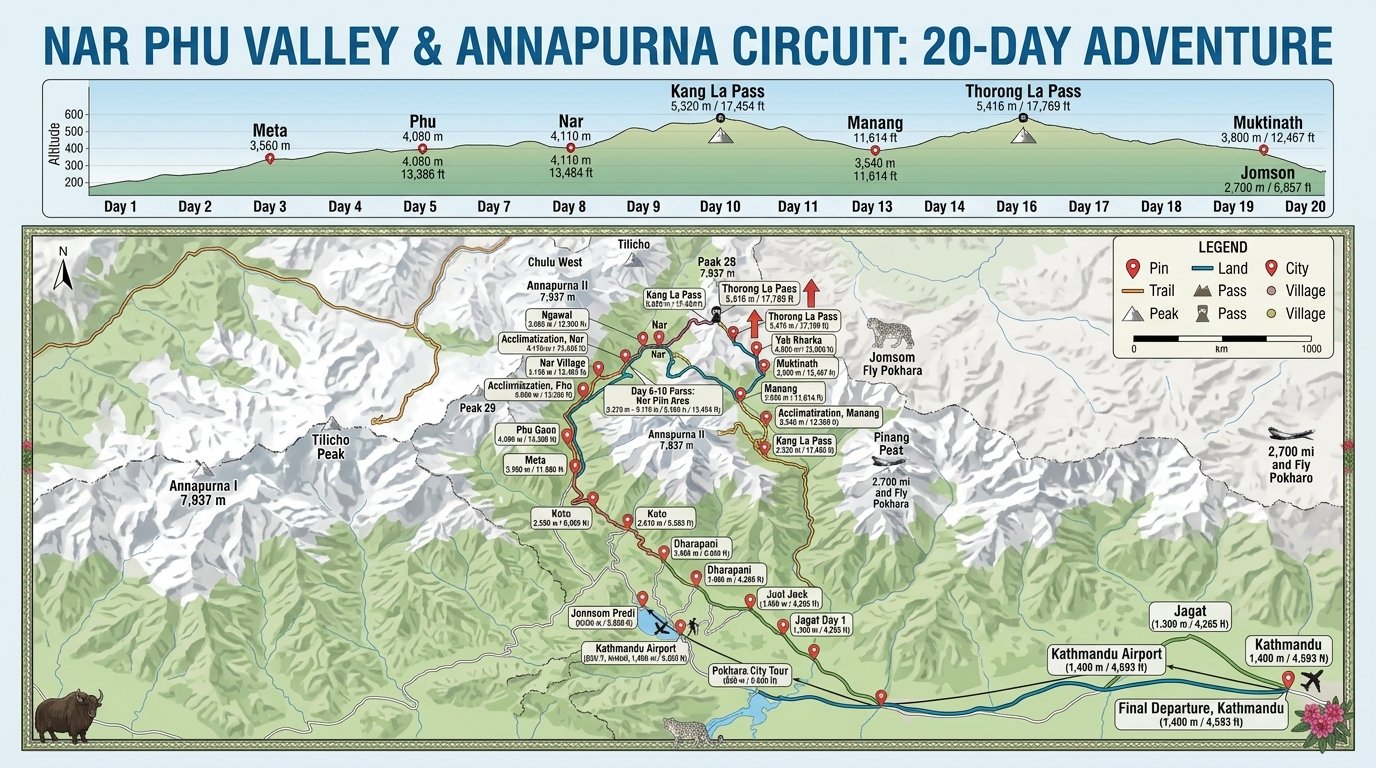
Nar Phu Valley with Annapurna Circuit Trek Altitude Chart
Nar Phu Valley with Annapurna Circuit Trek Gallery/Video


Best Time to Trek
The Nar Phu Valley Trek is best experienced during the spring (March to May) and autumn (September to November) seasons, when the Himalayan weather is most stable and clear sky conditions provide peak visibility.
Spring Season (March – May):
Spring transforms the region into a colorful paradise, with blooming rhododendrons and alpine wildflowers covering the lower trail sections. The daytime temperatures are pleasantly mild and dry, though cold mornings and sub-zero nights remain common at higher elevations near the passes. Overall, clear skies and vibrant greenery make this a phenomenal window for high-altitude trekking and photography.
Autumn Season (September – November):
Autumn is widely considered the ultimate season for this trek because post-monsoon rains wash away haze, leaving behind pristine, deep-blue skies and unmatched mountain visibility. Temperatures remain cool and comfortable during long walking days, though night temperatures drop rapidly toward late November as winter approaches.
Monsoon / Summer Season (June – August):
Although the upper Nar Phu Valley falls within a rain-shadow region and receives far less rain than southern Nepal, traveling here during the monsoon is generally not recommended. The lower access roads leading to the trailhead at Koto frequently suffer from heavy downpours, leading to muddy trails, swollen rivers, landslides, and unpredictable travel delays.
Winter Season (December – February):
Winter brings severe alpine weather marked by heavy snowfall and freezing temperatures throughout the valley. Crossing high elevations like the Kang La Pass ( 5,320 m) becomes exceptionally dangerous or impossible without technical ice-climbing equipment, and many villagers migrate to lower elevations for the season, leaving local lodges closed.
Trek Difficulty & Safety
The Nar Phu Valley Trek is classified as a challenging to strenuous high-altitude trek that requires strong physical fitness and mental endurance. Trekkers must navigate long walking days over steep, rugged terrain, including demanding ascents over two major high-altitude passes: Kang La Pass ( 5,320 m) and Thorong La Pass ( 5,416 m).
Because Nar Phu is a protected, remote restricted area, food and accommodation options are basic and rustic compared to developed commercial routes. Medical facilities and emergency infrastructure are extremely scarce in the valley, making comprehensive travel insurance covering high-altitude helicopter rescue (up to 5,500 m) and a licensed professional guide absolute necessities for safety.
How to Get to Nepal
Most international travelers arrive in Nepal by flying directly into Tribhuvan International Airport (TIA) in Kathmandu, the country’s primary international hub. A wide range of international airlines operate direct and connecting flights to Kathmandu from major transit hubs across the Middle East, Asia, and Europe.
Upon arrival at the airport, most nationalities can easily obtain a tourist visa on arrival, which is available for durations of 15, 30, or 90 days. It is recommended to complete the online visa application form prior to arrival to speed up border processing. From Kathmandu, all overland transport, domestic flights, and restricted permit logistics for the Nar Phu Valley Trek are arranged before driving to the trailhead at Koto or Besisahar.
Physical Fitness and Preparation
The Nar Phu Valley Trek requires a high level of physical fitness and strong endurance, as you will be trekking for 12 to 14 consecutive days over rugged, steep, and unpaved terrain. Daily walks average 5 to 7 hours, with pass-crossing days demanding up to 8 to 10 hours of continuous exertion at altitudes exceeding 5,000 m
Prior multi-day trekking experience is highly recommended, though fit beginners with dedicated training can complete the route. Preparation should begin 2 to 3 months before departure, focusing on cardiovascular training such as running, cycling, or swimming, combined with leg-strengthening exercises like squats and lunges. The most effective training is hiking on uneven, hilly trails while carrying a weighted daypack ( 5–8 kg) to condition your legs, back, and lungs for sustained mountain conditions.
Visa Options Overview
Nepal makes entering the country straightforward for most international travelers. You can obtain a tourist visa either On Arrival at Tribhuvan International Airport (TIA) in Kathmandu and designated land borders, or in advance via an Online Pre-Application or through a Nepalese Diplomatic Mission in your home country.
Visa On Arrival Process
The Visa On Arrival system is available for citizens of almost all countries (with a few exceptions noted below).
To complete the process efficiently upon arrival at Tribhuvan International Airport in Kathmandu:
-
Online Pre-Arrival Form: Complete the online pre-application form on the official Nepal Department of Immigration portal within 15 days prior to your arrival date. Print the submission receipt with the barcode.
-
Kiosk Alternative: If you do not fill out the form in advance, you can use the electronic kiosk terminals available in the arrivals hall at the airport.
-
Payment: Proceed to the bank counter in the immigration hall to pay the visa fee. Cash in major currencies (USD, EUR, GBP, AUD, CAD) or credit cards are accepted, though bringing crisp USD cash is often the fastest option.
-
Immigration Counter: Present your passport (valid for at least 6 months), submission receipt, payment receipt, and return flight ticket to the immigration officer for your visa stamp.
Tourist Visa Fees and Durations
Nepal offers three standard durations for tourist visas. All tourist visas are multiple-entry:
-
15-Day Visa: USD 30
-
30-Day Visa: USD 50
-
90-Day Visa: USD 125
Note: Children under 10 years old are granted a free visa, though they must still complete the application process.
Visa Extensions
If your trek or travel plans extend beyond your original visa duration, you can easily extend your tourist visa while in Nepal:
-
Location: Visa extensions are processed at the Department of Immigration office in Kalikasthan, Kathmandu, or the Immigration Office in Pokhara.
-
Extension Cost: USD 45 for a minimum 15-day extension, plus USD 3 for each additional day beyond 15 days.
-
Maximum Stay: A tourist visa can be extended up to a maximum total stay of 150 days in a single calendar year (January to December).
Countries Required to Apply in Advance
Citizens of the following countries are not eligible for a Visa On Arrival and must obtain a visa from their nearest Nepalese Embassy or Consulate prior to traveling:
-
Nigeria, Ghana, Zimbabwe, Swaziland, Cameroon, Somalia, Liberia, Ethiopia, Iraq, Palestine, Afghanistan, and Syria.
Visa Rules for Indian Citizens
Indian nationals do not require a visa to enter Nepal under the 1950 Indo-Nepal Treaty of Peace and Friendship. However, Indian citizens arriving by air or crossing land borders must present valid identification, such as a valid Indian Passport or a Voters ID Card issued by the Election Commission of India.
Why Choose Best Trek & Adventure
At Best Trek & Adventure, we are dedicated to turning your Himalayan dreams into safe, seamless, and unforgettable journeys. Based in Kathmandu, our licensed agency combines deep local expertise, rigorous high-altitude safety standards, and flexible, personalized service for every trekker. We handle all complex permit logistics directly through official government channels like the Nepal Tourism Board, ensuring complete compliance and hassle-free entry into restricted regions like Nar Phu.
Your safety and comfort are our top priorities. Our team consists of certified, English-speaking local guides trained in wilderness safety, first aid, and high-altitude health management. We keep group sizes small for attentive care during demanding pass crossings like Kang La ( 5,320 m) and Thorong La ( 5,416 m). Furthermore, we uphold strict ethical trekking standards by guaranteeing fair wages, full insurance coverage, and proper gear for all our porters and support staff.
Looking to explore more of Nepal’s breathtaking landscapes? Discover our full range of trips on Best Trek & Adventure, or check out our other popular packages like the classic Everest Base Camp Trek, the scenic Annapurna Base Camp Trek, or the culturally rich Langtang Valley Trek. Choose Best Trek & Adventure for an authentic, reliable, and extraordinary mountain
Nar Phu Valley with Annapurna Circuit Trek FAQS
Expand AllThroughout the walk, there are restrooms at the teahouses and lodges. Along the trail, there are private spots that hikers can use in case of emergency.
Water in bottles is inexpensive and widely accessible, but most trekking areas forbid carrying plastic bottles. Hence, you must always carry your water bottle, filled with either mineral water or boiled or filtered water.
It is recommended to carry water purification tablets or drops from your home country to Nepal. You can also find filtration products to remain on the safe side to purify your water.
You can either keep them at the Kathmandu Hotel or Pokhara. You can reset assured. We will take full responsibility for your luggage and they are kept in a very secure place.
Yes, you may get a Nepal visa at the airport when you get there. For a 15-day tourist visa with multiple entries, the price is USD 30; for a 30-day or 90-day tourist visa with multiple entries, the price is USD 50 and USD 125, respectively.
Traveler Reviews
Explore authentic feedback from our past adventurers with Best Treks and Adventure, sourced from TripAdvisor, Google, Facebook, and Trustpilot.

Ralfi Lahor (Spain)
Amazing Kathmandu 7 UNESCO World Heritage Sites Day Tour
Amazing Kathmandu 7 UNESCO World Heritage Sites Day Tour
We had a wonderful experience exploring the 7 UNESCO World Heritage Sites in Kathmandu Valley with Best Trek and Adventure. This Kathmandu day tour was a perfect way to discover the history, culture, architecture, and spiritual traditions of Nepal in a single day. Our tour guide Prakash was the best of the best guide for ever to us.
Our private Kathmandu sightseeing tour included Kathmandu Durbar Square, Swayambhunath (Monkey Temple), Boudhanath Stupa, Pashupatinath Temple, Patan Durbar Square, Bhaktapur Durbar Square, and Changu Narayan Temple. Every UNESCO World Heritage Site was unique and fascinating, with beautiful temples, ancient palaces, stupas, traditional Newari architecture, and incredible cultural heritage.
Our guide was friendly, knowledgeable, and helpful throughout the tour. He explained the history and religious importance of each place clearly and also gave us enough time to enjoy the surroundings and take photographs.
We highly recommend Best Trek and Adventure Pvt. Ltd. for anyone looking for a Kathmandu UNESCO World Heritage Sites tour, Kathmandu Valley sightseeing tour, or private Kathmandu day tour. The organization, transportation, guide service, and overall experience were excellent. It was truly a lifetime memorable trip in Kathmandu, Nepal. We would happily recommend Best Trek and Adventure to other travelers visiting Nepal. Namaste!
Rob Lannister (Switzerland )
Best Trek and Adventure is the best agency in Nepal
It was great time for Manaslu Circuit with Tsum Valley Trek with Best Trek and Adventure. Our guide Dinesh was great, polite, on-time and knowledgeable as well many years experienced. We are 100% satisfy and value of money with this agency and whole team. Prakash, owner of agency was responsible, organized and quick answer. So no need to search another agency then Best Trek and Adventure for your memorable trip to Nepal. Thank you! Namaste!
Ran Royan (Switzerland )
An excellent Annapurna Circuit Trek
We had perfect trip to Annapurna Circuit Trek include Tilicho Lake. Me and my 7 friends did this 15 days trip include Kathmandu and Pokhara Tour.
We had confirmed this trip almost 6 months before. They were responsive. They answer all our emails within 2 hours. When we had mate with their team also really helpful, experienced and kind. Even for hiking 🥾 to Annapurna Circuit we didn’t expect that kind of foods, services and teahouses but they had provided us great services. If you are planning any trip to Nepal. Feel free to contact this company and book this trip for your great trip. Highly recommend this agency Best Trek and Adventure for your any kind of trip. Dhanyabad. Namaste.
Ryan Roger (France)
Annapurna Circuit Trek
We had great time for Annapurna Circuit Trek with Best Trek and Adventure. Our guide Dinesh was an excellent . We also did Kathmandu and Pokhara tour.
Team member of this agency are really on time and responsive. They reply our all questions with in couple of hour. Highly recommend this agency and team for your any kind of trip. Thank you!
Ryan Roger (France)
Annapurna Circuit Trek
We had great time for Annapurna Circuit Trek with Best Trek and Adventure. Our guide Dinesh was an excellent . We also did Kathmandu and Pokhara tour.
Team member of this agency are really on time and responsive. They reply our all questions with in couple of hour. Highly recommend this agency and team for your any kind of trip. Thank you!
Add a Review
Price Start From
Book NowWhy choose Us
- An Excellent reviews and High Star Rating.
- Organized and Customizable Itinerary.
- Affordable Price.
- Focus for Eco-Friendly Tourism
- Well-Qualified Guides and Workers.