Everest Base Camp Trek vs Annapurna Circuit Trek: Complete Guide 2026/2027
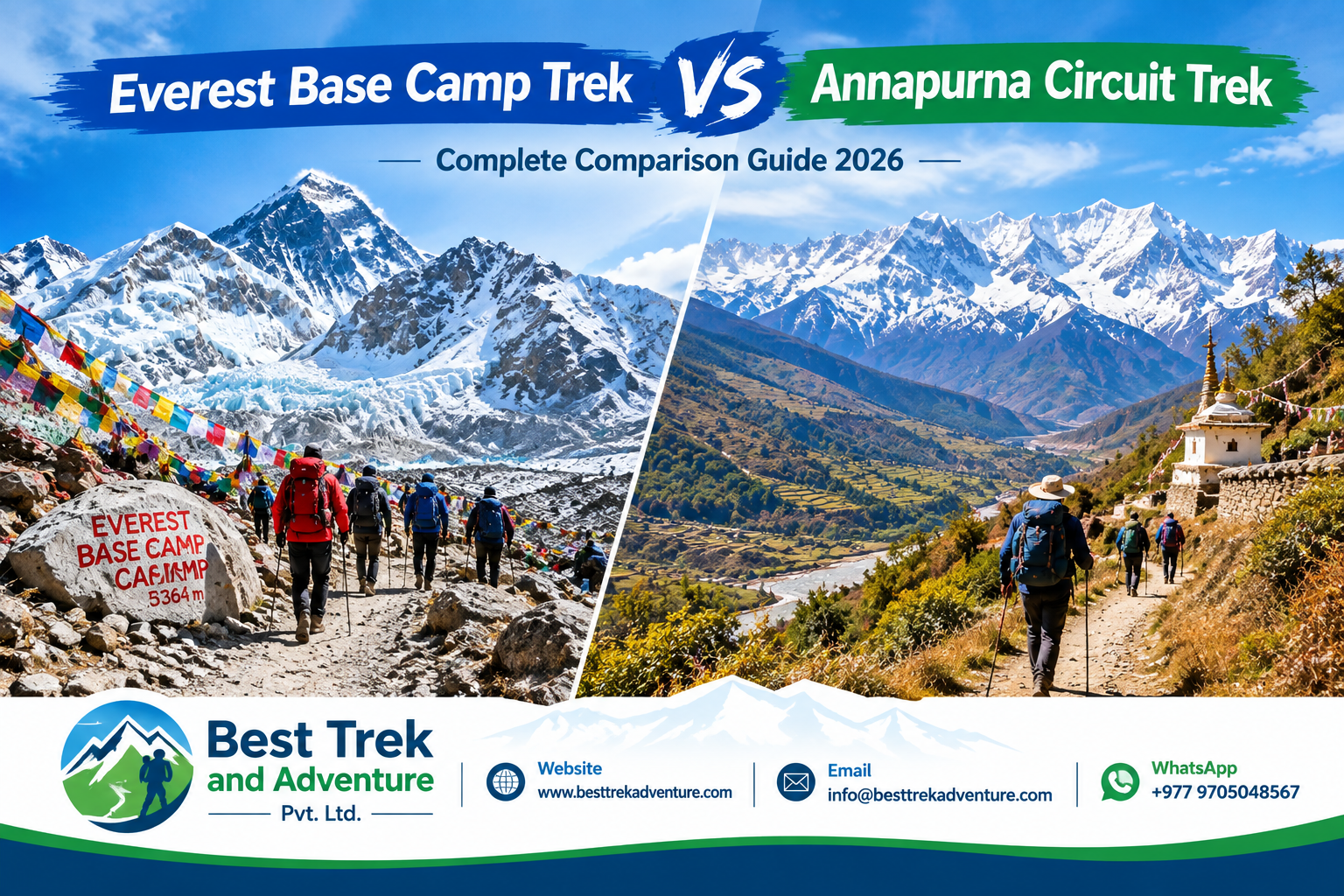
Everest Base Camp Trek vs Annapurna Circuit Trek
Nepal is home to some of the world’s most spectacular Himalayan trekking routes, and two of the most recognized are the Everest Base Camp Trek and the Annapurna Circuit Trek. Both offer extraordinary mountain scenery, traditional Himalayan villages, high-altitude landscapes, and memorable cultural experiences, but they are very different trekking adventures.
Choosing between the Everest Base Camp Trek and Annapurna Circuit Trek depends on several factors, including your available time, trekking experience, fitness, preferred scenery, altitude tolerance, budget, and the type of Himalayan experience you are looking for.
The Everest Base Camp route takes trekkers into the Khumbu region, where the journey is closely connected with Mount Everest, Sherpa culture, Buddhist monasteries, glaciers, and high Himalayan valleys. Nepal Tourism Board describes Everest Base Camp as one of the country’s most visited trekking regions, with the classic journey beginning around Lukla and passing through Namche Bazaar before continuing toward Everest Base Camp.
The Annapurna Circuit provides a very different experience. It travels around the Annapurna massif through changing landscapes, from lower mountain valleys and forests to the dry high-altitude landscapes of Manang and Mustang, with the famous Thorong La Pass forming the high point of the journey. Nepal Tourism Board highlights the region’s remarkable contrast between forested mountains, high Himalaya, and trans-Himalayan landscapes.
So, Everest Base Camp Trek vs Annapurna Circuit Trek — which one should you choose?
There is no universal answer. Understanding the differences will help you select the trek that matches your own travel goals.

Exact duration and route details can vary according to itinerary, road conditions, acclimatization days, and transportation arrangements. Current trekking sources commonly place standard Everest itineraries around two weeks and Annapurna Circuit itineraries around two to three weeks.
Everest Base Camp Trek
The Everest Base Camp Trek is one of Nepal’s most iconic Himalayan journeys. The trek takes travelers into the Khumbu region, home to Mount Everest and the Sherpa communities that have played an important role in Himalayan mountaineering.
A traditional itinerary begins with the journey to Lukla. From there, trekkers follow the Dudh Koshi Valley toward Namche Bazaar and continue through settlements such as Tengboche, Dingboche, Lobuche, and Gorak Shep before reaching Everest Base Camp.
Nepal Tourism Board notes that the classic route starts and finishes at Lukla and normally takes around two weeks, with Namche Bazaar serving as an important acclimatization point.
Major Highlights of Everest Base Camp
The main attraction is, naturally, Mount Everest. However, the journey offers much more than a view of the world’s highest mountain.
Highlights include:
- Lukla
- Namche Bazaar
- Tengboche Monastery
- Sherpa villages
- Sagarmatha National Park
- Ama Dablam
- Lhotse
- Nuptse
- Everest Base Camp
- Khumbu Glacier
- Kala Patthar
For many trekkers, the journey itself becomes as important as reaching Base Camp. Walking through mountain villages, crossing suspension bridges, meeting local people, and gradually entering the high Himalayas create a sense of adventure throughout the trek.
Annapurna Circuit Trek
The Annapurna Circuit Trek is famous for its exceptional variety of scenery and culture. Instead of traveling toward one destination and returning largely through the same valley, the Annapurna Circuit travels around the Annapurna massif. This means the landscape changes substantially during the journey.
Lower sections can feature green hills, agricultural communities, rivers, and forests. As the route climbs toward Manang, the environment becomes increasingly alpine. Beyond the high pass, the landscape changes again toward the drier valleys associated with Mustang.
Nepal Tourism Board describes the Annapurna region as an area of striking contrasts, extending from forested middle mountains into high Himalayan and trans-Himalayan desert landscapes.
Major Highlights of Annapurna Circuit
Important attractions include:
- Besisahar or the chosen trailhead
- Marsyangdi River Valley
- Manang
- Tilicho Lake side-trip possibilities
- Thorong La Pass
- Muktinath
- Kali Gandaki Valley
- Marpha
- Jomsom
- Annapurna mountain range
- Dhaulagiri views
- Traditional Himalayan villages
The constantly changing scenery is one of the defining characteristics of the Annapurna Circuit.
1. Everest Base Camp vs Annapurna Circuit: Scenery
Scenery is one of the biggest differences between these two treks.
The Everest Base Camp Trek is dominated by the high Himalayas. As you move deeper into the Khumbu, enormous peaks become increasingly prominent. Everest, Lhotse, Nuptse, Ama Dablam, Thamserku and other mountains create an extraordinary alpine environment.
The Annapurna Circuit, by comparison, offers greater changes in landscape. You may begin among greener hills and cultivated areas before entering pine and rhododendron forests, high mountain valleys, dry landscapes and eventually the dramatic terrain around Thorong La and Mustang.
Therefore, travelers who prefer a journey where the landscape changes significantly from beginning to end may find the Annapurna Circuit particularly interesting.
Travelers whose primary goal is to experience the Everest mountain environment may be more attracted to the Everest Base Camp route.
2. Altitude Comparison
Altitude is an important consideration for both treks.
Everest Base Camp itself is approximately 5,364 meters above sea level, while Kala Patthar, one of the principal viewpoints on the trek, reaches approximately 5,545 meters, depending on the route and measurement reference.
The Annapurna Circuit’s highest major point is Thorong La Pass at approximately 5,416 meters.
Both routes therefore reach serious high-altitude environments.
However, the way altitude is experienced is different.
On Everest Base Camp, altitude increases progressively as trekkers travel deeper into the Khumbu. Acclimatization stops such as Namche Bazaar and Dingboche are important parts of many standard itineraries.
On the Annapurna Circuit, trekkers gradually climb through the Marsyangdi Valley and spend time around Manang before tackling the high Thorong La crossing.
Altitude should never be underestimated on either trek.
3. Which Trek Is More Difficult?
It is difficult to declare one trek universally harder because difficulty depends on the individual trekker and itinerary.
Everest Base Camp involves prolonged high-altitude trekking, with several days spent above 3,000 meters and the final stages taking place in very thin air.
Annapurna Circuit includes the demanding crossing of Thorong La Pass, which requires a significant ascent followed by a long descent.
Recent trekking comparisons similarly identify altitude as a major challenge on both routes, with the Annapurna Circuit’s Thorong La crossing representing a concentrated high-altitude challenge while Everest involves a longer progression into very high terrain.
A good preparation program should include regular walking, uphill training, cardiovascular exercise, and longer hikes before departure.
4. Trek Duration
The length of your holiday can strongly influence your choice.
A standard Everest Base Camp Trek generally takes around two weeks, although exact itineraries vary.
The Annapurna Circuit often requires more time because it covers a larger route and passes through a wider range of landscapes. Current itineraries commonly range from roughly two to three weeks depending on road transport, side trips and trekking days.
If your schedule is relatively limited and reaching Everest Base Camp is your main goal, an appropriately designed EBC itinerary may fit your plans.
If you have additional time and want a longer journey through varied Himalayan environments, the Annapurna Circuit offers more opportunity for exploration.
5. Cultural Experience
Both treks offer fascinating cultural experiences, but the cultural character is different.
The Everest region is strongly associated with Sherpa culture. Namche Bazaar and other Khumbu settlements provide opportunities to see Buddhist monasteries, prayer flags, mani walls, traditional architecture and mountain communities.
Tengboche Monastery is one of the cultural highlights along the Everest route.
The Annapurna Circuit passes through several culturally distinct communities. Depending on the section of the route, travelers encounter Gurung, Manang and Thakali traditions, along with Hindu and Buddhist religious influences.
Muktinath is another important cultural and religious destination on the Annapurna route.
If your main interest is Sherpa culture and the history of Everest mountaineering, the Everest region offers a distinctive experience.
If you want greater cultural and geographical variety along one journey, the Annapurna Circuit provides a broader mix.
6. Transportation and Accessibility
The two treks also differ considerably in logistics.
Everest Base Camp traditionally begins with a flight toward Lukla, followed by trekking. Nepal Tourism Board identifies Lukla as the gateway to the Everest region.
Flight operations can be affected by mountain weather, so travelers should allow appropriate flexibility in their itinerary.
The Annapurna Circuit has more road access, especially in its lower sections. Modern road development has changed parts of the traditional route, and many trekking itineraries now use road transportation for selected sections.
This means the classic walking distance of the Annapurna Circuit can vary considerably depending on where a trek begins and ends.
For travelers who prefer a trek with road-based access rather than a mountain flight, the Annapurna Circuit may provide a different logistical experience.
7. Accommodation and Food
Both Everest Base Camp and Annapurna Circuit are well known for their teahouse trekking experience.
Teahouses and mountain lodges provide accommodation along much of the established trekking routes.
Rooms are generally simple, especially at higher elevations.
Common meals include:
- Dal bhat
- Rice
- Noodles
- Soups
- Pasta
- Potatoes
- Momos
- Eggs
- Tibetan-style breads
- Tea and other hot drinks
Food choices can vary by altitude and location. Better to do Food Tour in Kathmandu before this trek for your favorite choice of Nepali food.
On both treks, eating enough nutritious food and drinking sufficient fluids is important because trekking at altitude requires considerable energy.
8. Everest Base Camp vs Annapurna Circuit: Cost
The total cost depends on several factors, including:
- Trek duration
- Group size
- Guide and porter services
- Accommodation
- Transportation
- Permits
- Domestic flights
- Meals
- Personal expenses
- Side trips
- Travel insurance
Everest Base Camp generally involves the additional logistics of reaching Lukla, which can increase the overall trip cost.
The Annapurna Circuit has more road transportation options and does not normally require a mountain flight to reach its trekking region.
However, there is no single fixed price for either trek. Travelers should compare complete packages rather than looking only at the headline price.
A responsible package should clearly explain what is included and excluded.
9. Best Time for Everest Base Camp and Annapurna Circuit
The major trekking seasons overlap for both routes.
Spring: March to May
Spring offers generally favorable trekking conditions, with increasingly warm temperatures at lower elevations and blooming rhododendrons in many areas.
Autumn: September to November
Autumn is traditionally one of the most popular periods for Himalayan trekking. Following the monsoon, mountain visibility can be excellent when weather conditions cooperate.
Winter: December to February
Winter brings colder temperatures and snow at higher elevations. High passes and high-altitude sections can become more challenging.
Monsoon: June to August
The summer monsoon brings significant rainfall to many parts of Nepal. The Annapurna region contains rain-shadow areas, while some Everest routes can still be trekked with suitable preparation, but weather and trail conditions require careful consideration.
Always check current weather and trail conditions before departure.
10. Which Trek Has Better Mountain Views?
This depends on what type of mountain scenery you prefer.
The Everest Base Camp Trek offers a concentrated experience of the Khumbu Himalayas. The closer you get to Base Camp, the more dramatic the surrounding high-altitude environment becomes.
The Annapurna Circuit provides a broader variety of mountain landscapes, with different peaks appearing from different sections of the route.
Rather than asking which has “better” views, consider the type of scenery you want:
Choose Everest Base Camp if you want:
- Everest
- Lhotse
- Nuptse
- Ama Dablam
- Khumbu Glacier
- High alpine scenery
Choose Annapurna Circuit if you want:
- Annapurna range
- Dhaulagiri views
- Deep valleys
- Forests
- High mountain passes
- Dry trans-Himalayan landscapes
Both provide exceptional Himalayan scenery, but the visual character is different.
11. Which Trek Is Better for First-Time Himalayan Trekkers?
First-time trekkers can undertake either route with suitable preparation and a carefully planned itinerary.
However, first-time trekkers should not select a route solely because another person says it is easier.
Your physical condition, previous hiking experience, available time and ability to adapt to altitude are more important.
For either trek, preparation should include:
- Regular walking
- Hill training
- Cardiovascular exercise
- Strength training
- Comfortable trekking footwear
- Gradual acclimatization
- Appropriate clothing
- Travel insurance
- Proper hydration
A professional guide can also provide valuable support throughout the journey.
12. Everest Base Camp vs Annapurna Circuit for Photography
Photography enthusiasts will find excellent opportunities on both routes.
Everest provides dramatic high-altitude photographs, especially around Namche, Tengboche, Dingboche, Lobuche, Gorak Shep and Kala Patthar.
The Annapurna Circuit offers greater environmental variety, allowing photographers to capture forests, rivers, villages, mountain passes, dry valleys, monasteries and Himalayan peaks within a single trip.
If you want a portfolio showing many different environments, the Annapurna Circuit offers exceptional variety.
If your priority is dramatic Everest-region mountain photography, the Everest Base Camp Trek is an obvious route to consider.
13. Everest Base Camp or Annapurna Circuit: Which One Fits Your Travel Style?
Your personal priorities are perhaps the most useful way to compare the two.
Everest Base Camp may suit you if:
- Mount Everest is your primary goal.
- You want to experience the Khumbu region.
- You are interested in Sherpa culture.
- You want a classic Himalayan trekking experience.
- You are comfortable with prolonged high-altitude trekking.
- You have around two weeks available.
Annapurna Circuit may suit you if:
- You want changing landscapes.
- You enjoy long-distance trekking.
- You want to cross a famous Himalayan pass.
- You are interested in diverse mountain cultures.
- You want to experience both green valleys and dry high-altitude landscapes.
- You have additional time for a longer journey.
These are not rules. Many different types of trekkers can enjoy either route.
Everest Base Camp Trek vs Annapurna Circuit: Final Comparison
The Everest Base Camp Trek and Annapurna Circuit Trek represent two different sides of trekking in Nepal.
Everest Base Camp is centered around the world’s highest mountain and the unique landscape and culture of the Khumbu region. It provides an opportunity to walk through famous Sherpa settlements, visit monasteries, experience high-altitude valleys, and reach the base of Mount Everest.
Annapurna Circuit is a journey of geographical and cultural transition. The route travels through changing elevations and landscapes, eventually crossing Thorong La and continuing toward the Mustang side of the Annapurna region.
Neither trek needs to be treated as universally superior.
Instead, think about what you want your Himalayan journey to include.
If your dream is Mount Everest, Sherpa culture and the Khumbu, explore the Everest Base Camp Trek.
If your dream is landscape diversity, a high mountain pass and a longer journey around the Annapurna massif, explore the Annapurna Circuit Trek.
Whichever route you select, proper preparation, acclimatization, appropriate equipment, experienced local support and a realistic itinerary are essential.
Plan Your Nepal Trek with Best Trek and Adventure
At Best Trek and Adventure Pvt. Ltd., we help travelers explore Nepal through carefully planned trekking and adventure itineraries.
Whether you are interested in Everest Base Camp Trek, Annapurna Circuit Trek, Annapurna Base Camp, Langtang Valley, Manaslu Circuit, Mardi Himal, Upper Mustang or a customized Nepal adventure, our local team can help you plan your journey according to your available time, interests and trekking experience.
Nepal’s Himalayas are not simply a destination to visit. They are landscapes to walk through, cultures to experience and memories to carry home.
For more details Contact us Email: info@besttrekadventure.com For quick response WhatsApp: +9779705048567
Make an Inquiry



 September 18, 2026
7 UNESCO World Heritage Sites in Kathmandu Valley: Complete Guide
7 UNESCO World Heritage Sites in Kathmandu If you are planning a trip to Nepal and wondering what to see...
 August 31, 2026
Is Nepal Safe to Travel and Trek After the August 2026 Floods? Latest Travel & Trekking Update
Introduction Last Updated: August 31, 2026 The devastating flash floods that struck parts of Nepal on August 26, 2026, have...
 December 18, 2024
Everest Base Camp Trek 15 Days
Trek to Everest Base Camp for stunning Himalayan views, cultural immersion and a life-changing adventure to the heart of the...


