Annapurna Circuit Trek 2027: Complete Guide, Cost & Itinerary
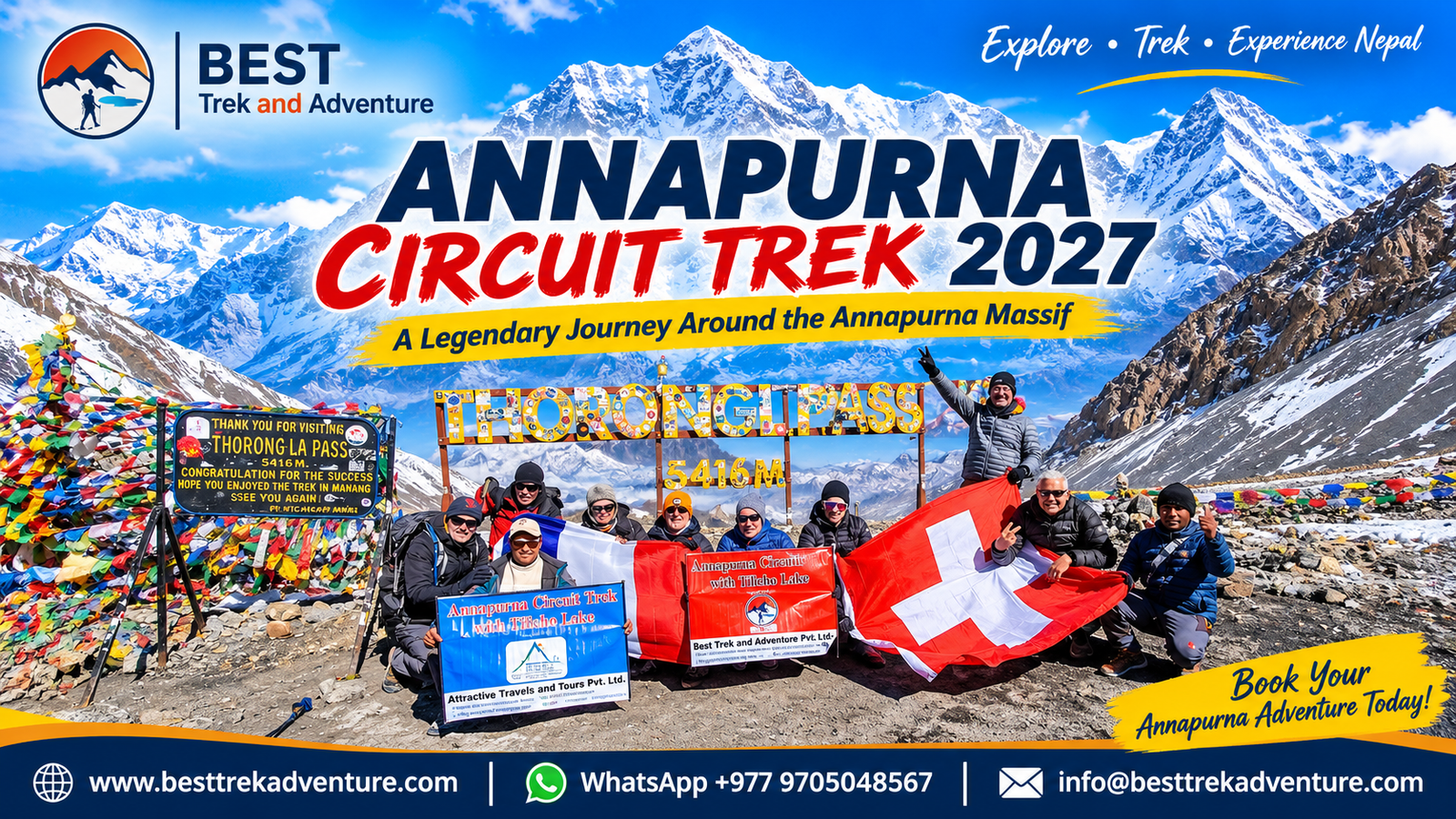
Annapurna Circuit Trek 2027
There are many reasons people travel to Nepal, but for anyone who enjoys walking in the mountains, the Annapurna Circuit is an experience worth considering. It is one of the country’s most rewarding trekking routes, taking you through traditional villages, deep valleys, beautiful forests and some of the most impressive mountain scenery in the Himalayas.
What makes this trek special is the variety. The landscape changes as you walk higher into the mountains. You begin among green hills and rivers, pass through pine forests and traditional settlements, and eventually reach the dry, rugged landscapes of the Manang and Mustang regions. Along the way, you will see snow-covered peaks, Buddhist monasteries, prayer flags and villages where life still follows many traditional customs.
The biggest challenge comes at Thorong La Pass, which stands at 5,416 metres above sea level. Reaching the pass is a major achievement, particularly for trekkers who have never walked at such an altitude. The views from the top make the effort worthwhile.
The Annapurna Circuit has changed over the years, particularly because of road construction in some lower sections. Nevertheless, there are still beautiful walking trails, traditional villages and wonderful mountain experiences to enjoy. Choosing the right route and allowing enough time makes a significant difference.
If you are planning to visit Nepal in 2027, this guide will help you understand what to expect, how much to budget, when to travel, what to pack and how to prepare.
At Best Trek and Adventure Pvt. Ltd., we organise trekking holidays in Nepal and help visitors plan their journeys according to their available time, interests and budget.
1. What Makes the Annapurna Circuit Trek Special?
The Annapurna Circuit is not simply a walk from one village to another. It is a journey through several different landscapes and cultures.
One day you might be walking beside a river through a green valley. A few days later, you could be looking across a dry mountain landscape with enormous snow-covered peaks in the distance.
Here are some of the experiences that make this trek memorable.
The mountain scenery
The Annapurna region is home to some of the most impressive mountains in Nepal. Depending on the route and weather, you can enjoy views of Annapurna I, Annapurna II, Annapurna III, Annapurna IV, Gangapurna, Dhaulagiri, Nilgiri and Tilicho Peak.
Traditional mountain villages
Places such as Chame, Pisang, Manang, Braga and Muktinath give you an opportunity to experience local life. Stone houses, small shops, monasteries and traditional architecture make these settlements very different from the cities of Nepal.
The challenge of Thorong La Pass
For many people, crossing Thorong La is the highlight of the entire journey. At 5,416 metres, it is a serious high-altitude challenge, but reaching the top is an unforgettable moment.
The culture of Manang and Mustang
The communities in these regions have strong cultural connections with Tibetan Buddhism and traditional Himalayan life. You will see prayer wheels, monasteries, chortens and colorful prayer flags along the trail.
The variety of landscapes
Few trekking routes offer such a noticeable change in scenery. The Annapurna Circuit takes you from green valleys to alpine terrain and the dry landscapes of Mustang.
2. Where Is the Annapurna Circuit?
The Annapurna Circuit is located in central Nepal, within the Annapurna region of Gandaki Province.
Much of the route passes through the Annapurna Conservation Area, one of Nepal’s important protected regions.
The traditional trekking journey begins around Besisahar and follows the Marsyangdi River towards Dharapani, Chame, Pisang and Manang. After crossing Thorong La Pass, trekkers descend towards Muktinath and the Kali Gandaki Valley.
Depending on the itinerary, the journey may finish in Jomsom or continue towards other destinations.
Kathmandu is generally the starting point for international visitors. From there, travelers travel by road towards Besisahar and the trekking region.
3. Annapurna Circuit Trek Highlights
Some of the places and experiences you should look forward to include:
- Walking through the beautiful Marsyangdi River Valley.
- Enjoying mountain views around Chame and Pisang.
- Exploring traditional villages in the Manang region.
- Visiting Braga Monastery.
- Spending an acclimatisation day in Manang.
- Enjoying the mountain scenery around Yak Kharka.
- Crossing Thorong La Pass at 5,416 metres.
- Visiting the sacred Muktinath Temple.
- Exploring the traditional settlements of Mustang.
- Enjoying the dramatic scenery of the Kali Gandaki Valley.
- Adding Tilicho Lake to your journey if time allows.
Every section has its own character. This is one reason many travellers choose the Annapurna Circuit over a shorter mountain holiday.
4. Annapurna Circuit Trek Route and Distance
The exact distance depends on where you begin, where you finish and how much of the journey you complete on foot.
A traditional route follows:
Besisahar – Bhulbhule – Jagat – Dharapani – Chame – Pisang – Manang – Yak Kharka – Thorong Phedi – Thorong La Pass – Muktinath – Jomsom – Pokhara.
Today, some trekkers use road transportation to avoid walking along lower road sections. Others prefer a longer itinerary with more time on the original walking trails.
My recommendation is to choose your route carefully rather than simply selecting the shortest available programme. The higher sections around Manang, Thorong La and Muktinath are among the most rewarding parts of the trek.
The trails through Upper Pisang, Ghyaru and Ngawal are particularly worthwhile when conditions and your itinerary allow.
5. Annapurna Circuit Trek 14-Day Itinerary
If you have approximately two weeks for your Nepal trekking holiday, the following itinerary is a practical option. It includes the major highlights of the circuit and an acclimatisation day in Manang.
The programme uses road transportation on some lower sections to make the journey fit into 14 days.
Day 1: Arrival in Kathmandu (1,400 m)
Welcome to Nepal!
After arriving at Tribhuvan International Airport, our representative can meet you and arrange your transfer to the hotel.
Take some time to rest after your international flight. If you feel comfortable, you can explore Thamel, where you will find restaurants, trekking shops and travel services.
Overnight in Kathmandu.
Day 2: Kathmandu to Besisahar and Dharapani (approximately 1,860 m)
After breakfast, leave Kathmandu and travel towards Besisahar.
The drive takes you through Nepal’s countryside, with views of rivers, hills, farmland and small settlements.
From Besisahar, continue towards Dharapani by local jeep or arranged vehicle, depending on the road conditions.
Dharapani is an important village on the Annapurna Circuit and a popular starting point for trekkers using the modern route.
Overnight in Dharapani.
Day 3: Dharapani to Chame (2,670 m)
Today you begin walking in the Annapurna region.
The trail follows the mountain valley through forests, villages and beautiful natural scenery. You will gradually gain altitude as you make your way towards Chame.
Chame is the administrative centre of Manang District. It is a pleasant place to spend the evening and prepare for the higher sections ahead.
Overnight in Chame.
Day 4: Chame to Upper Pisang (approximately 3,300 m)
The landscape becomes increasingly impressive as you continue towards Upper Pisang.
Along the way, you will see pine forests, rocky mountain slopes and spectacular views of the surrounding peaks.
Upper Pisang is particularly attractive because of its traditional houses and mountain setting.
Take some time to explore the village if you arrive early.
Overnight in Upper Pisang.
Day 5: Upper Pisang to Manang (3,540 m)
This is one of the most beautiful walking days of the Annapurna Circuit.
If trail conditions and your fitness allow, take the upper route through Ghyaru and Ngawal. The views from these villages are among the highlights of the Manang Valley.
You will see impressive mountain scenery, traditional settlements and wide Himalayan landscapes.
Continue towards Manang, where you will spend the next night.
Overnight in Manang.
Day 6: Acclimatisation Day in Manang (3,540 m)
Today is an important part of the itinerary.
Rather than immediately continuing higher, spend another night in Manang to give your body time to adjust to the altitude.
You can take a short acclimatisation walk around the village, visit Braga Monastery or explore the area around Gangapurna Lake.
Walk slowly and avoid exhausting yourself. The purpose of the day is to prepare for the higher elevations ahead.
Overnight in Manang.
Day 7: Manang to Yak Kharka (4,050 m)
Leave Manang and continue towards Yak Kharka.
The landscape becomes more open, with fewer trees and increasingly rugged mountain surroundings.
The walking is generally steady, but remember that you are now above 4,000 metres. Take your time and listen to your body.
Overnight in Yak Kharka.
Day 8: Yak Kharka to Thorong Phedi (approximately 4,450 m)
Today’s walk takes you closer to Thorong La Pass.
Follow the mountain trail towards Thorong Phedi, the main overnight stopping point before crossing the pass.
The surroundings are dramatic, and you will notice how much the landscape has changed since the beginning of the trek.
Your guide can discuss the weather, trail conditions and starting time for the following morning.
Overnight in Thorong Phedi.
Day 9: Thorong Phedi to Thorong La Pass (5,416 m) and Muktinath (3,760 m)
This is the biggest day of the Annapurna Circuit.
Most trekkers begin early, usually before sunrise, because the crossing is long and weather conditions can change during the day.
The climb towards Thorong La Pass is demanding, especially because of the altitude. Walk slowly, take breaks and follow your guide’s instructions.
When you reach the top, you will find colourful prayer flags and incredible mountain views. Take a moment to enjoy the achievement and photograph the experience.
After crossing the pass, descend towards Muktinath.
The descent is long, so you should be prepared for a full day of trekking.
Overnight in Muktinath.
Day 10: Muktinath to Jomsom (2,720 m)
After breakfast, spend some time exploring Muktinath.
The temple is an important pilgrimage destination for both Hindu and Buddhist communities. It is also a beautiful place to experience the spiritual side of the Mustang region.
Continue towards Jomsom by walking or arranged transportation, depending on the selected programme and road conditions.
Jomsom is an important town with shops, restaurants and accommodation.
Overnight in Jomsom.
Day 11: Jomsom to Pokhara
Travel from Jomsom to Pokhara by road or by domestic flight when available.
Flights depend on weather and airline schedules, so some flexibility is important.
Pokhara is a wonderful place to relax after the trek. Enjoy the lakeside atmosphere, restaurants and views of the surrounding mountains.
Overnight in Pokhara.
Day 12: Pokhara to Kathmandu
Return to Kathmandu by tourist bus, private vehicle or domestic flight.
The road journey offers views of rivers, green hills and Nepalese villages.
After reaching Kathmandu, transfer to your hotel.
Overnight in Kathmandu.
Day 13: Kathmandu Sightseeing or Free Day
Enjoy a free day in Kathmandu or arrange an optional sightseeing tour.
Popular places include Pashupatinath Temple, Boudhanath Stupa, Swayambhunath and the historic Durbar Squares of Kathmandu, Patan and Bhaktapur.
It is a good opportunity to discover Nepalese culture before your international departure.
Overnight in Kathmandu.
Day 14: International Departure
After breakfast, depending on your flight schedule, our representative can arrange your transfer to Tribhuvan International Airport.
We hope you return home with wonderful memories of Nepal and the Annapurna Himalayas.
Itinerary note: This is a sample 14-day programme. A longer itinerary is recommended if you want to walk more of the traditional circuit or include Tilicho Lake. The programme should be adjusted according to road access, altitude acclimatisation and weather conditions.
6. How Much Does Annapurna Circuit Trek Cost in 2027?
Cost is one of the first things most travellers want to know when planning the Annapurna Circuit.
There is no single price that suits every traveller. The total depends on the number of days, group size, transportation, accommodation and services included.
For example, a private trek with a dedicated guide and private transportation will usually cost more than joining a group and using shared transport.
The main expenses include:
Guide services: An experienced local trekking guide helps with navigation, daily arrangements, local information and safety.
Porter services: If you prefer not to carry your main luggage, you can arrange a porter according to the company’s porter policy and applicable regulations.
Accommodation: Most nights are spent in local teahouses. Accommodation is generally simple, especially at higher elevations.
Meals: Breakfast, lunch and dinner can represent a significant part of your daily trekking budget.
Transportation: Road transportation from Kathmandu and between trekking locations depends on the itinerary and vehicle type.
Permits and registration: Budget for the applicable conservation-area permit and trekking registration requirements.
Personal expenses: Snacks, hot drinks, charging, showers, tips and personal purchases are additional expenses unless specifically included.
What Should Your Trekking Package Include?
Before booking, ask the company to provide a clear breakdown of the services.
A package may include:
- Airport transfers.
- Ground transportation.
- Trekking guide.
- Required permits and registration.
- Teahouse accommodation.
- Meals during the trek.
- Porter services, if selected.
- Applicable guide and porter insurance.
- Government taxes and company service charges.
Items that may not be included are international flights, Nepal visa, travel insurance, personal equipment, tips, personal expenses and emergency evacuation costs.
At Best Trek and Adventure, we can prepare a quotation based on your dates, group size and preferred services.
Rather than choosing a package based only on its lowest price, check the quality of the arrangements and what you will actually receive.
7. Best Time for Annapurna Circuit Trek
The Annapurna Circuit can be beautiful in different seasons, but weather makes a big difference to the experience.
For most visitors, spring and autumn are the best times to plan the trek.
Spring: March to May
Spring brings warmer temperatures and beautiful landscapes to the Annapurna region.
Rhododendron forests bloom in the lower areas, and the days are generally pleasant for walking.
April and May are popular months for trekking.
Spring is a good choice if you enjoy colourful landscapes and comfortable daytime temperatures. Conditions at high elevations can still be cold, particularly early in the morning.
Autumn: September to November
Autumn is another excellent season.
After the monsoon, the landscape becomes fresh and the mountain views are often very clear.
October and November are particularly popular because of generally favourable trekking conditions.
If clear mountain views are high on your priority list, autumn is an excellent time to consider.
Winter: December to February
Winter trekking is possible, but the upper Annapurna region can become extremely cold.
Snowfall may affect the trail and make Thorong La Pass difficult or temporarily inaccessible.
Anyone considering a winter departure should obtain current local weather and trail information before travelling.
Monsoon: June to August
The monsoon brings heavy rainfall to much of Nepal.
Lower sections can become muddy, and landslides may affect transportation and trekking routes.
Some areas of Mustang receive less rainfall because they are in the Himalayan rain shadow. Even so, travel during the monsoon requires careful planning.
Our suggestion: Consider October, November, April or May for your 2027 Annapurna Circuit adventure. Always check actual conditions before departure.
8. How Difficult Is the Annapurna Circuit Trek?
The Annapurna Circuit is generally considered a moderate-to-challenging trek.
You do not need technical climbing experience, but you should be comfortable walking for several hours a day on uneven mountain trails.
The biggest challenge is the altitude, especially when crossing Thorong La Pass.
Some days involve steady uphill walking, while others include long descents. The weather can also change quickly in the mountains.
Can Beginners Complete the Annapurna Circuit?
Yes, beginners can complete the trek if they prepare properly and choose a sensible itinerary.
You do not need to be an athlete. However, you should be reasonably fit and comfortable with regular walking.
Before your trip, try to:
- Walk regularly, including uphill routes.
- Practise longer walks on weekends.
- Build your cardiovascular fitness.
- Strengthen your legs.
- Practise walking with a daypack.
- Wear your trekking boots before arriving in Nepal.
Most importantly, do not rush.
A steady pace and sufficient acclimatisation are more useful than trying to walk quickly.
9. Thorong La Pass: The Most Memorable Day
Thorong La Pass is the highlight many people think about when planning the Annapurna Circuit.
At 5,416 metres, it is one of the highest trekking passes in the world.
The day usually begins before sunrise. You leave your teahouse with a headlamp, warm clothing and enough water for the journey.
The climb is gradual in places but physically demanding because of the altitude. Every step requires patience.
Eventually, you reach the top, where colourful prayer flags mark the pass. The surrounding mountains and wide Himalayan landscape make it a remarkable place to stop and take photographs.
After enjoying the moment, you begin the long descent towards Muktinath.
Tips for a Successful Crossing
- Acclimatise properly before reaching the pass.
- Start at the time recommended by your guide.
- Wear warm and waterproof clothing.
- Carry snacks and drinking water.
- Walk at a steady pace.
- Check the weather before starting.
- Do not attempt the crossing during unsafe conditions.
The pass is not something to rush. Your safety matters much more than reaching the top on a particular day.
10. Permits for Annapurna Circuit Trek
Permits and trekking registration should be arranged before starting your journey.
The main conservation permit is the Annapurna Conservation Area Permit (ACAP).
The Nepal Tourism Board also publishes trekking requirements for routes including the Annapurna Circuit, covering licensed guides and agency-issued TIMS registration.
Because regulations and fees can change, confirm the current requirements before your 2027 departure.
A registered trekking company can help arrange the required documents.
Official information:
- Nepal Tourism Board: https://ntb.gov.np/
- TIMS information: https://ntb.gov.np/en/plan-your-trip/before-you-come/tims-card
- Trekking permits: https://ntb.gov.np/en/plan-your-trip/before-you-come/trekking-permit
- ACAP permit system: https://epermit.ntnc.org.np/
If you plan to visit restricted neighbouring areas such as Nar Phu, additional permits may be necessary.
11. Accommodation on the Annapurna Circuit
Most trekkers stay in local teahouses throughout the journey.
These are simple mountain lodges that provide accommodation and meals. They are an important part of trekking life in Nepal.
You should not expect luxury hotels in the higher villages. Rooms are generally basic, and bathrooms may be shared.
Some teahouses have private rooms and attached bathrooms, but facilities depend on the location.
The dining room is often the warmest and most social place in the lodge. It is where trekkers sit together, enjoy dinner and share stories about the day’s walk.
A good sleeping bag is recommended, especially during colder months.
12. Food During the Trek
You will find a surprising variety of food along the Annapurna Circuit.
Dal Bhat is one of the most popular meals. It usually includes rice, lentil soup, vegetables and pickles. It is filling and provides energy for long walking days.
Other common choices include:
- Momo, or Nepalese dumplings.
- Thukpa, a warm noodle soup.
- Tibetan bread.
- Pancakes.
- Porridge.
- Eggs.
- Fried rice.
- Noodle dishes.
- Pasta and potatoes.
Hot tea and coffee are widely available.
At higher elevations, food choices may become more limited, so it is worth carrying a few favourite snacks from lower villages.
Use filtered, treated or properly boiled drinking water.
13. Altitude Sickness and Safety
Altitude is something every Annapurna Circuit trekker should take seriously.
The higher you climb, the less oxygen is available. Your body needs time to adjust.
Altitude sickness can affect people of different ages and fitness levels. Being physically strong does not guarantee protection.
Common symptoms include headache, dizziness, nausea, loss of appetite and unusual tiredness.
More serious symptoms include confusion, difficulty walking straight and breathlessness at rest. These require urgent medical attention and descent.
How to Reduce the Risk
- Gain altitude gradually.
- Include acclimatisation days.
- Avoid excessive exercise during the first days at altitude.
- Drink sufficient fluids.
- Avoid alcohol during acclimatisation.
- Tell your guide immediately if you feel unwell.
- Never ignore worsening symptoms.
The acclimatisation day in Manang is particularly important.
Your guide should monitor the group’s condition and help adjust the itinerary if necessary.
14. What to Pack for Annapurna Circuit Trek 2027
Packing correctly makes a big difference, especially when temperatures change between the lower valleys and Thorong La Pass.
You do not need to carry everything you own. Focus on useful, lightweight equipment.
Clothing
- Thermal base layers.
- Fleece jacket.
- Warm down jacket.
- Waterproof jacket.
- Waterproof trousers.
- Trekking trousers.
- Warm gloves.
- Woollen hat.
- Sun hat.
- Trekking socks.
Footwear
- Comfortable trekking boots.
- Camp shoes or sandals.
- Spare laces.
Equipment
- Daypack.
- Duffel bag, if using a porter.
- Suitable sleeping bag.
- Trekking poles.
- Headlamp.
- Sunglasses.
- Reusable water bottles.
- Water purification system.
Personal items
- Sunscreen.
- Lip balm.
- Toiletries.
- Small first-aid kit.
- Personal medication.
- Hand sanitiser.
- Power bank.
- Camera.
Documents
- Passport.
- Nepal visa documents, where applicable.
- Trekking permits.
- Travel insurance.
- Emergency contact details.
Pack according to the season and your actual itinerary.
15. Transportation for Annapurna Circuit Trek
Most international travellers arrive in Kathmandu.
From there, the journey continues by road towards Besisahar and the Annapurna region.
The road journey provides an interesting introduction to Nepal, passing through riverside settlements, hills and terraced farmland.
From Besisahar, local jeeps or arranged vehicles can continue towards Dharapani or other trekking starting points, depending on road conditions.
After completing the trek, Jomsom provides access to Pokhara by road or domestic flight when available.
Flights in the mountain region are weather-dependent, so allow some flexibility in your travel schedule.
From Pokhara, you can return to Kathmandu by road or domestic flight.
16. Tilicho Lake: Worth Adding to Your Trek?
If you have extra time and enjoy exploring beyond the main trail, consider adding Tilicho Lake to your Annapurna Circuit itinerary.
Located at approximately 4,919 meters, Tilicho Lake is one of the most beautiful high-altitude lakes in Nepal.
The surrounding mountains and dramatic landscape make it a memorable destination for photography and mountain exploration.
The side trip requires additional days and suitable acclimatization. It is not something I would recommend adding to an already rushed itinerary.
If you have enough time, however, it can make your Annapurna adventure even more rewarding.
Annapurna Circuit with Tilicho and Ice Lake.
17. Visiting Muktinath Temple
After crossing Thorong La Pass, the trail descends towards Muktinath, an important religious destination in Mustang.
The temple is sacred to both Hindus and Buddhists and attracts pilgrims from Nepal and other countries.
Its peaceful atmosphere, religious architecture and mountain surroundings make it an interesting stop even for visitors who are not travelling for religious reasons.
For many trekkers, reaching Muktinath after the difficult crossing of Thorong La is an emotional moment.
18. Is the Annapurna Circuit Suitable for American, Canadian and Australian Travellers?
Absolutely. The Annapurna Circuit is a wonderful option for visitors from the United States, Canada and Australia who want to experience the Himalayas.
Many international travelers choose Nepal because it offers a combination of mountain adventure, culture, nature and affordable local travel experiences.
For visitors coming from overseas, a little preparation makes the trip much easier.
Allow enough time for international travel, consider possible flight delays and arrange suitable travel insurance before departure.
If this is your first visit to Nepal, you may also want to spend a day or two in Kathmandu before beginning the trek.
The city offers an interesting introduction to Nepalese culture, food, temples and historic architecture.
19. Annapurna Circuit Trek vs Annapurna Base Camp Trek
These two treks are often compared by visitors planning a holiday in the Annapurna region.
Both are beautiful, but they offer different experiences.
| Feature | Annapurna Circuit | Annapurna Base Camp |
|---|---|---|
| Main attraction | Thorong La Pass | Annapurna Sanctuary |
| Highest point | 5,416 m | Approximately 4,130 m |
| Typical duration | 14–20 days | 7–12 days |
| Landscape | Valleys, alpine terrain and Mustang | Forests and mountain sanctuary |
| Cultural experience | Manang and Mustang | Gurung and Magar villages |
| Difficulty | Moderate to challenging | Moderate to challenging |
If you have more time and want to experience different Himalayan landscapes, choose the Annapurna Circuit.
If you have a shorter holiday and want to reach a spectacular mountain sanctuary, Annapurna Base Camp may be the better option.
20. Travel Insurance: Do Not Leave It Until the Last Minute
Travel insurance is particularly important for high-altitude trekking.
Your policy should specifically cover trekking at the highest elevation of your planned itinerary.
For the Annapurna Circuit, check that the policy includes emergency medical treatment and helicopter evacuation at or above 5,416 metres.
Also review coverage for trip cancellation, delays, hospitalisation and repatriation.
Read the policy carefully before purchasing it. Not every standard travel insurance policy covers high-altitude trekking.
21. Responsible Trekking in the Annapurna Region
The Annapurna region is a beautiful place, and keeping it that way is everyone’s responsibility.
A few simple habits can make a positive difference.
Respect local customs, particularly when visiting monasteries and religious sites.
Avoid leaving plastic bottles and other rubbish along the trails.
Use local teahouses and purchase locally made products when possible.
Ask permission before photographing people.
Follow conservation rules and listen to your guide.
Responsible trekking helps protect the natural environment and supports the communities that make the Annapurna Circuit such a special destination.
22. Why Travel with Best Trek and Adventure Pvt. Ltd.?
A successful trekking holiday begins with good planning.
Choosing the right route, arranging transportation, understanding the altitude and organizing accommodation all contribute to a better experience.
Best Trek and Adventure Pvt. Ltd. is a Nepal-based trekking and tour company offering trekking adventures and travel arrangements throughout Nepal.
We understand that international visitors have different travel schedules, budgets and expectations. For this reason, we can help arrange private and customized trekking program.
Our services can include:
- Personalized trekking itineraries.
- Experienced local trekking guides.
- Transportation arrangements.
- Trekking permit assistance.
- Teahouse accommodation.
- Porter arrangements.
- Private and group trekking options.
- Customized Nepal tour packages.
Whether you are travelling alone, as a couple or with a group of friends, our team can help you plan a suitable Annapurna Circuit adventure.
We believe that good trekking is not only about reaching the destination. It is also about enjoying the journey, learning about local culture and returning home with wonderful memories.
23. Frequently Asked Questions
How many days does the Annapurna Circuit Trek take?
Most traditional itineraries take around 14–20 days. Shorter itineraries are possible by using transportation along selected lower sections.
How much does the Annapurna Circuit Trek cost in 2027?
The price depends on the itinerary, group size, accommodation, transportation and guide services. Contact Best Trek and Adventure for a personalized quotation.
What is the highest point of the trek?
Thorong La Pass is the highest point at 5,416 meters.
Is the Annapurna Circuit difficult?
It is a moderate-to-challenging trek because of the altitude, long walking days and high mountain pass.
Can beginners do this trek?
Yes. Beginners with good preparation, a suitable itinerary and sufficient acclimatization can complete the trek.
When is the best time to visit?
Spring and autumn are generally the best seasons. October, November, April and May are popular choices.
Do I need a guide?
The published Nepal Tourism Board requirements list the Annapurna Circuit among routes requiring a licensed guide and agency-issued TIMS registration. Confirm current arrangements before departure.
What permits are required?
The Annapurna Conservation Area Permit is required. Applicable trekking registration and guide requirements should also be arranged.
Is Thorong La Pass open throughout the year?
No. Snowfall and severe weather can make the pass unsafe or temporarily inaccessible.
Can I include Tilicho Lake?
Yes. It is a popular side trip, but you should allow additional days and sufficient acclimatization.
What accommodation is available?
Local teahouses and mountain lodges provide accommodation along most of the route.
Is Wi-Fi available?
Some villages offer Wi-Fi and mobile coverage, but the connection can be unreliable, particularly at higher elevations.
Do I need previous trekking experience?
Previous experience is helpful but not essential. Good physical preparation and a sensible itinerary are important.
Is travel insurance necessary?
Yes. Your policy should specifically cover high-altitude trekking and emergency helicopter evacuation.
Can I combine Annapurna Circuit and Annapurna Base Camp?
Yes, but this requires additional time and careful planning.
How can I book the trek?
Contact Best Trek and Adventure through our website, email or WhatsApp. Share your preferred dates and group size to receive an itinerary and quotation.
24. Plan Your Annapurna Circuit Trek 2027 with Best Trek and Adventure
Standing at Thorong La Pass, walking through the traditional villages of Manang or enjoying the peaceful surroundings of Muktinath are experiences that stay with you long after you return home.
The Annapurna Circuit is not a journey to rush. It is a chance to slow down, enjoy the mountains and discover a different side of Nepal.
Whether you are visiting from America, Canada, Australia or elsewhere, we would be pleased to help you organise your trekking holiday.
At Best Trek and Adventure Pvt. Ltd., we can prepare a programme around your travel dates, preferred services and available time.
Get in touch with our team and start planning your Annapurna adventure.
Best Trek and Adventure Pvt. Ltd.
Website: https://www.besttrekadventure.com
Email: info@besttrekadventure.com
WhatsApp: +977 9705048567
Location: Kathmandu, Nepal
Explore the Himalayas. Experience Nepal. Make your Annapurna adventure memorable!
Make an Inquiry



 September 22, 2026
Everest Base Camp Trek vs Annapurna Circutit Trek with Best Trek and Adventure Pvt. Ltd.
A stunning Nepal trekking banner comparing the Everest Base Camp Trek and Annapurna Circuit Trek, featuring spectacular Himalayan mountains, scenic...
 April 14, 2026
Best Time for Everest Base Camp Trekking – Easy Guide for Beginners
Introduction to Everest Base Camp Trekking Everest Base Camp Trekking is one of the most famous trekking journeys in the...
 October 26, 2026
Nepal Trekking Cost 2027: Complete Guide to Trek Prices, Permits, Guides, Porters and Budget
Nepal Trekking Cost 2027 Planning a trekking adventure in Nepal in 2027? Understanding the cost of trekking in Nepal is...


