Upper Mustang Trek
The Ultimate Upper Mustang Trek

Trip Duration
16 Days

Country
Nepal

Region
Mustang / Annapurna

Activities
Trekking

Grade
Moderate

Max Altitude
3810 m

Best Season
Spring and Autumn

Accomodation
Hotel and Tea House

Meals
Breakfast, Lunch and Dinner

Start-End Point
Kathmandu - Kathmandu

Group Size
2-29

Transportation
Land and Flight
Upper Mustang Trek Overview
What Is Upper Mustang Trek?
The Upper Mustang Trek is a spectacular journey into the remote and culturally rich landscapes of northern Nepal, often known for its distinctive Tibetan-influenced culture, ancient monasteries, dramatic cliffs, and barren mountain landscapes. Unlike the lush green scenery found on many other Nepalese trekking routes, Upper Mustang features a unique high-altitude desert environment with colorful rock formations, deep valleys, windswept plateaus, and traditional mud-brick villages. The trek takes you deep into the former Kingdom of Lo, with Lo-Manthang as one of its most important cultural highlights.
Where Is Upper Mustang Trek Located?
The Upper Mustang Trek is located in the northern part of Nepal’s Mustang district, in the rain-shadow region of the Annapurna and Dhaulagiri mountain ranges. The trekking route begins around Kagbeni after flying from Pokhara to Jomsom and gradually enters the restricted Upper Mustang region. Along the way, you pass through traditional settlements such as Chele, Geling, Charang, Lo-Manthang, and Dhakmar, experiencing a landscape and culture strongly influenced by neighboring Tibet.
How Long Does Upper Mustang Trek Take?
Our Upper Mustang Trek is a 16-day itinerary, including arrival in Kathmandu, sightseeing and preparation, transportation to Pokhara, the flight to Jomsom, trekking through Upper Mustang, and the return journey to Kathmandu. The trekking days generally involve around 3–7 hours of walking, depending on the route and destination for the day. The itinerary also includes a full exploration day in Lo-Manthang, allowing you to experience its historic monasteries, traditional settlements, and unique Tibetan-influenced culture.
What Is the Maximum Altitude of Upper Mustang Trek?
The current package lists 3,810 m / 12,500 ft as its maximum altitude, with Lo-Manthang at approximately 3,810 m. However, the detailed itinerary also mentions crossing Chogo La at around 4,325 m / 14,190 ft, so I strongly recommend correcting the Trip Info section on your website so the maximum altitude is consistent with the actual itinerary.
Why Choose Upper Mustang Trek?
The Upper Mustang Trek is an excellent choice for travelers looking for an experience that goes beyond traditional Himalayan scenery. The trek combines dramatic desert-like landscapes, ancient Buddhist monasteries, traditional Tibetan-style villages, colorful rock formations, and centuries-old cultural traditions. It is also one of the best options for trekking in Nepal during the monsoon season, because Upper Mustang lies in the rain shadow of the Annapurna and Dhaulagiri ranges.
What Makes Upper Mustang Trek Different?
Upper Mustang is very different from popular routes such as the Annapurna Circuit or Mardi Himal Trek. Instead of dense forests and continuously snow-covered mountain scenery, the trail features a dry, rugged landscape resembling the Tibetan plateau. The region is famous for its whitewashed villages, flat-roofed houses, ancient caves, monasteries, prayer flags, barren cliffs, and deep gorges. The cultural experience is equally important, as many local traditions, architecture, and Buddhist practices have strong Tibetan influences.
Is Upper Mustang Trek Suitable for Beginners?
The Upper Mustang Trek is suitable for reasonably fit trekkers, but it should not be considered an easy trek. The route involves several days of walking at moderate to high elevations, with steep ascents, descents, rocky trails, and changing weather conditions. Previous trekking experience is helpful but not essential if you are physically prepared and follow a suitable pace. A licensed guide is particularly important because Upper Mustang is a restricted trekking region with special entry requirements.
What Permits Are Required for Upper Mustang Trek?
Upper Mustang is a restricted trekking area, so travelers cannot enter independently like many unrestricted trekking destinations in Nepal. Foreign trekkers need a Restricted Area Permit for Upper Mustang, and the trek must be organized through an authorized trekking agency with a licensed guide. Your package page currently states that specific permits are required and that they must be arranged through a registered trekking company.
What Accommodation Is Available?
Accommodation during the trek is mainly provided in local tea houses, guesthouses, and small lodges. The facilities are generally basic but comfortable, with rooms commonly featuring twin beds. In remote villages, facilities can be limited compared with hotels in Kathmandu and Pokhara, but staying in local lodges provides a more authentic experience of life in the Mustang region. Your current package lists hotel accommodation in Kathmandu and Pokhara and tea house/local guesthouse accommodation during the trek.
What Meals Are Included?
The package includes breakfast, lunch, and dinner during the trekking section. Tea houses and local guesthouses generally serve simple but filling meals such as dal bhat, rice, noodles, pasta, potatoes, vegetables, soups, eggs, and Tibetan-influenced dishes. Meals may become more limited as you travel deeper into Upper Mustang because of the region’s remote location.
What Insurance Do I Need?
Travel insurance is strongly recommended for the Upper Mustang Trek. Your policy should cover trekking at the maximum altitude of your itinerary, emergency medical treatment, and emergency evacuation, including helicopter evacuation where applicable. Because Upper Mustang is a remote Himalayan region, it is important to check the altitude and trekking conditions covered by your insurance policy before departure.
What Should I Pack for Upper Mustang Trek?
Packing for Upper Mustang requires preparation for cold mornings, strong winds, dry conditions, intense sunlight, and changing temperatures. Essential items include sturdy trekking boots, warm layers, a waterproof jacket, thermal clothing, gloves, a warm hat, sunglasses, sunscreen, a reusable water bottle, headlamp, personal medication, basic first-aid supplies, and a sleeping bag suitable for cold mountain nights. Because the region can be very windy and dusty, sun protection and a buff or face covering are also useful.
- The Walled City of Lo Manthang: Explore the medieval walled capital of the former Kingdom of Lo, featuring traditional mud-brick houses, the historic Royal Palace, and ancient temples like Champa Lhakang and Thubchen Gompa.
- Ancient Monasteries & Cliff Caves: Visit Ghar Gompa (Lo Gekar), an 8th-century active monastery famous for its rock paintings, alongside mysterious high-altitude sky caves carved into vertical sandstone cliffs.
- Dramatic Trans-Himalayan Landscapes: Journey through a unique rain-shadow desert characterized by wind-carved canyons, striking red clay cliffs, and barren high-altitude plateaus.
- High Mountain Passes: Cross challenging and scenic high mountain passes, including Chele La, Yamda La, Lo La, and the highest point of the trek at Chogo La Pass (4,325 m).
- Medieval Gateway & Historic Villages: Trek through traditional settlements like Kagbeni, Tangbe, Geling, and Charang—home to massive fortresses (Dzongs) and red-walled monasteries.
- Majestic Himalayan Panoramas: Enjoy sweeping backdrops of towering snow-capped peaks, including Mount Dhaulagiri, Manaslu, Annapurna I, Nilgiri, Tilicho, and Machhapuchhre.
- Authentic Cultural Immersion: Experience preserved Tibetan-influenced traditions, traditional horse and mule caravans, and seasonal events like the vibrant Tiji Festival.
- The Kali Gandaki Gorge: Trek alongside or through the Kali Gandaki River valley, recognized as one of the deepest river gorges in the world, flanked dramatically by towering mountain monoliths.
- Mysterious Sky Caves of Mustang: Marvel at thousands of ancient, man-made multi-story cave dwellings carved high into vertical sandstone and clay cliffs, serving as an enduring archaeological wonder.
- Rain-Shadow Advantage for All-Season Trekking: Benefit from its unique geographical position behind the Annapurna and Dhaulagiri massifs, which blocks monsoon clouds and allows for dry trekking conditions even during the summer months.
- Historic Salt-Trade Route Heritage: Walk sections of the ancient trans-Himalayan trade route that historically connected Tibet and India via salt, grain, and wool caravans.
- The Colorful Tiji Festival: Witness the vibrant 3-day spiritual celebration in Lo Manthang (typically in May) featuring elaborate masked monk dances symbolizing the triumph of good over evil.
- Authentic Local Cuisine & Hospitality: Savor unique regional flavors, including traditional Tibetan butter tea (suja), local barley dishes, and fresh apple products from high-altitude orchards, paired with the warm hospitality of the indigenous Loba people.
Outline Itinerary
Day 01: Arrival in Kathmandu – 1,300 m / 4,265 ft
Day 02: Kathmandu Sightseeing & Trek Preparation
Day 03: Kathmandu to Pokhara – 827 m / 2,713 ft
Day 04: Fly to Jomsom & Trek to Kagbeni – 2,810 m / 9,219 ft
Day 05: Kagbeni to Chele – 3,050 m / 10,007 ft
Day 06: Chele to Geling – 3,510 m / 11,516 ft
Day 07: Geling to Charang – 3,620 m / 11,877 ft
Day 08: Charang to Lo-Manthang – 3,810 m / 12,500 ft
Day 09: Explore Lo-Manthang – 3,810 m / 12,500 ft
Day 10: Lo-Manthang to Dhakmar – 3,810 m / 12,500 ft
Day 11: Dhakmar to Samar – 3,150 m / 10,335 ft
Day 12: Samar to Kagbeni – 2,810 m / 9,219 ft
Day 13: Kagbeni to Jomsom – 2,720 m / 8,924 ft
Day 14: Fly/ Drive from Jomsom to Pokhara –
Day 15: Pokhara to Kathmandu – 827 m / 2,713 ft
Day 16: Departure from Kathmandu – 1,300 m / 4,265 ft
Detail Itinerary
Expand AllUpon your arrival at Tribhuvan International Airport in Kathmandu, you will be warmly welcomed by our representative staff, who will escort and drop you off at your hotel. After completing hotel check-in, take time to freshen up, relax, and recover from your flight. Spend the remainder of the day at your leisure resting or exploring the surrounding city. Overnight stay in Kathmandu.
Max Altitude:
1,400 m / 4,593 ft
Duration:
30 to 45 minutes drive
Accommodation:
3 Star Category Hotel
Meals:
-
After breakfast, set out on a guided tour of Kathmandu’s most iconic UNESCO World Heritage Sites. Explore Kathmandu Durbar Square, an ancient royal complex that offers a glimpse into the rich history of Nepal’s Malla and Shah kings. Next, visit Pashupatinath Temple, one of the most sacred Hindu pilgrimage sites in the world, located along the holy Bagmati River. Continue to Swayambhunath Stupa (popularly known as the Monkey Temple), perched on a hilltop with sweeping views of the valley, and Boudhanath Stupa, one of the largest spherical stupas in the world and a vibrant center of Tibetan Buddhism. In the afternoon, gather at our office to meet your guide and fellow trekkers for a comprehensive trip briefing, route discussion, and final gear check. Overnight stay in Kathmandu.
Max Altitude:
1,400 m / 4,593 ft
Duration:
5-7 hours
Accommodation:
3 Star Category Hotel
Meals:
Breakfast
After breakfast, embark on a scenic overland drive westward from Kathmandu to Pokhara, affectionately known as “The Lake City” for its beautiful waters and surrounding peak views. Upon arrival, you are greeted by majestic panoramas of the Himalayan skyline, including Mount Dhaulagiri (8,167 m), Mount Manaslu (8,156 m), Mount Machhapuchhre (6,993 m), and the Annapurna range. After checking into your hotel and taking a short rest, enjoy a relaxing boat ride on serene Phewa Lake followed by an evening stroll through the town’s charming streets. Overnight stay in Pokhara.
Trek Distance:
210km
Max Altitude:
1,400 m / 4,593 ft
Duration:
6 to 7 hours drive + 1 to 2 hours boating / leisure
Accommodation:
3 Star Category Hotel
Meals:
Breakfast
Board an early morning scenic flight from Pokhara to Jomsom, a high-altitude town famous for its local apple orchards, strong mountain winds, and dramatic valley views. Upon landing, assemble your gear and begin trekking along an open path following the wide Kali Gandaki River bed. Pass through the quiet settlement of Eaklibatti before reaching Kagbeni, a historic gateway village strategically located at the confluence of two rivers. Kagbeni is renowned for its traditional Tibetan-style flat-roofed mud houses, narrow alleyways, and the striking ruins of an ancient brick fortress. Overnight stay in Kagbeni.
Trek Distance:
11 km / 6.8 mi
Max Altitude:
2,810 m / 9,219 ft
Duration:
20-minute flight + 3 to 4 hours trek
Accommodation:
Tea House or Local Hotel
Meals:
Breakfast, Lunch and Dinner
After your permits are checked at the Kagbeni checkpoint, officially enter the restricted region of Upper Mustang and begin your trek along the sandy riverbed of the Kali Gandaki River. Walking against the region’s characteristic mountain winds, ascend a scenic hill to reach Tangbe Village, admired for its narrow alleyways, whitewashed traditional houses, barley and buckwheat fields, and lush apple orchards. Continuing forward, pass through Chhusang village, cross the Kali Gandaki River via a bridge, and make a final climb along a rocky cliffside ridge to reach the hilltop village of Chele. Overnight stay in Chele.
Trek Distance:
12 km / 7.5 mi
Max Altitude:
3,050 m / 10,006 ft
Duration:
5-6 hours
Accommodation:
Tea House or Guest House
Meals:
Breakfast, Lunch and Dinner
Start early from Chele, leaving the main riverbed of the Kali Gandaki behind as you climb through a steep, deep canyon up to Chele La Pass (3,600 m), where beautiful views of Gyakar village unfold across the gorge. Ascend gradually to the pleasant village of Samar (3,600 m), then continue climbing over Bhena La Pass (3,830 m) into Bhena village, which presents stunning panoramas of the Damodar Himal range. Pressing on, cross Yamda La Pass (3,870 m) and pass through Syangmochen (3,800 m) before descending into Geling. This historic village is dominated by an impressive ancient fort, a palace, and two red-walled monasteries set against a dramatic Himalayan backdrop. Overnight stay in Geling.
Trek Distance:
14 km / 8.7 mi
Max Altitude:
3,870 m / 12,696 ft
Duration:
6 to 7 hours
Accommodation:
Tea House or Guest House
Meals:
Breakfast, Lunch and Dinner
Depart Geling after breakfast and set out on a scenic trek toward Charang (Tsarang), the historic second-largest settlement in Upper Mustang. The trail ascends steadily through barren mountain landscapes up to Ghami La Pass (3,520 m), offering commanding vistas of the surrounding arid peaks. Descending from the pass, pass through the picturesque village of Ghami (3,490 m), famous for its vibrant terraced fields and long sacred Mani walls. Continuing across the river and over an open alpine plateau framed by dramatic red canyon walls, you will arrive in Charang, a village dominated by an ancient five-story Dzong (fortress) and a historic red monastery. Overnight stay in Charang.
Trek Distance:
14 km / 8.7 mi
Max Altitude:
3,520 m / 11,548 ft
Duration:
5 to 6 hours
Accommodation:
Tea House or Local Guest House
Meals:
Breakfast, Lunch and Dinner
Begin your trek by descending into a deep canyon and crossing the river before embarking on a steady uphill climb to the Lo La Pass (3,950 m). Reaching the top of the pass rewards you with your first breathtaking, full view of the historic walled city of Lo Manthang below. Descend from the pass into the valley to enter this ancient capital. The village offers striking views of surrounding Himalayan peaks—including Nilgiri, Tilicho, Annapurna I, and Bhrikuti Peak—as well as the sacred landscape surrounding Damodar Kunda. Overnight stay in Lo Manthang.
Trek Distance:
11 km / 6.8 mi
Max Altitude:
3,950 m / 12,959 ft
Duration:
4 to 5 hours
Accommodation:
Tea House or Local Guest House
Meals:
Breakfast, Lunch and Dinner
Spend a full day exploring the historic walled city of Lo Manthang, the ancient capital of the former Kingdom of Lo. Rich in Tibetan Buddhist heritage, culture, and traditions, the town features traditional mud-brick houses, monastics’ residences, and the imposing four-story Royal Palace. Visit the city’s four major ancient monasteries, including Champa Lhakang (housing a colossal clay statue of Maitreya Buddha and intricate wall mandalas), Thubchen Gompa, and Chodey Gompa. You can also opt to rent horses to visit the surrounding valleys and nearby Chhoser cave complexes, sample authentic local cuisine, or experience the vibrant Tiji Festival if visiting in May. Overnight stay in Lo Manthang.
Trek Distance:
6–10 km exploration walks or horse rides
Max Altitude:
3,840 m / 12,598 ft
Duration:
5 to 6 hours
Accommodation:
Tea House or Local Guest House
Meals:
Breakfast, Lunch and Dinner
Leaving Lo Manthang, take an alternative western route on your return journey, ascending steadily to cross Chogo La Pass (4,325 m)—the highest mountain pass of this trek. From the pass, descend into the valley to visit Lo Gekar Monastery (also known as Ghar Gompa). Dating back to the 8th century, it is recognized as one of the oldest active Tibetan Buddhist gompas in Nepal, famous for its ancient rock paintings and intricate murals. After exploring the monastery, ascend across an alpine moraine before making a final descent into a scenic valley to reach Dhakmar, a village renowned for its dramatic blood-red clay cliffs and wind-carved rock formations. Overnight stay in a local lodge at Dhakmar.
Trek Distance:
18 km / 11.2 mi
Max Altitude:
4,325 m / 14,189 ft
Duration:
6 to 7 hours
Accommodation:
Tea House or Local Guest House
Meals:
Breakfast, Lunch and Dinner
Leaving the red cliffs of Dhakmar, the trail ascends steeply up a rocky path toward the village of Chele. Along the way, observe traditional village life and notice the fierce Tibetan Mastiffs guarding many local homes. The day proceeds at a comfortable pace, offering frequent opportunities to rest, photograph the rugged surroundings, and interact with local villagers. As you penetrate deeper into the region, settlements become more scattered and life takes on a simpler, remote feel. Continuing along the side of a dramatic steep canyon, cross a mountain pass before descending on a pleasant path into Samar. Nestled in a grove of poplar trees, Samar serves as a key stopping point for traditional horse and mule caravans. Overnight stay in a local lodge at Samar.
Trek Distance:
14 km / 8.7 mi
Max Altitude:
3,820 m / 12,533 ft
Duration:
5 to 6 hours
Accommodation:
Tea House or Local Guest House
Meals:
Breakfast, Lunch and Dinner
Wake up early in the morning to begin your trek back toward Kagbeni, retracing your steps southward along the familiar trail. Head toward the Mustang Khola and cross its scenic gorge leading back to Chele. Continuing onward through Chhusang and Tangbe, you will once again meet the broad valley of the Kali Gandaki River. Follow the sandy riverbed trail past blossoming apple orchards that warmly welcome you back to the historic gateway village of Kagbeni. Overnight stay in Kagbeni.
Trek Distance:
17 to 18 km / 10.6 to 11.2 mi
Max Altitude:
3,660 m / 12,007 ft
Duration:
6-7 hours
Accommodation:
Tea House or Local Guest House
Meals:
Breakfast, Lunch and Dinner
Leaving the medieval gateway of Kagbeni behind, embark on a short and scenic final trek back toward Jomsom, following the broad, gravelly path alongside the Kali Gandaki River. Because this is a relatively brief walk, you will have plenty of time upon arrival to explore Jomsom’s local markets, visit nearby sites, or relax at a tea house. Keep an eye out for the strong afternoon valley winds that frequently sweep through this mountain hub. Overnight stay in Jomsom.
Trek Distance:
10 to 11 km / 6.2 to 6.8 mi
Max Altitude:
2,810 m / 9,219 ft
Duration:
2.5 to 3.5 hours
Accommodation:
Tea House or Local Guest House
Meals:
Breakfast, Lunch and Dinner
The days of long treks conclude today as you board an early morning scenic flight from Jomsom back to Pokhara, enjoying breathtaking aerial vistas of the towering Himalayan peaks. Upon arrival and hotel check-in, spend your afternoon exploring Pokhara’s most prominent landmarks, including the cascading waters of Davis Falls, the mystical limestone formations of Gupteshwor Mahadev Cave, a relaxing boat ride on serene Phewa Lake, and a leisurely stroll through the vibrant Lakeside Market. Overnight stay in Pokhara.
Max Altitude:
2,740 m / 8,989 ft
Duration:
20-minute flight + 3 to 4 hours sightseeing
Accommodation:
3 Star Category Hotel
Meals:
Breakfast
Conclude your incredible Himalayan journey by traveling back from Pokhara to Kathmandu. You can choose between a scenic 30-minute domestic flight or a 7 to 8-hour overland drive along winding mountain highways, both offering magnificent views of the landscapes. Upon returning to Kathmandu, check into your hotel and enjoy free time to relax or stroll through the vibrant streets for last-minute souvenir shopping. In the evening, join your agency representatives for a special farewell dinner at a traditional Nepali cultural restaurant, featuring authentic local cuisine accompanied by live cultural music and dance performances. Overnight stay in Kathmandu.
Max Altitude:
1,400 m / 4,593 ft
Duration:
6-8 hours by road / 30 minutes by flight
Accommodation:
3 Star Category Hotel
Meals:
Breakfast and Dinner
After breakfast, our representatives will transfer you from your hotel to Tribhuvan International Airport approximately 3 hours before your scheduled flight time. As your incredible Himalayan journey comes to an end, it is time to say goodbye and wish you a safe and pleasant journey home, with hopes of welcoming you back soon for your next adventure in Nepal!
Max Altitude:
1,400 m / 4,593 ft
Duration:
30 to 45 minutes drive
Accommodation:
-
Meals:
Breakfast
Upper Mustang Trek Includes/Exclude
- Airport pickup by private vehicle from International/ domestic flight.
- All the transportation as per the itinerary.
- 3 Star Hotel accommodation in Kathmandu and Pokhara with a B/B basis.
- Tea house accommodation during the trek.
- Three times meal in the trek.
- Hot soup in high places 3 days.
- Two-way flight: Pokhara – Jomsome – Pokhara.
- A professional guide for trek and tour.
- An assistant guide for more than 9 pax.
- Porter service (2 trekkers: 1 porter).
- Insurance for guides and porters.
- Food and accommodation for guides and porters.
- All necessary documents (Permits and TIMS).
- All government and local taxes.
- Necessary medical kit for staff.
- Airport taxes of Pokhara and Jomsome.
- Trekking map as itinerary.
- Farewell dinner in Kathmandu last evening.
- Trip completion certificate.
- Airport drop by private vehicle from International/ domestic flight.
- Visa for Nepal.
- International flight to and from Kathmandu.
- Lunch and dinner in Kathmandu and Pokhara.
- Entry fee in monuments areas in Kathmandu and Pokhara tour.
- Travel and rescue insurance (If needed) of clients.
- Personal expenses: Hot shower, battery charge during the trek, internet, bar bills, laundry service, and mineral water.
- Extra night accommodation exception of the itinerary.
- Tips for your guide and porters.
Upper Mustang Trek route map
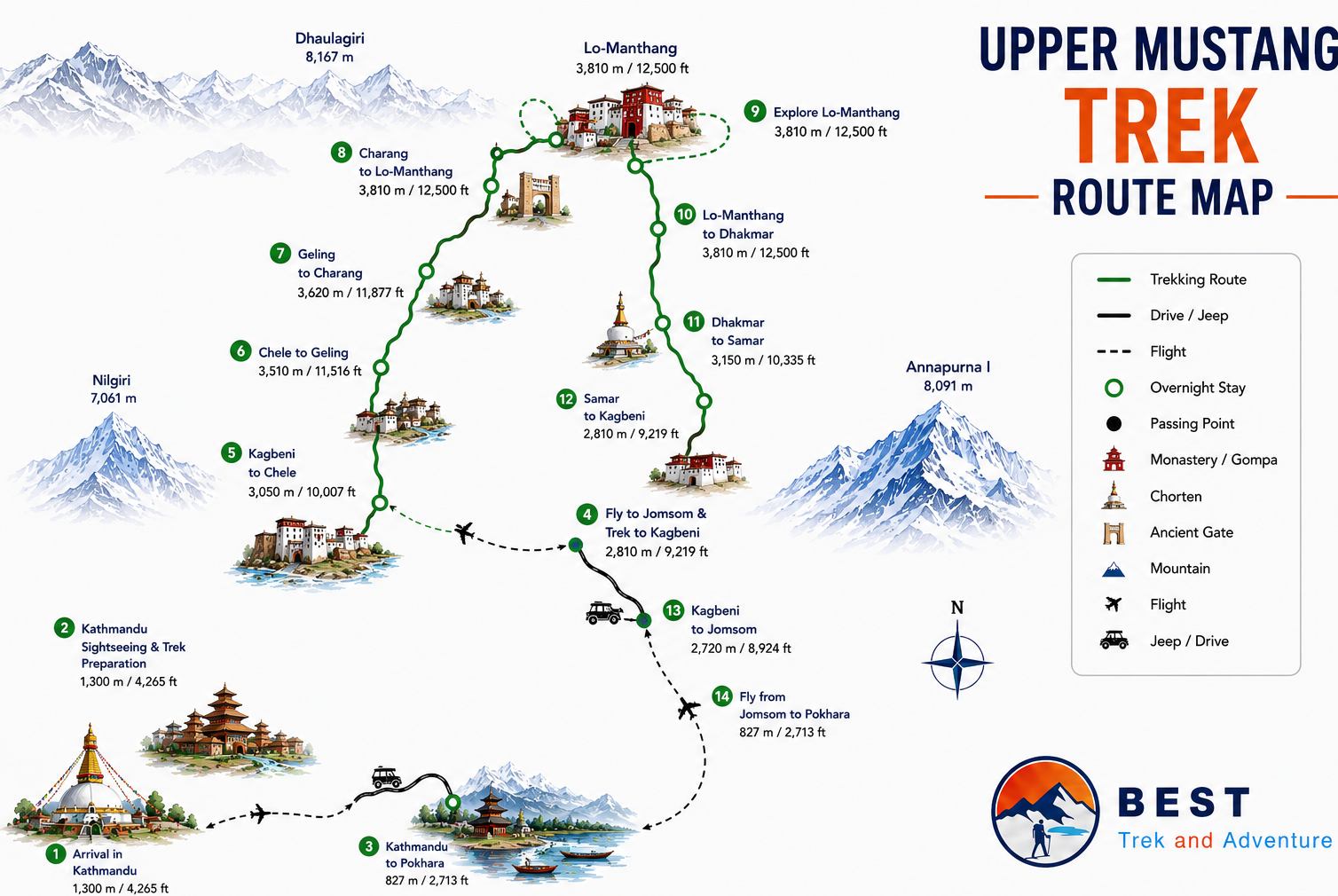
Upper Mustang Trek Altitude Chart
Upper Mustang Trek Gallery/Video
Upper Mustang Trek – Essential Information
Upper Mustang Trek Permits
The Upper Mustang Trek is a restricted-area trek in Nepal, so trekkers need special permits in addition to the regular trekking permits required for the Annapurna region. Foreign trekkers must arrange the required permits through a registered trekking agency, and the trek must be undertaken with an authorized guide.
The main permits associated with the Upper Mustang Trek are:
3. Trekkers’ Information Management System (TIMS) Card
The TIMS Card helps authorities maintain trekking records and improve the safety and management of trekkers in Nepal’s trekking regions. TIMS arrangements should be made through a registered trekking agency where required.
You will generally need your original passport and valid Nepal visa information when completing the permit process.
TIMS requirements and fees can change, so we recommend confirming the current regulations with your trekking agency before departure.
Food During the Upper Mustang Trek
Food during the Upper Mustang Trek combines traditional Nepali, Tibetan, and international dishes. Tea houses and local guesthouses generally serve breakfast, lunch, and dinner, providing filling meals to support you during long trekking days.
Popular meals include dal bhat, noodles, pasta, rice, vegetables, potatoes, soups, eggs, burgers, and Tibetan-style dishes. Traditional Mustang foods such as dhido, buckwheat-based dishes, local breads, and other regional specialties can also be found in some villages.
Local dairy products and regional foods provide an opportunity to experience the traditional cuisine of Mustang. In some settlements, you may also find locally produced beverages and traditional drinks.
Because Upper Mustang is a remote region, the variety of food can become more limited as you travel farther from Jomsom and Pokhara. Meals are generally simple, fresh, and prepared using locally available ingredients.
Accommodation During the Upper Mustang Trek
Accommodation during the trek is mainly provided in local tea houses, guesthouses, and small lodges. These establishments are often family-owned and provide a simple but comfortable place to rest after a day of trekking.
Rooms generally have beds and mattresses, while blankets may be available. Bathroom facilities vary from village to village, with some lodges offering attached bathrooms and others providing shared facilities.
Hot showers may be available in some places for an additional fee, usually using gas-heated water. Because Upper Mustang is remote, accommodation becomes more basic as you travel deeper into the region.
In Jomsom and Kagbeni, accommodation facilities are generally more developed than in the higher and more remote villages.
Accommodation in Kathmandu
Kathmandu offers a wide range of hotels, from comfortable budget properties to luxury accommodations. At the beginning and end of your Upper Mustang Trek, you will stay at your designated hotel in Kathmandu according to your package arrangement.
Our team will assist you with your hotel check-in and can provide recommendations if you wish to explore the city during your free time.
Wi-Fi and Internet Access on the Upper Mustang Trek
Internet connectivity in Upper Mustang can be limited and unreliable because of the region’s remote location and challenging terrain.
Wi-Fi may be available in some larger settlements and tea houses, but connection quality can vary significantly. Mobile network coverage is also inconsistent, particularly in remote sections of the trail.
For this reason, trekkers should not rely on continuous internet access during the trek. It is best to inform family or friends before departure that communication may be limited at certain points along the route.
Altitude Sickness
The Upper Mustang Trek reaches high elevations, with the route in your itinerary reaching Lo-Manthang at approximately 3,810 m / 12,500 ft. If your route crosses Marang La at approximately 4,230 m / 13,878 ft, this should be listed as the maximum trekking altitude.
Altitude sickness can affect anyone traveling to higher elevations, regardless of age or fitness level. Common symptoms can include headache, nausea, dizziness, fatigue, and difficulty sleeping.
The best ways to reduce the risk include gradual ascent, proper acclimatization, adequate hydration, sufficient rest, and avoiding overexertion.
If symptoms become severe or worsen, the safest response is to stop ascending and descend to a lower elevation. Any medication for altitude sickness should be taken only according to appropriate medical advice.
Drinking Water During the Upper Mustang Trek
Staying properly hydrated is essential during the Upper Mustang Trek. Trekkers can purchase bottled or boiled water at tea houses and lodges along the route, although availability and cost can vary in remote villages.
We recommend carrying a reusable water bottle or hydration system and using a reliable water purification method when treating untreated water.
Common purification options include:
- Boiling water
- Water purification tablets
- Portable water filters
- UV purification devices
If using untreated natural water, it should be properly treated before drinking. This helps reduce the risk of waterborne illnesses during the trek.
1. Boiling Water
Boiling is an effective method for making water safer to drink. Water should be brought to a proper boil and treated according to established water-safety guidance, particularly at higher elevations.
2. Water Purification Tablets
Chlorine- or iodine-based purification tablets can be useful when boiling water is not practical. Follow the manufacturer’s instructions carefully regarding dosage and contact time.
3. UV Purification
Portable UV purification devices can be used to treat clear water by exposing microorganisms to ultraviolet light. They are lightweight and convenient for trekking but require batteries or another power source.
4. Filtration Systems
Portable water filters can remove many bacteria and protozoa from water. Depending on the filter, they may not remove all viruses or dissolved contaminants, so check the manufacturer’s specifications and consider combining filtration with another purification method when appropriate.
Communication and Electricity
Electricity and mobile connectivity are available in some settlements along the Upper Mustang route, but services can be limited and unreliable in remote areas.
Larger villages generally have better access to electricity, while smaller settlements may rely on solar power or other backup systems. Charging facilities may also be available at tea houses for an additional fee.
Mobile reception and internet access can vary significantly from one location to another. Trekkers should therefore carry a power bank and avoid relying entirely on mobile connectivity throughout the trek.
Baggage Allowance on the Jomsom Flight
The flight between Pokhara and Jomsom operates with baggage restrictions because of the small aircraft and challenging mountain-airport conditions.
Your package should clearly state the current baggage and hand-luggage allowance provided by the airline, as these limits can change.
If you have excess luggage, you may be able to leave it securely at your hotel in Pokhara and collect it after returning from the trek. We recommend confirming the storage and baggage arrangements with our team before departure.
Travel Insurance for Upper Mustang Trek
Travel insurance is strongly recommended for the Upper Mustang Trek. Your insurance policy should specifically cover high-altitude trekking, emergency medical treatment, and emergency evacuation, including helicopter rescue where applicable.
Before purchasing insurance, check the maximum altitude covered by the policy and confirm that it covers the activities included in your itinerary.
A suitable policy may also provide coverage for trip cancellation, interruption, baggage loss, delays, and other travel-related emergencies, depending on the plan.
Because Upper Mustang is a remote Himalayan region, having appropriate insurance provides important financial protection in case of an unexpected emergency.
Tipping During the Upper Mustang Trek
Tipping is not mandatory, but it is a common way for trekkers to show appreciation for the guides, porters, drivers, and other support staff who contribute to their journey.
The amount you choose to tip depends on the quality of service, trek duration, and your personal preference. Rather than following a strict percentage, it is best to consider the overall service provided and use the recommendations of your trekking agency or group leader.
A simple “Dhanyabad” (thank you) accompanied by a respectful gesture is also a meaningful way to express your appreciation.
Currency Exchange and ATMs
It is important to carry sufficient Nepalese rupees before entering the more remote areas of Upper Mustang. ATMs and banking facilities are limited outside major settlements.
You can exchange major international currencies and withdraw cash in Kathmandu and Pokhara before beginning the trek. Jomsom and some larger settlements may also have limited banking or ATM facilities, but these should not be relied upon.
Once you travel deeper into Upper Mustang, access to ATMs and currency exchange becomes increasingly limited. Therefore, we recommend carrying enough cash to cover meals, drinks, Wi-Fi, charging, hot showers, tips, and personal expenses throughout the trek.
Upper Mustang Trek FAQS
Expand AllIt is not possible to visit the restricted region without a special permit, porter, or guide. For your Upper Mustang trek to be simple, safe, and meaningful, you might require permits, a guide, or services from a tour company. Travel with an experienced, knowledgeable guide if you want to fully explore the area.
Selecting the ideal time to come can be crucial since the local climate and seasons can have a significant impact on your experience.
1)Spring Season (March to May):
The Himalayan peaks covered in snow, verdant pastures, and blossoming flowers make springtime an ideal season for the Upper Mustang Trek. Trekking is ideal at this time of year because of the moderate temperatures and typically dry weather. During the day, the average temperature ranges from 15°C to 20°C, and in the evening, it falls to about 5°C.
2)Summer Season (June to August):
Monsoon rarely occurs in Upper Mustang. Upper Mustang receives no precipitation because it is located in a rain-shadowed location. It is difficult to travel due to the hot, muggy weather.
During this season, the typical daytime temperature is between 20°C and 25°C, while the typical nighttime temperature is approximately 10°C.
3)Autumn Season (September to November):
With sunny skies, pleasant days, and cold nights, autumn is the ideal season to visit the Upper Mustang region.
During the dry season, this is the ideal time of year to explore and go trekking. During the day, the temperature is roughly 20°C, but it can drop as low as 5°C at night. As the busiest time of year in Upper Mustang occurs in the fall, expect larger crowds.
4)Winter Season (December to February):
Upper Mustang experiences severe winter weather, with extremely low temperatures and a lot of snowfall. It can go as low as -20°C during this season, making trekking and exploring the area difficult.
There are no age restrictions for the Upper Mustang Trek. However, it is usually only recommended for people who are physically fit and have some prior trekking experience, given the difficulty of the climb and the high altitude.
The restroom arrangements on the Upper Mustang Trek are somewhat simple. Most teahouses and lodges have shared bathrooms, most of which have squat toilets however others may have Western-style toilets.
The primary route is roughly 100 kilometers long, however as previously indicated, it can be modified if desired. Every day at approximately 8.30 a.m., the walk begins after breakfast. Along the way, there are numerous opportunities to pause, take in the scenery, take pictures, or enjoy a cup of tea.
The hike is beautiful because we don’t reach any specific altitude, but the pace is leisurely and the schedule allows for great acclimatization. Trekking often lasts six or seven hours a day, ending in the middle of the afternoon.
The price of trekking in Upper Mustang can vary significantly based on several variables, including the length of the walk, the type of lodging you select, and your mode of transportation. A 10-day hike in Upper Mustang can set you back anything from $1,500 and $3,000 per person on average.
Traveler Reviews
Explore authentic feedback from our past adventurers with Best Treks and Adventure, sourced from TripAdvisor, Google, Facebook, and Trustpilot.

Ran Royan (Switzerland )
An excellent Annapurna Circuit Trek
We had perfect trip to Annapurna Circuit Trek include Tilicho Lake. Me and my 7 friends did this 15 days trip include Kathmandu and Pokhara Tour.
We had confirmed this trip almost 6 months before. They were responsive. They answer all our emails within 2 hours. When we had mate with their team also really helpful, experienced and kind. Even for hiking 🥾 to Annapurna Circuit we didn’t expect that kind of foods, services and teahouses but they had provided us great services. If you are planning any trip to Nepal. Feel free to contact this company and book this trip for your great trip. Highly recommend this agency Best Trek and Adventure for your any kind of trip. Dhanyabad. Namaste.
Ryan Roger (France)
Annapurna Circuit Trek
We had great time for Annapurna Circuit Trek with Best Trek and Adventure. Our guide Dinesh was an excellent . We also did Kathmandu and Pokhara tour.
Team member of this agency are really on time and responsive. They reply our all questions with in couple of hour. Highly recommend this agency and team for your any kind of trip. Thank you!
Ryan Roger (France)
Annapurna Circuit Trek
We had great time for Annapurna Circuit Trek with Best Trek and Adventure. Our guide Dinesh was an excellent . We also did Kathmandu and Pokhara tour.
Team member of this agency are really on time and responsive. They reply our all questions with in couple of hour. Highly recommend this agency and team for your any kind of trip. Thank you!
Nill Armastrang (nillarmastrang@gmail.com)
Everest Base Camp Trek with Best Trek
It was great trip to Everest Base Camp Trek with Best Trek and Adventure. Then provided best services with best guide and perter. They were so punctual, kind and on time. Highly recommend this agency for your Everest Base Camp Trek and any other trip to Nepal.
Gann Roger (United State)
Brilliant trip Everest Base Camp
It was brilliant trip to Everest Base Camp with Best Trek and Adventure. Our guide Padam was an excellent. Very friendly and helpful. Our trip to Everest Base Camp was success because of Best Trek and Adventure and our guide Padam. Also porter Raju was nice and very strong man. They have provided all services in time. Also Kathmandu UNESCO Tour with Prakash was an excellent. He is the best guide in Kathmandu. We can’t recommend other agency for your trip to Nepal except Best Trek and Adventure.
Add a Review
Why choose Us
- An Excellent reviews and High Star Rating.
- Organized and Customizable Itinerary.
- Affordable Price.
- Focus for Eco-Friendly Tourism
- Well-Qualified Guides and Workers.