Nepal Travel Guide for Americans 2026–2027 | Cost, Visa, Treks & Tours
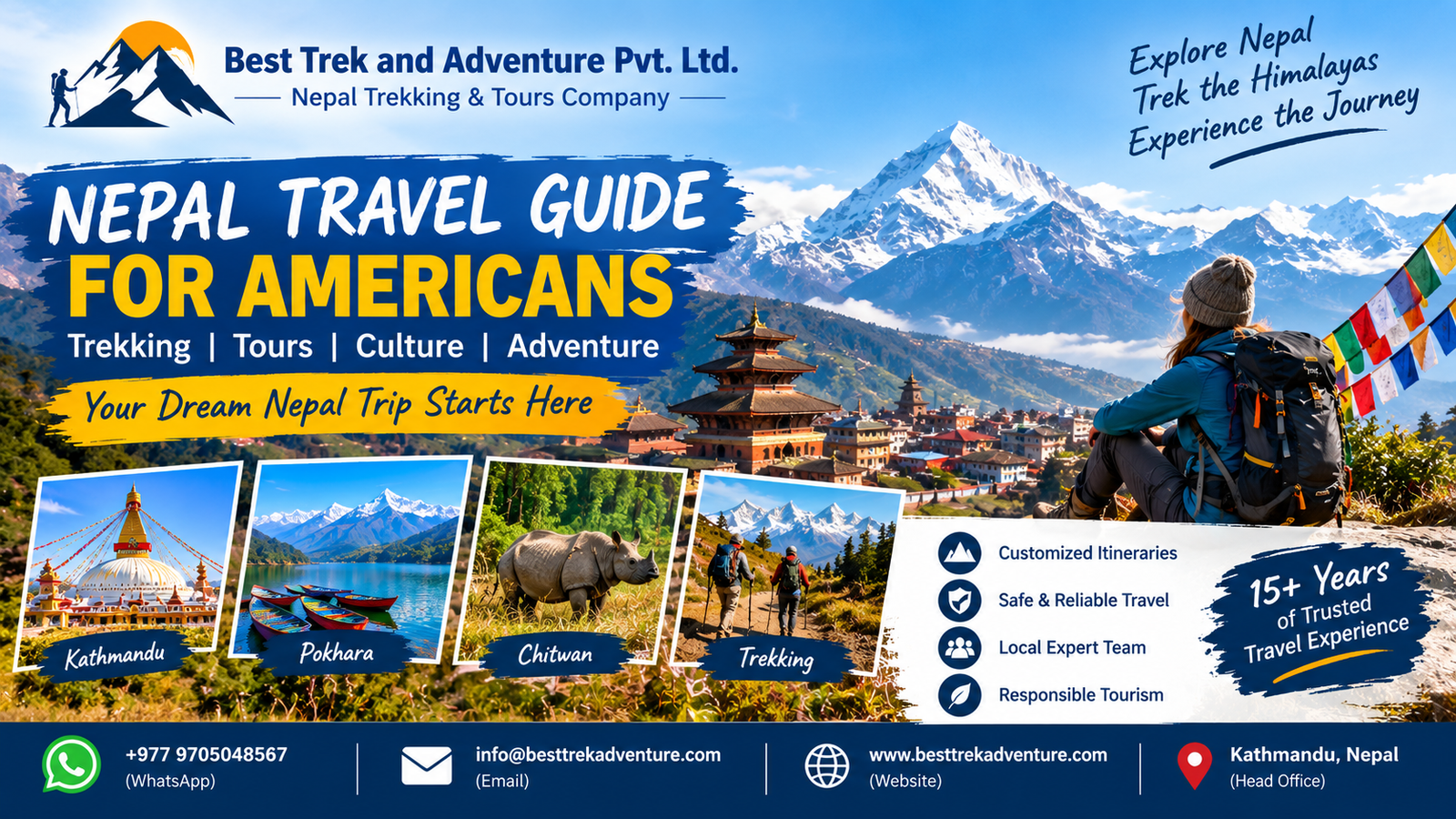
Nepal Travel Guide for Americans
Planning a trip to Nepal from the United States? Nepal is one of the world’s most rewarding destinations for travelers who want a combination of Himalayan adventure, ancient culture, spectacular mountain scenery, wildlife, spirituality, and authentic local experiences.
From the historic streets and temples of Kathmandu to the snow-covered peaks of the Everest and Annapurna regions, Nepal offers an extraordinary range of experiences within a relatively small country. American travelers can enjoy cultural tours, luxury holidays, family vacations, wildlife safaris, adventure activities, and world-famous Himalayan trekking.
If you are searching for a Nepal travel guide for Americans, planning a Nepal trip from the USA, or wondering about the best places to visit in Nepal, Nepal travel costs, visas, trekking, itineraries, and the best time to visit, this guide will help you plan your journey.
Best Trek and Adventure Pvt. Ltd. is a Kathmandu-based Nepal trekking and tour company helping international travelers discover Nepal through carefully organized trekking, tours, cultural experiences, adventure activities, and customized holidays.
Why Should Americans Visit Nepal?
Nepal is much more than a destination for mountain climbers. Although Mount Everest is undoubtedly one of its biggest attractions, travelers can experience an incredible variety of landscapes, cultures, religions, communities, and activities during a single visit.
For American travelers, Nepal can be particularly appealing because it offers opportunities to combine several types of travel.
You can spend a few days exploring UNESCO World Heritage Sites in Kathmandu, travel to Pokhara for Himalayan views and outdoor activities, visit Chitwan National Park for a jungle safari, and then continue to a Himalayan trekking destination.
Nepal also provides opportunities to experience traditional villages, Buddhist monasteries, Hindu temples, local markets, mountain communities, scenic viewpoints, and diverse cuisine.
The country’s geography creates remarkable variety. The Himalayas dominate the north, the middle hills contain valleys, forests and traditional settlements, while the southern Terai provides a warmer landscape with national parks and wildlife.
The Nepal Tourism Board describes Everest, Annapurna and Langtang among the country’s major trekking regions, while Nepal’s attractions also include cultural destinations, wildlife areas and adventure activities.
For a first-time visitor from the United States, this means you do not have to choose between culture and adventure. You can experience both.
Traveling to Nepal from the USA
One of the first questions American travelers ask is how to get to Nepal.
The main international gateway is Tribhuvan International Airport in Kathmandu.
There are generally no nonstop commercial flights from major U.S.A. cities to Kathmandu, so travelers normally connect through another international airport in Asia or the Middle East.
Depending on your departure city, common routing possibilities may involve connections in cities such as Doha, Dubai, Istanbul, Delhi, Bangkok, Singapore or other major international aviation hubs.
Your exact route will depend on your departure airport, airline, travel dates, budget and preferred connection time.
Major U.S. departure cities
American travelers commonly begin their journey from major international airports such as:
- New York
- Washington, D.C.
- Boston
- Chicago
- Los Angeles
- San Francisco
- Dallas
- Houston
- Seattle
- Atlanta
Because international flight schedules change, travelers should compare current airline schedules before booking.
For most Americans, it is worth considering the total journey time rather than simply choosing the lowest airfare. A slightly more convenient connection can make a long journey to Nepal considerably easier.
How Long Should Americans Spend in Nepal?
The ideal length of a Nepal trip depends on what you want to experience.
A short vacation can cover Kathmandu and Pokhara, while a longer trip can combine cities, wildlife and trekking.
7 Days in Nepal
A one-week trip can include:
Kathmandu
Pokhara
Cultural sightseeing
Himalayan views
Short hikes
Adventure activities
10 Days in Nepal
Ten days provides enough time for a more balanced experience.
A possible itinerary includes:
Kathmandu – Pokhara – Chitwan – Kathmandu
This allows travelers to experience culture, mountains and wildlife.
14 Days in Nepal
Two weeks is an excellent amount of time for a first Nepal vacation.
You could combine:
Kathmandu
Bhaktapur
Pokhara
Chitwan
Nagarkot
A short Himalayan trek
Or dedicate most of the trip to a major trek such as the Everest Base Camp Trek.
18–21 Days in Nepal
Three weeks gives you much greater flexibility.
You could combine a major trek with cultural sightseeing and a wildlife experience.
For example:
Kathmandu – Everest Base Camp Trek – Pokhara – Chitwan – Kathmandu
Alternatively:
Kathmandu – Annapurna Circuit Trek – Pokhara – Chitwan
The longer your trip, the more opportunities you have to experience Nepal beyond the most famous tourist attractions.
Nepal Visa for American Citizens
American citizens traveling to Nepal for tourism need a valid passport and tourist visa.
Nepal’s Department of Immigration currently provides Visa on Arrival at Tribhuvan International Airport for eligible tourists. Tourist visa options currently include 15-day, 30-day and 90-day visas, with listed fees of US$30, US$50 and US$125, respectively.
Travelers can also complete the required online visa application process before arrival.
The Department of Immigration advises that passports should have at least six months of validity before travel.
Practical visa advice for Americans
Before traveling:
Check your passport expiration date.
Complete the online application if appropriate.
Keep a copy of your application or submission information.
Carry your passport.
Have payment available for the visa fee.
Check the latest Nepal immigration requirements before departure.
Immigration rules and procedures can change, so always confirm current requirements through Nepal’s official Department of Immigration before your trip.
How Much Does a Nepal Trip Cost from the USA?
The cost of a Nepal vacation depends heavily on the type of trip you choose.
There is no single price for a Nepal vacation because a backpacking trip, luxury tour and Everest Base Camp trek have very different costs.
Your overall budget may include:
- International airfare
- Nepal visa
- Hotels
- Domestic flights
- Private transportation
- Trekking permits and fees
- Guide
- Porter
- Meals
- Entrance fees
- Travel insurance
- Equipment
- Tips
- Adventure activities
Budget Travel
Budget-conscious travelers can choose simple accommodation, local restaurants and public transportation.
Mid-Range Travel
Many American visitors prefer comfortable hotels, private transportation and organized sightseeing while maintaining reasonable costs.
Luxury Travel
Luxury travelers can choose premium hotels, private vehicles, helicopter experiences, upgraded accommodations and personalized itineraries.
Trekking Costs
A trekking budget depends on:
- Trek duration
- Trekking region
- Guide and porter services
- Accommodation
- Transportation
- Permits and fees
- Domestic flights
- Equipment
- Meals
- Personal expenses
A reputable local trekking company can provide a detailed quotation based on your preferred itinerary.
Best Time to Visit Nepal from the USA
Nepal can be visited throughout the year, but the ideal season depends on your destination and activities.
For traditional Himalayan trekking, spring and autumn are generally the most popular periods.
The Nepal Tourism Board identifies September to November and February to May as favorable trekking periods, while its climate information highlights spring and autumn as particularly suitable for many trekking areas.
Spring: March to May
Spring is an excellent season for trekking and mountain travel.
The weather generally becomes warmer, and rhododendrons bloom across many hill regions.
Spring is particularly attractive for travelers who want:
- Trekking
- Mountain views
- Photography
- Nature
- Himalayan landscapes
Summer and Monsoon: June to August
Nepal’s monsoon season brings significant rainfall to many parts of the country.
However, this does not mean Nepal is closed to travelers.
Certain areas, particularly rain-shadow regions such as parts of Mustang, can offer different travel opportunities during the monsoon.
Autumn: September to November
Autumn is one of the most popular periods for visiting Nepal.
After the monsoon, many mountain areas can have clear skies and excellent visibility.
October and November are especially popular for trekking.
Winter: December to February
Winter can be excellent for lower-altitude cultural tours and selected trekking routes.
Higher elevations can be very cold, so travelers planning high-altitude treks should prepare appropriately.
Nepal Tourism Board climate information notes that Nepal can be visited throughout the year, although spring and autumn are generally preferred for many trekking destinations.
Best Places to Visit in Nepal for American Travelers
Nepal offers far more than Mount Everest.
Here are some of the most worthwhile destinations to include in your itinerary.
1. Kathmandu
Kathmandu is the natural starting point for most international visitors.
The Kathmandu Valley contains remarkable cultural and religious sites, traditional neighborhoods, temples, stupas and historic squares. We have best coverage day tour in Kathmandu.
Important attractions include:
Swayambhunath Stupa
Boudhanath Stupa
Pashupatinath Temple
Kathmandu Durbar Square
Patan Durbar Square
Bhaktapur Durbar Square
Kathmandu is also an excellent place to experience Nepalese food, shopping, art and local life.
2. Pokhara
Pokhara is one of Nepal’s most popular tourist destinations.
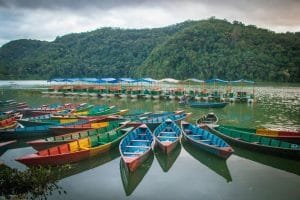
The city is famous for its lakes, mountain views, relaxed atmosphere and adventure opportunities.
Popular activities include:
- Boating on Phewa Lake
- Sunrise viewing
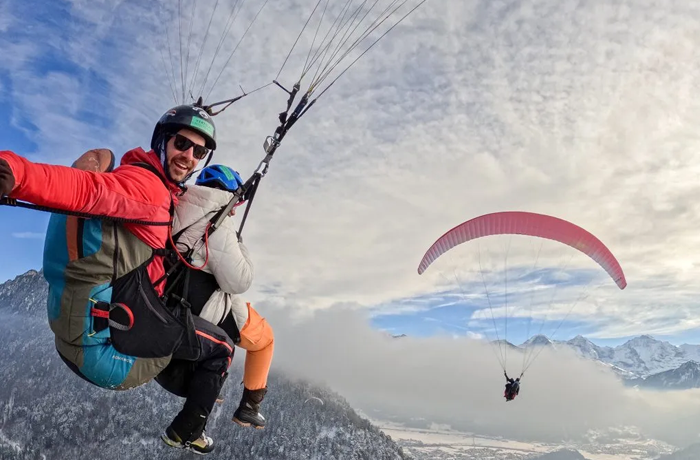
- Paragliding
- Hiking
- Mountain biking
- Ziplining
- Photography
- Visiting caves and waterfalls
Pokhara is also the gateway to many Annapurna-region treks.
3. Chitwan National Park
For American travelers who enjoy wildlife, Chitwan can be a wonderful addition to a Nepal itinerary.
The region offers opportunities for jungle experiences and wildlife observation.
Depending on the season and local conditions, visitors may encounter animals such as rhinoceros, deer, crocodiles and numerous bird species.
A Chitwan visit provides a dramatic contrast to the Himalayas.
4. Nagarkot
Nagarkot is a popular hill destination near Kathmandu.
It is particularly known for Himalayan sunrise and sunset views when weather conditions are favorable.
A night in Nagarkot can be added easily to many Kathmandu itineraries.
5. Bandipur
Bandipur is a charming hill settlement with traditional architecture, mountain scenery and a quieter atmosphere.
It is an attractive destination for travelers who want to experience a more relaxed side of Nepal.
6. Lumbini
Lumbini is an important Buddhist pilgrimage destination and is traditionally recognized as the birthplace of Siddhartha Gautama, the Buddha.
Visitors interested in Buddhism, spirituality, history and architecture can include Lumbini in a longer Nepal itinerary.
Best Treks in Nepal for American Travelers
Trekking is one of Nepal’s defining travel experiences.
The Nepal Tourism Board notes that approximately one in four visitors to Nepal goes trekking and identifies Everest, Annapurna and Langtang among the country’s traditional major trekking regions.
The right trek depends on your fitness, available time, altitude experience and travel preferences.
Everest Base Camp Trek
The Everest Base Camp Trek is perhaps the most iconic Himalayan journey in Nepal.
It takes travelers through the Khumbu region and traditional Sherpa settlements toward the base of Mount Everest.
Highlights include:
- Lukla
- Namche Bazaar
- Tengboche
- Dingboche
- Everest Base Camp
- Kala Patthar
- Sagarmatha National Park
The Nepal Tourism Board describes the Everest region as a destination combining dramatic Himalayan scenery, Sherpa culture, Buddhist traditions and trekking experiences.
This trek is physically demanding and reaches high altitude, so proper acclimatization and preparation are important.
Annapurna Circuit Trek
The Annapurna Circuit Trek is another classic Himalayan journey.
The landscape changes dramatically along the route, from green valleys and villages to high mountain terrain and the dry landscapes of the trans-Himalayan region.
The Annapurna region offers routes ranging from short treks to longer journeys around the massif.
It is a particularly interesting option for travelers who want variety.
Annapurna Base Camp Trek
The Annapurna Base Camp Trek offers an impressive Himalayan experience in a relatively compact itinerary.
Travelers walk through villages, forests and mountain landscapes toward the Annapurna Sanctuary.
It is an excellent option for people who want a Himalayan trekking experience without committing to a very long expedition.
Mardi Himal Trek
For travelers looking for a shorter Himalayan adventure, the Mardi Himal Trek is worth considering.
The route offers spectacular mountain scenery and passes through forests, villages and high-altitude landscapes.
It can be a good option for travelers who have limited vacation time but still want to experience trekking in the Himalayas.
Langtang Valley Trek
The Langtang Valley Trek offers mountain scenery, cultural experiences and Himalayan landscapes relatively close to Kathmandu.
It is suitable for travelers looking for an alternative to Everest and Annapurna.
Manaslu Circuit Trek
For more experienced trekkers seeking a longer and more remote Himalayan journey, the Manaslu Circuit Trek is an exciting option.
The trail combines mountain scenery, traditional villages and high-altitude terrain.
Because trekking regulations and permit requirements vary by region, travelers should work with a properly registered trekking company and confirm current requirements before departure.
Upper Mustang Trek
Upper Mustang offers a very different Himalayan landscape.
Instead of the lush forests found on many lower trails, travelers encounter dry valleys, dramatic cliffs, caves, traditional villages and Tibetan-influenced culture.
It can be particularly attractive to photographers and travelers interested in history and remote landscapes.
Do You Need to Be Extremely Fit to Trek in Nepal?
Not every Nepal trek requires the fitness level of an elite athlete.
However, trekking should not be underestimated.
Even relatively moderate routes involve:
- Long walking days
- Uneven trails
- Stairs
- Ascents and descents
- Changing weather
- High altitude on some routes
For high-altitude treks, acclimatization is especially important.
Travelers should discuss their personal fitness and health considerations with an appropriate medical professional before undertaking strenuous or high-altitude travel.
The best trek is the one that matches your available time, experience and physical preparation.
Altitude and Acclimatization
Altitude is one of the most important issues for American travelers planning a Himalayan trek.
Someone who exercises regularly at sea level can still experience altitude-related problems.
That is why trekking itineraries should be designed with appropriate acclimatization.
Good trekking practices include:
- Ascending gradually
- Allowing acclimatization days
- Staying properly hydrated
- Walking at a sustainable pace
- Listening to your guide
- Informing your guide if you feel unwell
- Understanding symptoms of altitude sickness
Do not ignore serious symptoms.
If you become seriously ill at altitude, descending can be an important part of emergency management.
A professional trekking company should have a clear emergency procedure and should explain the itinerary and altitude profile before departure.
What Is Nepal Food Like for Americans?
Nepalese food is diverse and often less familiar to first-time American visitors.
Popular dishes include:
Dal Bhat
Rice, lentil soup, vegetables and accompanying dishes form one of Nepal’s most important everyday meals.
Momos
Momos are steamed or fried dumplings that are extremely popular throughout Nepal.
They can be filled with vegetables, chicken, buff or other ingredients.
Thukpa
A warm noodle soup that can be especially enjoyable in mountain areas.
Newari Cuisine
The Kathmandu Valley is famous for traditional Newari dishes.
Tibetan-Inspired Foods
Mountain regions offer foods influenced by Himalayan and Tibetan culinary traditions.
American travelers who enjoy trying local cuisine will find plenty of opportunities to explore.
Where Should Americans Stay in Nepal?
Accommodation ranges from international-standard hotels to simple mountain teahouses.
Hotels in Kathmandu and Pokhara
Travelers can choose from:
- Budget hotels
- Boutique hotels
- Luxury properties
- Heritage accommodations
- International-standard hotels
Teahouses During Trekking
On many established trekking routes, teahouses provide basic accommodation and meals.
Facilities vary according to location and altitude.
Travelers should understand that accommodation becomes more basic as they travel into remote and high-altitude regions.
This is part of the trekking experience.
What Should Americans Pack for Nepal?
Your packing list depends on the season and itinerary.
For a general Nepal tour, consider:
- Comfortable walking shoes
- Lightweight clothing
- Warm layer
- Rain jacket
- Sun protection
- Sunglasses
- Sunscreen
- Reusable water bottle
- Personal medications
- Small daypack
- Universal travel adapter
- Power bank
- Passport copies
- Travel insurance documents
For trekking, you may additionally need:
- Trekking boots
- Thermal layers
- Fleece
- Down jacket
- Trekking trousers
- Warm hat
- Gloves
- Headlamp
- Trekking poles
- Sleeping bag
- Water purification method
- High-SPF sunscreen
- Lip balm
- Personal first-aid supplies
Your trekking company can provide a detailed equipment checklist before departure.
Travel Insurance for Nepal
Travel insurance is strongly recommended for international travelers visiting Nepal.
This becomes particularly important for trekking and adventure travel.
Depending on your itinerary, consider coverage for:
- Medical treatment
- Emergency evacuation
- Trip cancellation
- Lost baggage
- Delays
- Trekking activities
- High-altitude trekking
Do not assume that a standard travel policy automatically covers high-altitude trekking or helicopter evacuation.
Read the policy carefully and confirm that your planned activities and maximum trekking altitude are covered.
The current U.S. State Department advisory for Nepal recommends travelers consider insurance that includes medical evacuation, noting that medical facilities can be limited in some circumstances.
Is Nepal Safe for American Travelers?
Nepal is visited by travelers from around the world every year, but international visitors should take normal travel precautions and stay informed about current conditions.
The U.S. Department of State currently lists Nepal at Level 2: Exercise Increased Caution, with the current advisory citing natural-disaster risks. The advisory issued September 4, 2026, specifically identifies the Rasuwagadhi–Timure–Syafrubesi area in Rasuwa District as an area where travelers should not go because of flood damage, disrupted transportation and communications, recovery operations and potential additional flooding and landslides.
This information can change.
American travelers should check the latest U.S. State Department advisory and official Nepalese information before departure.
During the trip:
- Keep copies of important documents.
- Monitor weather conditions.
- Follow local instructions.
- Use registered trekking and tour operators.
- Be cautious during demonstrations or large gatherings.
- Respect local customs.
- Have appropriate travel insurance.
- Follow your guide’s advice during trekking.
Nepal Culture and Etiquette for American Travelers
One of the most rewarding parts of visiting Nepal is interacting with local communities.
A few simple cultural practices can make your experience more respectful.
Dress Respectfully
Modest clothing is recommended, particularly when visiting temples, monasteries and rural communities.
Remove Shoes When Required
Some religious and cultural sites require visitors to remove their shoes.
Ask Before Photographing People
A friendly request before taking someone’s portrait is always appreciated.
Respect Religious Sites
Do not touch religious objects unless permitted.
Use Your Right Hand When Appropriate
The right hand is traditionally used for giving and receiving in many Nepalese cultural contexts.
Learn a Few Nepali Words
Simple expressions such as Namaste can be warmly appreciated.
Money and Payments in Nepal
The local currency is the Nepalese Rupee (NPR).
Cards are accepted at many hotels, restaurants and established businesses in cities, but cash remains useful, especially in rural areas and during trekking.
American travelers should carry some Nepalese currency for:
- Small restaurants
- Local transportation
- Shops
- Tips
- Rural accommodation
- Trekking expenses
ATMs are available in major cities and tourist centers, but access becomes less reliable in remote mountain areas.
It is therefore wise to prepare enough cash before beginning a remote trek.
Tipping in Nepal
Tipping is common in Nepal’s tourism and hospitality sector, although practices differ depending on the service.
Travelers may tip:
- Guides
- Porters
- Drivers
- Hotel staff
- Restaurant staff
For trekking groups, many travelers choose to provide a tip to guides and porters at the end of the trek based on service, group arrangements and personal satisfaction.
Your travel company can explain customary tipping practices before your trip.
Nepal Travel Itinerary Ideas for Americans
Here are some sample concepts that can be customized.
7-Day Nepal Highlights
Day 1: Arrive Kathmandu
Day 2: Kathmandu sightseeing
Day 3: Kathmandu – Pokhara
Day 4: Pokhara sightseeing and Himalayan views
Day 5: Pokhara activities
Day 6: Return to Kathmandu
Day 7: Departure
10-Day Nepal Culture, Mountains and Wildlife
Day 1: Arrival Kathmandu
Day 2: Kathmandu sightseeing
Day 3: Kathmandu – Pokhara
Day 4: Pokhara exploration
Day 5: Pokhara – Chitwan
Day 6: Chitwan jungle activities
Day 7: Chitwan – Kathmandu
Day 8: Kathmandu Valley
Day 9: Nagarkot
Day 10: Departure
14-Day Nepal Adventure Itinerary
A two-week itinerary can be designed around your interests.
For example:
Days 1–3: Kathmandu Valley
Days 4–5: Pokhara
Days 6–11: Short Himalayan trek
Day 12: Return to Pokhara
Day 13: Kathmandu
Day 14: Departure
For trekkers, the same vacation period could instead be structured around an Everest or Annapurna trek.
14-Day Everest Base Camp Concept
Travelers with approximately two weeks can dedicate much of their Nepal holiday to the Everest region.
A typical program may include:
- Kathmandu arrival and preparation
- Flight toward the Everest region
- Trek through Sherpa villages
- Acclimatization in Namche Bazaar
- Trek toward Everest Base Camp
- Kala Patthar or another viewpoint
- Return trek
- Kathmandu sightseeing
- International departure
Exact trekking days and transportation arrangements can change because Himalayan weather and operational conditions can affect mountain flights.
A responsible itinerary should always include appropriate flexibility.
Why Book with a Local Nepal Trekking Company?
For American travelers, working with a local Nepal-based travel company can simplify many aspects of the journey.
A local company can assist with:
- Airport arrival
- Hotels
- Transportation
- Domestic flights
- Trekking permits
- Guides
- Porters
- Trekking equipment
- Sightseeing
- Emergency coordination
- Itinerary adjustments
- Cultural experiences
Most importantly, a local team understands the realities of travel in Nepal.
Mountain weather, road conditions, domestic flights, trekking routes and local festivals can affect an itinerary.
Having experienced local support can make it easier to adapt when plans change.
Why Choose Best Trek and Adventure Pvt. Ltd.?
Best Trek and Adventure Pvt. Ltd. is a Nepal-based trekking and tour company located in Kathmandu.
Our goal is to help international travelers experience Nepal through professionally arranged trekking, tours, cultural journeys and adventure experiences.
We organize a wide range of Nepal travel experiences, including:
- Everest Base Camp Trek
- Annapurna Circuit Trek
- Annapurna Base Camp Trek
- Manaslu Circuit Trek
- Mardi Himal Trek
- Upper Mustang Trek
- Kathmandu sightseeing
- Pokhara tours
- Chitwan National Park tours
- Nagarkot trips
- Bhaktapur tours
- Bandipur tours
- Lumbini tours
- Mountain flights
- Helicopter tours
- Jungle safaris
- Rafting
- Paragliding
- Mountain biking
- Customized Nepal holidays
Rather than forcing every traveler into the same itinerary, we can help design a trip according to your available time, interests and preferred travel style.
Whether you are a solo traveler, couple, family, group of friends or private tour group, your Nepal experience can be customized.
Customized Nepal Trips for American Travelers
American travelers have different expectations and vacation schedules.
Some may have only one week available.
Others may have several weeks and want to combine trekking with cultural sightseeing.
A customized Nepal trip can be designed around your priorities.
Adventure Travelers
Combine trekking, rafting, mountain flights, paragliding and other outdoor activities.
Culture Travelers
Focus on Kathmandu Valley, Buddhist and Hindu heritage, historic towns and traditional communities.
Family Travelers
Combine comfortable hotels, manageable sightseeing, wildlife experiences and shorter hikes.
Luxury Travelers
Include premium hotels, private transportation, customized sightseeing and helicopter experiences.
Photographers
Build an itinerary around Himalayan viewpoints, traditional villages, wildlife and cultural locations.
Spiritual Travelers
Explore Buddhist monasteries, pilgrimage destinations, meditation centers and important Hindu sites.
Responsible Travel in Nepal
Tourism can create important opportunities for local communities, but travelers also have a responsibility to protect the places they visit.
When trekking:
- Avoid unnecessary plastic waste.
- Carry reusable water bottles.
- Follow local waste-management practices.
- Respect wildlife.
- Stay on designated trails where required.
- Avoid damaging plants.
- Respect local traditions.
- Support local businesses.
- Treat guides and porters fairly.
- Avoid purchasing illegal wildlife products.
Responsible travel helps preserve Nepal’s natural and cultural heritage for future generations.
What Makes a Nepal Trip Special for Americans?
For many American visitors, Nepal’s greatest attraction is not one particular mountain or temple.
It is the combination of experiences.
You can wake up in Kathmandu surrounded by centuries-old architecture, fly toward the Himalayas, walk through a Sherpa village, watch the sunset over snow-covered peaks, return to Pokhara for lakeside relaxation, and finish your vacation watching wildlife in the Terai.
That variety makes Nepal unusually rewarding.
The country is compact compared with many large travel destinations, but the experiences are remarkably diverse.
Frequently Asked Questions About Traveling to Nepal from the USA
Is Nepal worth visiting for American travelers?
Nepal offers a combination of Himalayan scenery, trekking, cultural heritage, wildlife, adventure activities and traditional communities. It can therefore suit many different travel styles.
How many days should Americans spend in Nepal?
For a first visit, 10–14 days provides enough time to combine several major destinations. Trekkers may prefer two or three weeks depending on their chosen route.
Do U.S. citizens need a visa for Nepal?
Yes. U.S. citizens traveling for tourism need a Nepal tourist visa. Nepal currently provides tourist Visa on Arrival for eligible travelers at Tribhuvan International Airport, with 15-, 30- and 90-day options.
What is the best month to visit Nepal?
October and November are among the most popular months for trekking, while spring is also a favorable trekking period. Conditions vary according to altitude and region.
Is Everest Base Camp suitable for beginners?
People with no previous high-altitude trekking experience can undertake Everest Base Camp with appropriate preparation, acclimatization and professional support, but it is still a demanding high-altitude trek.
Is Nepal expensive for American travelers?
Nepal can accommodate different budgets. The total cost depends on accommodation, transportation, trekking, activities and travel style.
Can I combine Everest with Pokhara and Chitwan?
Yes, although the itinerary needs to be designed around the duration of the Everest trek and transportation schedule.
What currency does Nepal use?
Nepal uses the Nepalese Rupee (NPR).
Can I use U.S. dollars in Nepal?
U.S. dollars are useful for certain tourism payments, but travelers should carry Nepalese rupees for everyday purchases and many local expenses.
Do I need travel insurance?
Travel insurance is strongly recommended, particularly for trekking and adventure travel. Check whether your policy covers high-altitude trekking and emergency evacuation.
Do I need a guide for trekking?
Trekking requirements vary according to the route and current regulations. Travelers should check current rules and use appropriately registered trekking professionals where required.
Can Best Trek and Adventure create a private itinerary?
Yes. Private and customized Nepal trips can be designed around your preferred destinations, travel dates, activities, accommodation level and available time.
Final Thoughts: Plan Your Nepal Adventure from the USA
Planning your first journey from the United States to Nepal can initially seem complicated.
There are flights to arrange, visa requirements to check, destinations to choose, accommodation to book and, if you are trekking, altitude and equipment to consider.
But once the basic planning is complete, Nepal becomes an extraordinary destination to explore.
Whether your dream is to stand beneath Mount Everest, walk through the Annapurna Himalayas, explore ancient Kathmandu, relax beside Phewa Lake in Pokhara, experience a Chitwan jungle safari, discover Buddhist and Hindu heritage, or combine all of these experiences in one vacation, Nepal offers countless possibilities.
For American travelers, the most important step is choosing an itinerary that fits your time, interests, budget and level of adventure.
At Best Trek and Adventure Pvt. Ltd., we help travelers from around the world discover Nepal through carefully planned trekking, tours and customized travel experiences.
From your arrival in Kathmandu to your final departure, our local team can assist with the practical details while helping you experience the landscapes, cultures and communities that make Nepal unforgettable.
Ready to Plan Your Nepal Trip from the USA?
Best Trek and Adventure Pvt. Ltd.
Nepal Trekking & Tours Company – Kathmandu, Nepal
🌐 Website: www.besttrekadventure.com
📧 Email: info@besttrekadventure.com
📱 WhatsApp: +977 9705048567
Explore Nepal. Trek the Himalayas. Experience the Journey.
Contact Best Trek and Adventure Pvt. Ltd. to discuss your preferred travel dates, destinations and activities, and let our local team help create your personalized Nepal adventure.
Make an Inquiry



 July 23, 2026
Annapurna Circuit Trek with Tilicho Lake and Ice Lake
The Annapurna Circuit Trek with Tilicho Lake and Ice Lake combines the classic Annapurna Circuit with the scenic Tilicho Lake...
 December 18, 2024
Annapurna Base Camp Trek – 12 Days
Trek to Annapurna Base Camp for breathtaking mountain views, rich culture, lush forests, and an unforgettable journey to the heart...
 December 18, 2024
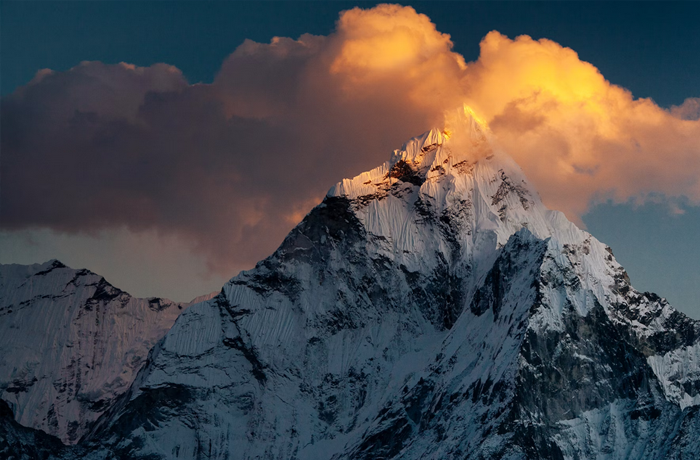
Everest Base Camp Trek 15 Days
Trek to Everest Base Camp for stunning Himalayan views, cultural immersion and a life-changing adventure to the heart of the...
 January 8, 2025
Kathmandu, Pokhara, and Chitwan Tour
Nepal is a top tourist destination that is rich in art, architecture, natural landscape, and cultural diversity.


