7 UNESCO World Heritage Sites in Kathmandu Valley: Complete Guide
7 UNESCO World Heritage Sites in Kathmandu
If you are planning a trip to Nepal and wondering what to see in Kathmandu, the answer begins with the extraordinary cultural heritage of the Kathmandu Valley. Within a relatively compact area, travelers can discover ancient temples, Buddhist stupas, royal palace squares, traditional Newari architecture, historic courtyards, sacred rivers, monasteries, sculptures, and living religious traditions.
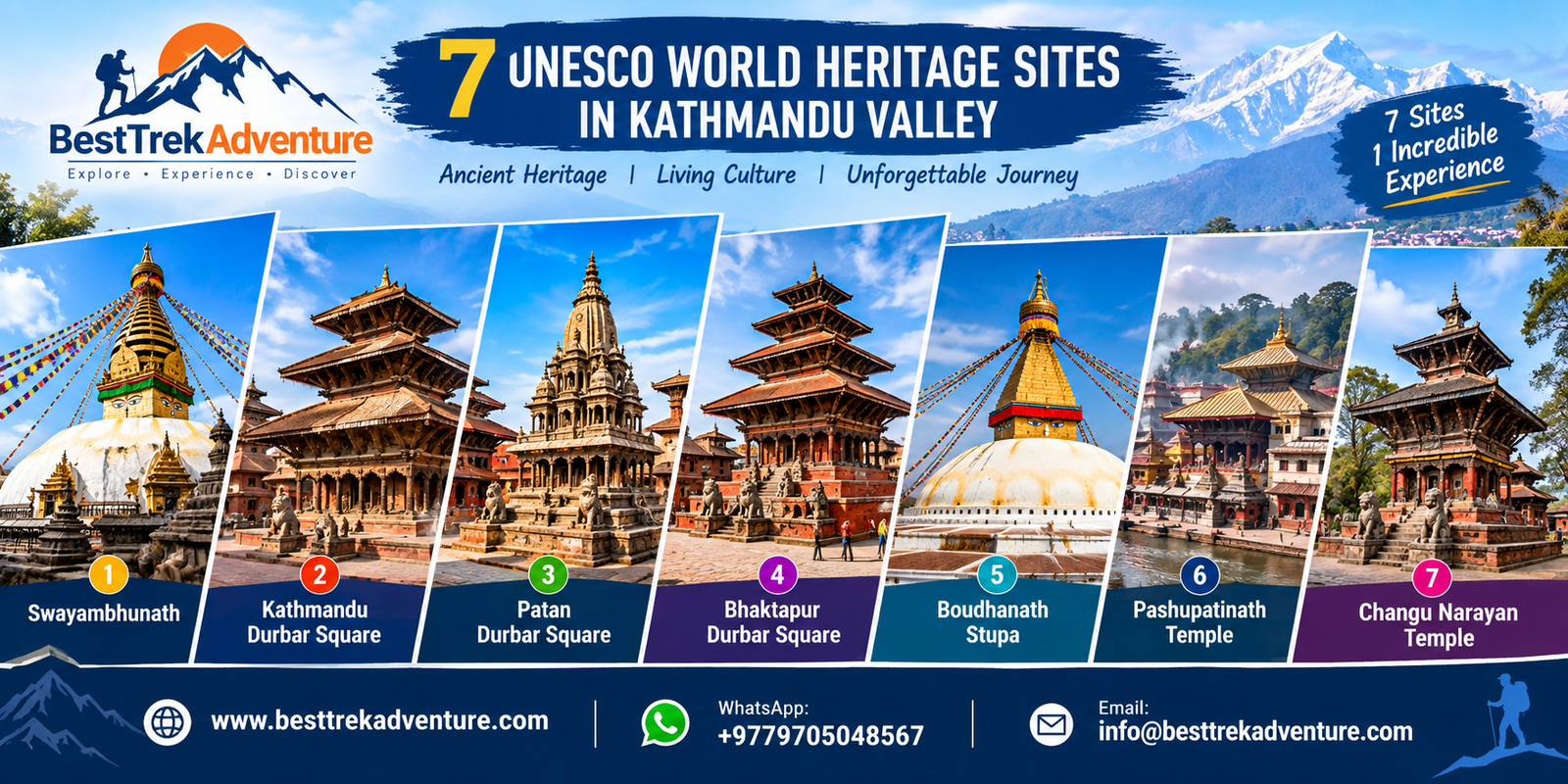
The 7 UNESCO World Heritage Sites in Kathmandu Valley are among the most important cultural attractions in Nepal. They include Kathmandu Durbar Square, Patan Durbar Square, Bhaktapur Durbar Square, Swayambhunath, Boudhanath, Pashupatinath, and Changu Narayan. UNESCO recognizes these seven monument zones together as the Kathmandu Valley World Heritage property, which was inscribed on the World Heritage List in 1979.
For travelers, visiting all seven provides a remarkable introduction to Nepal’s history, religion, architecture, art, and traditional culture. The experience is particularly valuable because the heritage of Kathmandu Valley is not limited to monuments preserved behind museum walls. Many of these places remain active centers of Hindu and Buddhist worship.
From the hilltop Swayambhunath Stupa, with its panoramic views and prayer flags, to the enormous Boudhanath Stupa, the historic royal squares of Kathmandu, Patan and Bhaktapur, and the sacred Hindu complexes of Pashupatinath and Changu Narayan, every destination reveals a different part of Kathmandu Valley’s cultural identity.
This complete guide explains the 7 UNESCO World Heritage Sites in Kathmandu Valley, what makes each site special, what to see, how to plan a one-day heritage tour, the best time to visit, cultural etiquette, photography tips, and why exploring these destinations with a knowledgeable local tour company can make the experience more meaningful.
What Are the 7 UNESCO World Heritage Sites in Kathmandu Valley?
The Kathmandu Valley UNESCO World Heritage property consists of seven monument zones. UNESCO identifies them as the three historic Durbar Squares of Kathmandu, Patan and Bhaktapur, the Buddhist religious complexes of Swayambhu and Bauddhanath, and the Hindu religious complexes of Pashupati and Changu Narayan.
The seven sites are:
-
Kathmandu Durbar Square
-
Patan Durbar Square
-
Bhaktapur Durbar Square
-
Swayambhunath Stupa
-
Boudhanath Stupa
-
Pashupatinath Temple
-
Changu Narayan Temple
It is important to understand that these seven locations are collectively recognized as one UNESCO World Heritage property, known as Kathmandu Valley, rather than seven separate UNESCO World Heritage properties. UNESCO describes the property as seven distinct monument zones that together demonstrate the valley’s exceptional historical and artistic achievements.
This distinction is useful when writing about the sites and when planning your trip.
Why Is Kathmandu Valley a UNESCO World Heritage Site?
Kathmandu Valley is internationally recognized because of its extraordinary concentration of historic architecture, religious monuments, traditional urban settlements, artistic craftsmanship, and living cultural traditions.
UNESCO highlights the exceptional craftsmanship developed by the Newar communities of the valley, particularly in brick, stone, timber and bronze. The property also demonstrates the long coexistence and interaction of Hinduism and Buddhism, together with other traditional beliefs and practices.
The valley’s historic architecture reached a particularly important period between approximately the 16th and 18th centuries, when palace complexes, temples, stupas, courtyards, and urban centers developed remarkable artistic sophistication.
The Nepal Tourism Board also describes Kathmandu, Patan and Bhaktapur as three historic cities associated with the Malla period and emphasizes the valley’s extensive collection of monuments, sculptures, temples, and artistic heritage.
For travelers, this means that a visit to Kathmandu is much more than ordinary city sightseeing. The streets themselves can become part of the cultural experience.
1. Kathmandu Durbar Square – Historic Royal Center of Kathmandu
Kathmandu Durbar Square is one of the most important historic areas in the capital and one of the three royal Durbar Squares included within the Kathmandu Valley UNESCO World Heritage property.
Located in the historic center of Kathmandu, the square contains palace buildings, temples, courtyards, sculptures, and examples of traditional Newari architecture.
The area was historically associated with the royal palace of Kathmandu and developed as an important political, religious, and cultural center.
For visitors, one of the most interesting aspects of Kathmandu Durbar Square is the extraordinary amount of detail found throughout the complex.
Look closely at the wooden windows, carved doors, temple struts, statues, roofs, brickwork, and courtyard architecture. Many details that appear small at first reveal considerable artistic skill.
What Can You See at Kathmandu Durbar Square?
Important attractions in and around the historic square include:
- Hanuman Dhoka Palace
- Kumari Ghar
- Traditional temples
- Historic courtyards
- Stone and bronze sculptures
- Intricately carved wooden architecture
- Traditional Newari buildings
- Religious shrines
- Historic palace structures
Kumari Ghar is particularly interesting because it is associated with the living tradition of the Kumari, the revered living goddess of Kathmandu.
Why Visit Kathmandu Durbar Square?
Kathmandu Durbar Square is ideal for travelers interested in:
- Nepalese history
- Royal architecture
- Hindu and Buddhist traditions
- Newari craftsmanship
- Photography
- Traditional urban life
- Cultural sightseeing
The surrounding historic streets also provide a glimpse of how old Kathmandu continues to function as a living urban environment.
2. Patan Durbar Square – A Showcase of Newari Art and Architecture
Located in Lalitpur, Patan Durbar Square is another major component of the Kathmandu Valley UNESCO World Heritage property.
Patan has long been associated with artistic craftsmanship, and its historic center demonstrates the extraordinary architectural and artistic traditions that developed in the Kathmandu Valley.
The square contains temples, palace buildings, courtyards, sculptures, and traditional architectural details.
Among the well-known attractions are Krishna Mandir, Bhimsen Temple, the former royal palace complex, and Patan Museum.
Krishna Mandir
Krishna Mandir is one of the best-known monuments in Patan Durbar Square. Its distinctive stone architecture makes it particularly recognizable.
The temple reflects the religious and artistic sophistication of the historic city.
Patan Museum
Patan Museum provides additional context for understanding Nepalese religious art and traditional craftsmanship.
If you are interested in sculpture, architecture, bronze casting, wood carving, and the artistic heritage of Nepal, Patan deserves plenty of attention.
What Makes Patan Different?
While Kathmandu Durbar Square reveals the history of the capital, Patan offers a particularly strong impression of the valley’s artistic traditions.
The combination of temples, palace courtyards, sculptures, traditional streets, and local cultural life makes Patan one of the most interesting stops on a Kathmandu UNESCO World Heritage tour.
3. Bhaktapur Durbar Square – Traditional Newari City
Bhaktapur Durbar Square is located in the historic city of Bhaktapur, one of the three major traditional cities of the Kathmandu Valley.
For many visitors, Bhaktapur provides one of the strongest impressions of traditional Newari urban architecture.
The historic area contains temples, palace buildings, courtyards, brick-paved streets, traditional houses, workshops, shops, and religious monuments.
Major Attractions in Bhaktapur
Some of the most recognized landmarks include:
- 55-Window Palace
- Golden Gate
- Nyatapola Temple
- Vatsala Temple
- Traditional courtyards
- Historic brick streets
- Traditional Newari buildings
- Local handicraft shops
The Nyatapola Temple is especially notable for its impressive multi-tiered pagoda form. This one is the tallest temple of Nepal.
The Golden Gate and 55-Window Palace provide additional examples of the architectural craftsmanship for which Bhaktapur is famous.
Experience Traditional Bhaktapur
One of the best ways to appreciate Bhaktapur is to walk rather than simply stop for photographs.
Observe the carved windows, brick walls, temple roofs, courtyards, local shops, artisans, and people going about their daily activities.
Bhaktapur is also known for traditional foods and local specialties. Travelers may have the opportunity to try Juju Dhau, a famous traditional yogurt associated with Bhaktapur.
For photographers and culture lovers, Bhaktapur is particularly rewarding because the historic environment remains closely connected with everyday community life.
4. Swayambhunath Stupa – The Famous Monkey Temple
Swayambhunath, commonly known to international travelers as the Monkey Temple, is one of Kathmandu’s most recognizable landmarks.
The Buddhist stupa sits on a hill overlooking Kathmandu Valley and is surrounded by temples, shrines, prayer wheels, prayer flags, sculptures, and other religious features.
UNESCO identifies the Swayambhunath monument zone as one of the Buddhist religious complexes forming part of the Kathmandu Valley World Heritage property. UNESCO also notes that it contains the oldest Buddhist monument, a stupa, in the valley.
Why Is Swayambhunath Special?
Swayambhunath combines spirituality, architecture, history, and scenery. After climbing the steps toward the main complex, visitors can enjoy views over Kathmandu Valley when weather and visibility are favorable.
The stupa itself is characterized by its white dome and golden architectural elements, including the famous Buddha eyes.
Around the complex, you may see:
- Buddhist prayer wheels
- Prayer flags
- Monasteries and shrines
- Statues
- Butter lamps
- Pilgrims
- Monks
- Visitors
- Monkeys
- Hindu and Buddhist Traditions
One of the remarkable characteristics of Kathmandu Valley is the close relationship between Hindu and Buddhist traditions. Swayambhunath illustrates this cultural interaction particularly well. The wider complex includes Buddhist and Hindu religious elements, reflecting the valley’s long tradition of shared cultural and religious spaces.
Best Experience at Swayambhunath
Take time to walk around the stupa respectfully, observe the religious practices, and look at the architectural details.
Do not rush immediately to the viewpoint. The religious environment is an important part of the experience.
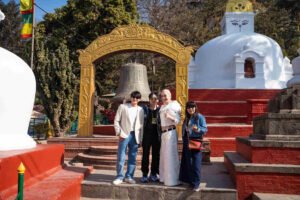
5. Boudhanath Stupa – Center of Buddhist Culture
Boudhanath, also called Boudha or Boudhanath Stupa, is one of the most important Buddhist landmarks in Kathmandu.
UNESCO describes the Bauddhanath monument zone as one of the Buddhist religious ensembles of Kathmandu Valley and identifies it as containing the largest stupa in Nepal.
The enormous white dome and golden structure dominate the surrounding neighborhood.
Boudhanath is more than an architectural landmark. It remains an active religious center.
Visitors can walk around the stupa while observing pilgrims, monks, prayer wheels, monasteries, traditional shops, restaurants, and Buddhist practices.
Things to Experience at Boudhanath
During your visit, take time to:
- Walk around the stupa clockwise
- Observe prayer wheels
- See Buddhist monasteries
- Watch pilgrims and devotees
- Photograph the architecture
- Explore surrounding streets
- Experience the Tibetan Buddhist atmosphere
The area surrounding Boudhanath is particularly interesting because religious life, tourism, local business, and community activities exist side by side.
Boudhanath for Photography
The stupa provides numerous photography opportunities.
The white dome, golden spire, Buddha eyes, prayer flags, surrounding buildings, and changing light create different photographic possibilities throughout the day.
Always remember that Boudhanath is an active religious site. Photography should be respectful and should not interfere with worship.
6. Pashupatinath Temple – Sacred Hindu Heritage of Nepal
Pashupatinath Temple is one of the most important Hindu religious complexes in Nepal and one of the seven monument zones within the Kathmandu Valley UNESCO World Heritage property.
Located beside the Bagmati River, the Pashupatinath complex includes temples, shrines, statues, courtyards, sacred spaces, and ghats.
UNESCO identifies Pashupati as the Hindu temple ensemble within the Kathmandu Valley World Heritage property.
The main temple is dedicated to Lord Shiva.
Can Tourists Enter Pashupatinath Temple?
The main temple has entry restrictions for non-Hindu visitors. However, visitors can explore appropriate areas around the wider complex and observe the religious environment from permitted locations.
Because Pashupatinath remains an active sacred site, visitors should follow signs and instructions from local authorities and guides.
The Bagmati River
The Bagmati River is an important part of the religious landscape of Pashupatinath.
The ghats beside the river are associated with Hindu funeral and cremation traditions. Visitors may observe ceremonies from appropriate public viewpoints, but these are deeply personal and sacred events.
Photography should therefore be approached with exceptional sensitivity.
What Makes Pashupatinath Important?
A visit to Pashupatinath provides insight into:
- Hindu religious traditions
- Temple architecture
- Sacred river culture
- Hindu open cremation ceremony
- Pilgrimage
- Religious ceremonies
- Nepalese spirituality
- Living heritage
For travelers interested in culture and religion, it is one of the most meaningful stops on a Kathmandu heritage itinerary.
7. Changu Narayan Temple – Ancient Heritage in a Hilltop Setting
Changu Narayan Temple is located on a hilltop near Bhaktapur and forms the seventh monument zone of the Kathmandu Valley UNESCO World Heritage property.
The temple is dedicated to Lord Vishnu and is surrounded by traditional settlement patterns, sculptures, inscriptions, and architectural features.
UNESCO notes that the Changu Narayan monument zone includes a traditional Newari settlement and a Hindu temple complex containing one of the valley’s early inscriptions dating to the fifth century AD.
What Can You See at Changu Narayan?
Highlights include:
- Traditional temple architecture
- Stone sculptures
- Wood carvings
- Religious images
- Historic inscriptions
- Traditional settlement
- Hilltop surroundings
The location offers a different atmosphere from the densely urban heritage areas of Kathmandu and Patan.
It can be especially enjoyable for travelers who want to combine cultural sightseeing with a quieter setting.
Can You Visit All 7 UNESCO World Heritage Sites in One Day?
One of the most common questions travelers ask is:
“Can I visit all 7 UNESCO World Heritage Sites in Kathmandu Valley in one day?”
The answer is yes, with a well-organized itinerary and efficient transportation, although it is a full-day sightseeing experience.
The seven sites are spread across different parts of Kathmandu Valley. Traffic, road conditions, entrance procedures, sightseeing time, and the pace of the group can all affect the schedule.
For travelers with limited time in Kathmandu, however, a professionally organized private tour can provide an efficient way to experience all seven monument zones in one day.
Best Treks and Adventure offers a Kathmandu 7 UNESCO World Heritage Sites Day Tour specifically designed around this cultural sightseeing experience.
Kathmandu 7 UNESCO World Heritage Sites Day Tour – Best Treks and Adventure
Suggested One-Day Kathmandu UNESCO World Heritage Tour Itinerary
A practical full-day itinerary can begin in the morning and continue through the major heritage areas.
Stop 1: Swayambhunath
Start at Swayambhunath and explore the stupa, shrines, prayer wheels, architecture, and Kathmandu Valley viewpoint.
Stop 2: Kathmandu Durbar Square
Continue to historic Kathmandu and explore Hanuman Dhoka, temples, courtyards, Kumari Ghar, and surrounding traditional architecture.
Stop 3: Patan Durbar Square
Travel to Lalitpur and discover Patan’s palace complex, temples, sculptures, courtyards, and artistic heritage.
Stop 4: Bhaktapur Durbar Square
Continue to Bhaktapur and explore its historic palace square, Nyatapola Temple, Golden Gate, 55-Window Palace, and traditional streets.
Stop 5: Changu Narayan
Visit Changu Narayan Temple and explore its ancient religious and architectural heritage.
Stop 6: Boudhanath
Continue to Boudhanath and walk around the enormous Buddhist stupa.
Stop 7: Pashupatinath
Complete the heritage journey at Pashupatinath and explore the permitted areas of this major Hindu religious complex.
The actual sequence may be adjusted according to traffic, local conditions, opening arrangements, and the tour operator’s schedule.
How Long Should You Spend at Each UNESCO Site?
If you are attempting all seven sites in a single day, you should expect a relatively efficient sightseeing pace.
A one-day tour is designed to provide an overview of the major attractions rather than several hours of detailed exploration at every individual monument.
If you have several days in Kathmandu, you can divide the sites across multiple days and spend longer at each location. Relax way of explore those sites. For example:
Day 1
Kathmandu Durbar Square + Swayambhunath
Day 2
Patan Durbar Square + Boudhanath+Pashupatinath
Day 3
Bhaktapur Durbar Square + Changu Narayan
However, travelers with limited time can combine all seven into a single organized cultural tour.
Best Time to Visit the 7 UNESCO World Heritage Sites in Kathmandu
Kathmandu’s heritage sites can be visited throughout the year.
The ideal time depends on your priorities, weather preferences, and overall Nepal itinerary.
Spring – March to May
Spring generally provides comfortable conditions for sightseeing and walking around historic areas.
Flowers and greenery can add to the scenery, while the weather can be pleasant for outdoor exploration.
Monsoon – June to September
The monsoon season brings rainfall to Kathmandu Valley.
Travelers visiting during this period should carry rain protection and allow extra flexibility for road travel.
The advantage is that the valley can appear lush and fresh after rainfall.
Autumn – September to November
Autumn is a popular period for travel in Nepal.
The weather is often favorable for sightseeing and outdoor activities, although exact conditions vary from year to year.
Winter – December to February
Winter can provide comfortable daytime sightseeing conditions, although mornings and evenings can be cold.
A light warm layer is useful, particularly for early morning visits.
What to Wear for a Kathmandu Heritage Tour?
Because several of the seven UNESCO monument zones are active religious sites, respectful clothing is recommended.
Comfortable clothing covering the shoulders and knees is generally a sensible choice when visiting temples and religious complexes.
Comfortable walking shoes are particularly important because historic areas can include stone, brick, steps, uneven surfaces, and walking paths.
Pack:
- Comfortable walking shoes
- Water bottle
- Sunglasses
- Sunscreen
- Light jacket
- Rain protection when appropriate
- Small backpack
- Camera or smartphone
- Some Nepalese currency
You may need to remove shoes in certain religious areas, so footwear that is easy to take off and put back on can be convenient.
Cultural Etiquette at Kathmandu UNESCO Sites
The seven heritage sites are not simply tourist attractions. They are living cultural and religious places.
Respectful behavior is therefore essential.
Ask Before Photographing People
Avoid photographing individuals closely without permission, particularly during religious ceremonies.
Follow Temple Rules
Different religious sites may have different rules regarding clothing, photography, footwear, and access.
Follow posted instructions and local guidance.
Do Not Touch Sacred Objects Unnecessarily
Religious statues, shrines, ritual objects, and architectural elements should be treated respectfully.
Walk Clockwise Around Buddhist Stupas and Hindu Temples
When visiting Buddhist stupas such as Swayambhunath, Boudhanath and Hindu Temples, walking clockwise around the central structure is part of the customary pilgrimage practice.
Be Respectful Around Cremation Ceremonies
Pashupatinath is an important place for Hindu cremation traditions.
Visitors should maintain distance and avoid intrusive photography.
A local guide can help explain what is appropriate.
Why Hire a Local Guide for a Kathmandu UNESCO Tour?
You can certainly see the monuments without a guide, but the experience can be much richer when someone explains what you are looking at.
Kathmandu’s architecture contains layers of symbolism and history that may not be immediately obvious.
A carved figure might represent a deity.
A temple roof may have a specific architectural tradition.
A palace courtyard may be connected with royal history.
A stupa may contain symbolic elements representing Buddhist teachings.
A guide can connect these details to Nepal’s history and culture.
A knowledgeable local guide can explain:
- Newari architecture
- Hindu traditions
- Buddhist traditions
- Royal history
- Religious symbolism
- Temple customs
- Traditional craftsmanship
- Local festivals
- Historic legends
- Cultural etiquette
This is especially valuable when visiting seven heritage sites in a single day.
Kathmandu UNESCO Sites for Photography
Kathmandu Valley is a dream destination for cultural photography.
Every monument zone has a different visual character.
Swayambhunath
Capture prayer flags, the stupa, Buddha eyes, temples, and panoramic valley views.
Kathmandu Durbar Square
Focus on wooden architecture, temples, palace courtyards, statues, and traditional streets.
Patan Durbar Square
Look for stone architecture, metal sculptures, temple details, courtyards, and intricate carvings.
Bhaktapur
Photograph brick streets, pagoda temples, traditional windows, courtyards, and local life.
Changu Narayan
Focus on sculptures, temple architecture, inscriptions, and the hilltop environment.
Boudhanath
Capture the large white dome, golden spire, prayer flags, surrounding monasteries, and pilgrims.
Pashupatinath
Photograph architecture and landscape respectfully while following restrictions around religious ceremonies and sacred areas.
Kathmandu UNESCO World Heritage Sites for Families
The seven-site tour can be a good cultural experience for families visiting Nepal.
The current Best Treks and Adventure tour is presented as an easy sightseeing experience and can be organized using private transportation.
However, families should remember that this is a full-day cultural itinerary.
Children may need breaks, snacks, water, and comfortable footwear.
Historic areas can contain:
- Steps
- Uneven surfaces
- Crowded streets
- Busy courtyards
- Temple stairs
- Walking sections
Parents should also explain to children that some places are active religious sites and require respectful behavior.
Kathmandu UNESCO World Heritage Sites for First-Time Visitors
If you are visiting Nepal for the first time, the seven heritage sites provide an excellent introduction to Kathmandu Valley.
They reveal several different aspects of Nepal within one itinerary:
Religion: Hindu and Buddhist traditions.
Architecture: Pagodas, stupas, palace complexes, temples, courtyards, and traditional houses.
History: Ancient settlements, royal centers, religious traditions, and centuries of artistic development.
Culture: Newari craftsmanship, festivals, local food, religious practices, and community life.
Art: Wood carving, stone sculpture, metalwork, painting, and architectural ornamentation.
This combination makes the Kathmandu Valley UNESCO World Heritage experience particularly distinctive.
How Kathmandu’s Seven Sites Show Hindu and Buddhist Heritage
One of the most fascinating aspects of the Kathmandu Valley is the coexistence of Hindu and Buddhist traditions.
The UNESCO World Heritage property includes Buddhist religious complexes at Swayambhu and Bauddhanath and Hindu religious complexes at Pashupati and Changu Narayan. It also includes the historic urban centers of Kathmandu, Patan, and Bhaktapur, where Hindu and Buddhist traditions appear throughout the built environment.
This cultural interaction is one reason Kathmandu can feel different from other historic cities.
A visitor may encounter a Buddhist stupa, Hindu shrine, traditional courtyard, monastery, temple, and local marketplace within a relatively short distance.
The result is a living cultural landscape rather than a collection of isolated monuments.
Traditional Newari Architecture in Kathmandu Valley
The Newar communities of Kathmandu Valley have played a central role in the development of the valley’s artistic and architectural heritage.
UNESCO specifically highlights highly developed craftsmanship in brick, stone, timber, and bronze.
When visiting the seven heritage sites, look for:
- Carved wooden windows
- Decorative doors
- Brick façades
- Pagoda roofs
- Stone sculptures
- Metal statues
- Palace courtyards
- Temple struts
- Traditional urban layouts
The architectural details can sometimes be more impressive than the large monuments themselves.
Take time to look upward, into courtyards, and along side streets.
Is a Kathmandu UNESCO Tour Worth Adding to a Nepal Trek?
For travelers visiting Nepal primarily for trekking, Kathmandu’s UNESCO heritage sites provide an important cultural balance to a mountain adventure.
Trekking introduces visitors to Himalayan landscapes, mountain communities, trails, and high-altitude environments.
Kathmandu introduces another side of Nepal:
- History
- Religion
- Architecture
- Art
- Urban culture
- Traditional craftsmanship
- Festivals
- Local food
A cultural day tour before or after a trek can therefore add considerable depth to your Nepal experience.
It is also convenient for travelers who have only one free day in Kathmandu between flights or other tours.
What Else Can You Do in Kathmandu After Visiting the UNESCO Sites?
If you have additional time in Kathmandu, consider extending your cultural experience beyond the seven UNESCO monument zones.
Depending on your interests, you can explore:
- Thamel
- Kirtipur
- Local markets
- Traditional Newari restaurants
- Museums
- Monasteries
- Local craft shops
- Chandragiri
- Nagarkot
- Kathmandu Valley hiking routes
You can also combine Kathmandu sightseeing with longer Nepal itineraries including Pokhara, Chitwan National Park, Lumbini, trekking regions, and mountain experiences.
Nepal’s four UNESCO World Heritage properties include Kathmandu Valley, Lumbini, Chitwan National Park, and Sagarmatha National Park.
Frequently Asked Questions About the 7 UNESCO World Heritage Sites in Kathmandu Valley
How many UNESCO World Heritage Sites are in Kathmandu Valley?
The Kathmandu Valley UNESCO World Heritage property contains seven monument zones. They are Kathmandu Durbar Square, Patan Durbar Square, Bhaktapur Durbar Square, Swayambhunath, Boudhanath, Pashupatinath, and Changu Narayan.
Are the seven sites seven separate UNESCO World Heritage Sites?
No. UNESCO recognizes them collectively as the Kathmandu Valley World Heritage property, consisting of seven monument zones.
When was Kathmandu Valley listed as a UNESCO World Heritage Site?
Kathmandu Valley was inscribed on the UNESCO World Heritage List in 1979.
Can I visit all seven sites in one day?
Yes. A well-organized sightseeing itinerary can cover all seven in one full day. However, the schedule can be busy, and traffic and sightseeing time can affect the exact timing.
Which Kathmandu UNESCO site is best for architecture?
All seven offer distinctive architecture. Patan and Bhaktapur are particularly well known for traditional Newari artistic and architectural details, while Kathmandu Durbar Square provides a strong combination of palace and temple architecture.
Which UNESCO site is Buddhist?
Swayambhunath and Boudhanath are the two Buddhist monument zones within the Kathmandu Valley World Heritage property.
Which UNESCO sites are Hindu?
Pashupatinath and Changu Narayan are the two Hindu religious monument zones identified by UNESCO within the property.
Can non-Hindus visit Pashupatinath?
The main temple has restrictions on entry for non-Hindus. Visitors can explore permitted areas around the wider complex.
Is Kathmandu Durbar Square worth visiting?
Kathmandu Durbar Square provides an important introduction to the historic royal and architectural heritage of Kathmandu and forms one of the seven UNESCO monument zones.
Is Bhaktapur worth visiting?
Bhaktapur is particularly valuable for travelers interested in traditional Newari architecture, historic streets, temples, courtyards, and local cultural life.
Is Boudhanath open to tourists?
Boudhanath is an active religious area that visitors can explore respectfully. Visitors should follow local rules and avoid disrupting religious activities.
What should I wear?
Comfortable and respectful clothing is recommended. Comfortable walking shoes are also important because several heritage areas involve walking on historic streets, courtyards, steps, and uneven surfaces.
What should I bring?
Bring water, comfortable shoes, sun protection, weather-appropriate clothing, a small bag, and a camera if desired.
Do I need a guide?
A guide is not necessarily required, but a knowledgeable local guide can provide historical, religious, architectural, and cultural context that can make the visit more meaningful. So highly recommend to do this tour with government license holder tour guide.
Why Choose Best Treks and Adventure for Your Kathmandu Heritage Tour?
Exploring seven major heritage destinations in one day requires thoughtful organization.
Best Treks and Adventure offers the Kathmandu 7 UNESCO World Heritage Sites Day Tour for travelers who want to explore the valley’s major cultural attractions efficiently.
The tour focuses on the seven UNESCO monument zones and provides an organized way to experience Kathmandu Valley’s historic and religious heritage.
For travelers who are short on time, this type of private cultural sightseeing tour can make it easier to combine multiple destinations without having to arrange separate transportation and logistics for every site.
You can view the current itinerary and tour information here: Click the Kathmandu 7 UNESCO World Heritage Sites Day Tour
Final Thoughts: Explore the 7 UNESCO World Heritage Sites in Kathmandu Valley
The 7 UNESCO World Heritage Sites in Kathmandu Valley offer an extraordinary journey through Nepal’s history, religion, art, architecture, and living culture.
Kathmandu Durbar Square introduces you to the historic royal center of the capital.
Patan Durbar Square reveals the artistic heritage of Lalitpur.
Bhaktapur Durbar Square takes you into a remarkably preserved traditional Newari urban environment.
Swayambhunath provides a hilltop Buddhist experience overlooking Kathmandu.
Boudhanath introduces you to one of Nepal’s most important Buddhist centers.
Pashupatinath provides an insight into the country’s Hindu religious traditions and sacred Bagmati River landscape.
Changu Narayan connects visitors with an ancient Hindu temple complex and traditional hilltop settlement.
Together, these seven monument zones demonstrate why Kathmandu Valley is internationally recognized for its cultural heritage. UNESCO emphasizes the exceptional traditional craftsmanship, historic urban fabric, architecture, and long coexistence of Hindu and Buddhist traditions found across the valley.
For a first-time visitor to Nepal, these sites provide much more than a checklist of tourist attractions. They offer an opportunity to understand the cultural foundations of Kathmandu and to see how history, religion, architecture, craftsmanship, and everyday life continue to interact.
If you have only one day available for cultural sightseeing in Kathmandu, a carefully organized Kathmandu 7 UNESCO World Heritage Sites Day Tour can provide an efficient introduction to the valley’s most important heritage areas.
If you have more time, return to your favorite locations, explore them more slowly, visit museums and monasteries, walk through traditional neighborhoods, sample Newari cuisine, and experience the valley beyond its most famous monuments.
Kathmandu is not simply a gateway to the Himalayas. It is a destination of extraordinary cultural depth in its own right.
Plan your visit, discover the 7 UNESCO World Heritage Sites in Kathmandu Valley, and experience the history, spirituality, architecture, and traditions that make Nepal’s capital region one of South Asia’s most fascinating cultural destinations.
Ready to explore Kathmandu’s seven UNESCO World Heritage Sites?
Plan your cultural journey with Best Treks and Adventure and discover the temples, stupas, palaces, historic squares, sacred sites, traditional architecture, and living heritage of Kathmandu Valley in one memorable journey. Contact us: Email: info@besttrekadventure.com / WhatsApp: +9779705048567
Other Suggested Day Tours:
-
Kathmandu Day Tour: Top 4 UNESCO World Heritage Sites
-
Chandragiri Cable Car and Monkey Temple Day Tour Overview
-
Nagarkot Sunrise and Bhaktapur Durbar Square Heritage Tour
-
Namobuddha Monastery Spiritual Experience with Dhulikhel Day Tour
-
Everest Base Camp Helicopter Tour with Everest View Hotel Landing
-
Kirtipur Heritage and Swayambhunath Monkey Temple Day Tour
-
Nagarkot Sunrise and Morning Hike to Changunarayan
-
Kathmandu UNESCO World Heritage Sites Day Tour
-
Everest Scenic Flight / Mountain Flight by Plane with Hotel Pickup
-
Pashupatinath Evening Aarati with Boudhanath
-
Explore Kathmandu in a Day: Top 4 or 2 World Heritage Sites
Make an Inquiry




 February 10, 2026
Kathmandu Day Tour – Visit Swayambhunath, Patan, Pashupatinath & Boudhanath
Kathmandu Day Tour Overview: Explore Culture, History, and Spiritual Life A Kathmandu Day Tour is a simple and well-planned way...
 September 22, 2025
Dog Festival in Nepal: Dates, Traditions, and the Meaning of Kukur Tihar
A country whose tourism industry is built around the trekking routes where dogs are said to be “known only by...
 June 23, 2026
Nepal Tour Package Guide – Explore Mountains, Culture & Heritage in Nepal
Nepal Tour is a travel experience where visitors explore the natural beauty, culture, and heritage of Nepal. It is a...


