Who Was Pasang Lhamu Sherpa? The Inspiring Story of Nepal’s First Female Everest Climber
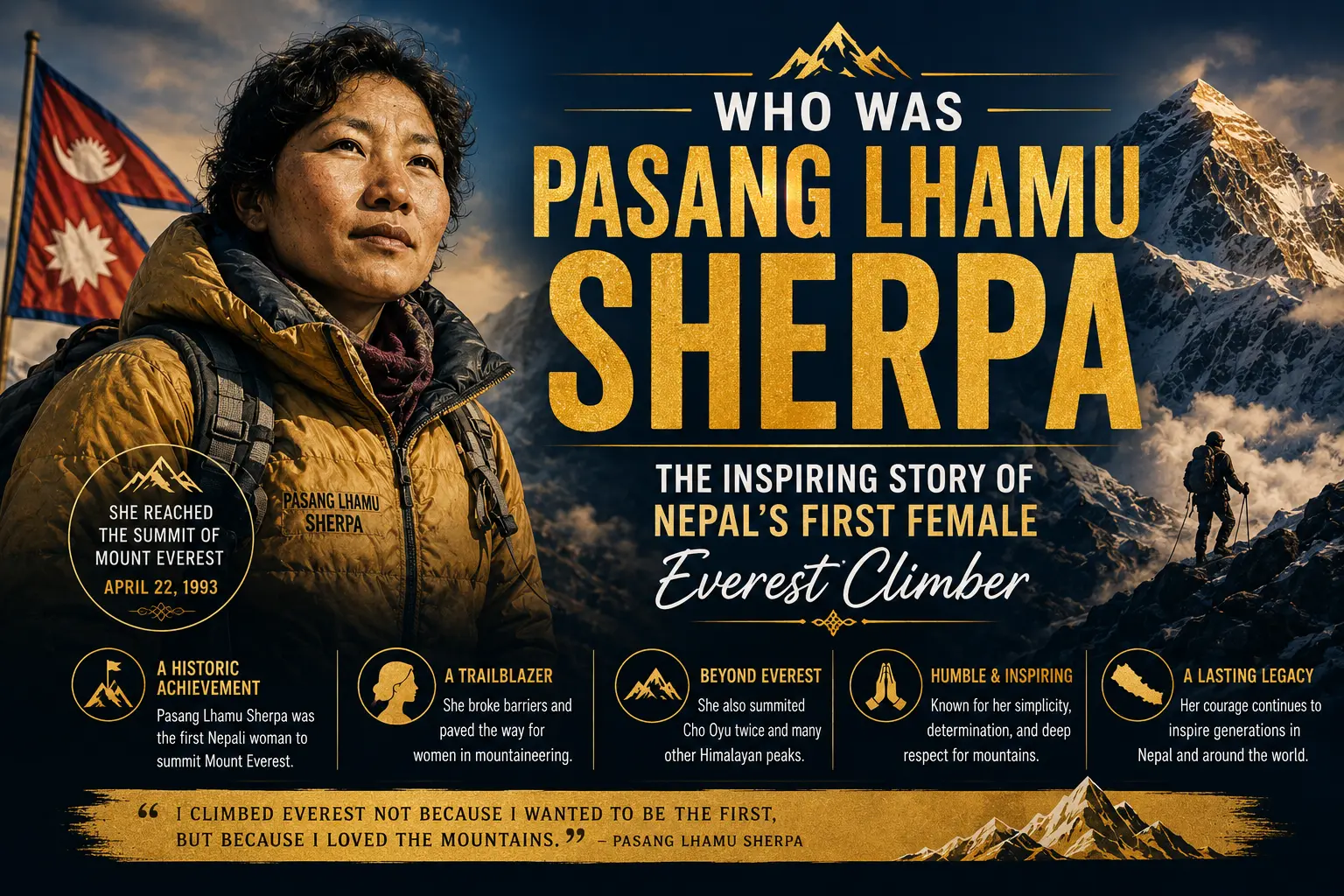
Who Was Pasang Lhamu Sherpa?
Pasang Lhamu Sherpa was a brave Nepali mountaineer who made history as the first Nepali woman to reach the summit of Mount Everest. Her story is not only about climbing the world’s highest mountain. It is also about courage, hard work, and the determination to follow a dream at a time when very few Nepali women were involved in high-altitude mountaineering.
Pasang Lhamu Sherpa was born on December 10, 1961, in the Solukhumbu district of Nepal. She came from a Sherpa family, a community closely connected with the mountains and mountain life. She grew up in the Himalayan region, where high mountains, steep trails, and difficult weather were part of everyday life. Her family background gave her a natural connection with the mountains, although becoming a professional climber was not an easy path for a woman in Nepal at that time.
From an early age, Pasang Lhamu developed a strong interest in the mountains. She later moved to Kathmandu, where she became more involved in mountaineering activities. Her growing interest encouraged her to take climbing seriously and learn the skills needed for high-altitude expeditions. She trained hard, gained experience on different mountains, and slowly built the confidence needed to attempt much bigger challenges.
Her journey was not simple. During the 1980s and early 1990s, mountaineering in Nepal was still largely seen as a man’s field. Women faced social expectations and limited opportunities, and high-altitude climbing required great physical strength, technical knowledge, money, and strong support from an expedition team. Pasang Lhamu continued despite these difficulties. She wanted to prove that a Nepali woman could also stand on the highest point on Earth.
Her dream of climbing Everest required more than physical preparation. It demanded patience and the courage to continue after difficult experiences. She attempted Mount Everest several times before reaching the summit in 1993. These earlier attempts became an important part of her journey because they gave her valuable climbing experience and strengthened her determination.
Pasang Lhamu became an important figure in Nepal because her achievement went beyond personal success. At a time when women had fewer opportunities in adventure sports, she showed that determination could challenge traditional ideas about what women could achieve. Her story also became closely connected with Nepal’s identity as a country known around the world for Himalayan mountains and mountaineering.
Her life continues to hold a special place in Nepal’s mountain history. For many young women and aspiring climbers, her journey represents the courage to choose a difficult path and keep moving toward a goal, even when the road is filled with obstacles.
Pasang Lhamu Sherpa’s Journey Into Mountaineering
Pasang Lhamu Sherpa grew up close to the mountains, and climbing became part of her life from a young age. Born into a Sherpa family in Solukhumbu, she had a natural connection with the Himalayan landscape. Her father, Phurba Kitar Sherpa, was involved in mountain work, and Pasang spent time learning about the mountains and trekking from him. Her early experiences helped her understand that the mountains were not only beautiful places but also demanding environments that required strength, patience, and respect.
Her interest in mountaineering became stronger during her teenage years. Instead of seeing the mountains only as part of her home, she began to dream about climbing them. This was an important choice because professional mountaineering was still largely a male-dominated field in Nepal. Women had fewer opportunities to work as climbers and guides, and social expectations often pushed women toward traditional family roles.
Pasang slowly built her climbing experience by taking part in different mountain expeditions. In 1987, she climbed Pisang Peak in the Manang region and Yala Peak in Langtang. These climbs gave her valuable experience in high-altitude conditions. She later expanded her experience outside Nepal by climbing Mont Blanc in France in 1990. She also climbed Mount Cho Oyu, one of the world’s highest mountains, along with other peaks. These achievements helped her develop the skills and confidence needed for her much bigger dream of climbing Everest.
The road to Everest was not easy. Pasang faced the normal dangers of high-altitude climbing, including cold temperatures, strong winds, thin air, difficult terrain, and changing weather. At the same time, she had to deal with the extra challenges faced by women climbers in Nepal. At that time, it was uncommon to see Nepali women taking leading roles in major mountain expeditions. Her decision to continue climbing required both physical courage and the strength to challenge old ideas about women and mountaineering.
Her first major Everest experience came with the French Women Everest Expedition in 1991. She reached about 7,997 meters, but the expedition could not continue because of dangerous conditions and a shortage of oxygen. She returned to Everest again in the following years, making further attempts but facing bad weather and other difficulties. One of her later attempts reached around 8,747 meters, very close to the summit, before the mountain once again forced the team to turn back.
These setbacks did not end her dream. Instead, each expedition gave her more knowledge about the mountain and helped her prepare for another attempt. She learned from experienced climbers, worked with Sherpa teammates, improved her high-altitude skills, and gained a deeper understanding of Everest’s difficult conditions. Her husband, Lhakpa Sonam Sherpa, and other members of the mountaineering community also played important roles in supporting her climbing ambitions.
By the time she prepared for her final Everest expedition, Pasang had already gained years of experience on Himalayan and international peaks. She was no longer simply a woman with a dream of climbing Everest. She had become an experienced mountaineer who understood the risks and was ready to face one of the hardest challenges in her life. Her repeated attempts had also made her determination stronger, setting the stage for the historic climb that would change the story of women in Nepali mountaineering.
Pasang Lhamu Sherpa’s Historic Everest Climb
Reaching the summit of Mount Everest was a dream that Pasang Lhamu Sherpa carried for several years. Her journey to the top was not achieved on her first try. Before her historic climb in 1993, she had already made three attempts to reach the summit in 1990, 1991, and 1992. Each expedition brought new challenges, including severe weather, difficult climbing conditions, and the physical demands of working at extreme altitude. These unsuccessful attempts did not stop her from trying again. Instead, they gave her more experience and made her determination even stronger.
By 1993, Pasang had gained experience from climbing several high mountains and had already spent years preparing for Everest. Her final expedition was organized as a Nepali women’s Everest expedition, with support from her husband, Lhakpa Sonam Sherpa, and other climbers. The expedition was also supported by San Miguel Beer, which helped cover part of the climbing cost. Pasang raised the remaining funds herself. Her expedition included several experienced Sherpa climbers who supported her during the dangerous journey toward the summit.
The team followed the southern side of Everest, using the South Col and Southeast Ridge route. On April 22, 1993, Pasang and her Sherpa teammates started their summit push from the South Col. The weather that morning was clear, giving the climbers a valuable chance to move toward the summit. After a long and difficult climb, Pasang Lhamu Sherpa reached the top of Mount Everest at 8,848 meters. She was 32 years old and became the first Nepali woman to stand on the summit of the world’s highest mountain.
Her achievement was historic for Nepal. At a time when high-altitude mountaineering was still mainly dominated by men, a Nepali woman had reached the highest point on Earth. Her success showed the strength and determination of Nepali women and became an important moment in the country’s mountaineering history. She was also among the very small number of women who had reached Everest at that time. Her achievement was not simply a personal victory. Many people in Nepal saw it as a victory for women who wanted to challenge traditional limits and follow their own dreams.
However, the return journey became a tragedy. After reaching the summit, the team began descending, but the weather changed quickly. Strong conditions made the descent extremely dangerous. Sonam Tshering Sherpa, an experienced Everest climber, became seriously ill near the South Summit. Pasang stayed with him while efforts were made to get help. The difficult weather and limited communication made rescue extremely difficult. The climbers were unable to safely continue their descent.
Pasang and Sonam Tshering died on the mountain on April 22, the same day she achieved her historic summit. Her body was later brought down from the mountain after the weather improved. Her death brought deep sadness across Nepal, but the importance of her achievement did not disappear. Her courage, determination, and willingness to face Everest despite repeated setbacks made her one of the most remembered figures in Nepal’s mountaineering history.
Pasang Lhamu Sherpa’s Legacy in Nepal
The achievement of Pasang Lhamu Sherpa continues to hold a special place in Nepal’s history. Her successful Everest climb was not only a major achievement in mountaineering but also an important moment for Nepali women. She reached the summit at a time when women had fewer opportunities to take part in high-altitude expeditions. Her story showed that courage, preparation, and determination can help people move beyond social limits and follow difficult dreams.
Her achievement still matters today because many young Nepali women have entered mountaineering, trekking, adventure sports, and other outdoor professions. Pasang’s story gave them an example of a woman who did not allow traditional expectations to decide what she could achieve. Young climbers can learn from her patience as well as her courage. She failed in several earlier attempts to climb Everest but continued preparing and trying again. Her journey shows that a difficult setback does not always mean the end of a dream.
Pasang Lhamu Sherpa also received important national recognition after her death. The Government of Nepal declared her a national hero in 1993. She was also awarded the Nepal Tara, one of the country’s important national honors, after her historic Everest achievement. Her name became closely connected with Nepal’s mountaineering history, and her contribution has continued to be remembered through different memorials, events, and institutions.
One of the most important organizations connected with her legacy is the Pasang Lhamu Foundation. Established in her memory, the foundation has worked in areas such as education, health, women’s empowerment, and support for communities. The organization reflects the wider values associated with her life, especially the belief that people should have opportunities to improve their future. Her legacy therefore reaches beyond the mountains and into social development.
Her name can also be found in different places and institutions across Nepal. Roads, schools, organizations, and other public places have been named in her honor. The Pasang Lhamu Highway is one well-known example. It connects areas of Rasuwa with other parts of the country and carries the name of a woman who became a symbol of courage in Nepal. Her memorials and statues are also reminders of the important role she played in the country’s mountaineering story.
For Nepali mountaineering, her contribution is especially meaningful because she helped change the way people viewed women in the climbing world. Before her historic Everest summit, professional mountaineering was often seen as an activity mainly suited to men. Her achievement challenged that idea. In the years after her climb, more Nepali women became involved in climbing and mountain-related work. Her story became part of a larger movement that encouraged women to take part in areas once considered difficult or unsuitable for them.
Pasang Lhamu Sherpa remains a source of inspiration for climbers, students, women, and young people across Nepal. Her life reminds people that success is often built through repeated effort rather than one easy attempt. She faced dangerous mountains, social challenges, failed expeditions, and extreme weather, yet she continued toward her goal. The image of a young Nepali woman standing on the summit of Everest has become a powerful symbol of determination.
Today, her name is remembered not only when people talk about Mount Everest but also when they talk about courage, women’s progress, and Nepal’s Himalayan identity. Her story continues to connect the mountains with a wider message of hope and possibility for future generations.
Why Pasang Lhamu Sherpa Is Still an Inspiration Today
The story of Pasang Lhamu Sherpa is more than the story of a woman who climbed Mount Everest. It is the story of someone who continued to follow her dream even when the journey was difficult. She faced failed attempts, harsh mountain conditions, and social barriers, but she did not allow these challenges to take away her goal. Her courage and determination continue to touch people in Nepal and around the world.
At the time when Pasang began her mountaineering journey, women in Nepal had fewer opportunities to take part in adventure and professional climbing. Mountaineering was widely seen as a man’s field, especially at extreme altitude. Pasang challenged this way of thinking through her actions. She did not need to make a loud statement about equality. Her decision to train, climb, and return to Everest after difficult attempts became a powerful statement on its own.
Her story carries an important message for Nepali women and young people. A person’s background or gender should not always decide how far they can go. Dreams may require patience, preparation, and many attempts. Pasang showed this through her own experience. She did not reach Everest on her first attempt. She returned to the mountain with greater experience and continued working toward her goal until she stood on the summit in 1993.
Modern climbers can learn many things from Pasang Lhamu Sherpa. One of the most important lessons is the value of preparation. Climbing a mountain like Everest requires physical fitness, technical skills, mental strength, teamwork, and respect for changing mountain conditions. Her journey also teaches climbers to learn from difficult experiences rather than simply seeing them as failures. Her repeated attempts gave her greater knowledge of the mountain and helped prepare her for her historic expedition.
Her story is also important for international visitors who come to Nepal to experience the Himalayas. Many people know Mount Everest as the world’s highest mountain, but the mountain has a much deeper human story. It is connected with the lives of Sherpa communities, Nepali climbers, local traditions, and generations of people who have worked in the mountains. Learning about Pasang Lhamu Sherpa helps visitors understand that Nepal’s mountaineering history is not only about foreign expeditions or famous mountain records. Nepali climbers have also played a major role in shaping the history of Everest.
For travelers visiting the Everest region, her story can add a different meaning to the journey. Walking through the Himalayan trails, seeing Everest, and learning about the people who challenged the mountain can make the experience more personal. Pasang’s story reminds visitors that behind every famous mountain are people with dreams, families, struggles, and sacrifices.
For young people, her life carries an even wider message. Success does not always come quickly, and difficult goals may require several attempts. Her journey encourages people to believe in their abilities while understanding the importance of hard work and preparation.
Pasang Lhamu Sherpa holds a lasting place in Nepal’s history because she changed more than a mountaineering record. She became a symbol of courage for women and young climbers and helped open a wider path for Nepali women in mountaineering. Her name continues to live in Nepal’s mountains, communities, institutions, and in the stories of people who look toward Everest and remember the woman who once dared to climb it.